CJC-1295 and Ipamorelin: What the Pairing Actually Shows
These peptides target different signals involved in growth hormone release, but that doesn’t establish an added benefit from taking them together.
CJC-1295 mimics growth hormone-releasing hormone, while ipamorelin activates a ghrelin receptor involved in growth hormone release. That gives the pairing a plausible rationale, and one review describes a combined hormonal effect. It does not establish that using both improves strength, body composition, recovery, or healthy aging in people, including women. 2 3 4
Why these two peptides get paired
Growth hormone (GH) release responds to more than one signal. CJC-1295 is a synthetic version of growth hormone-releasing hormone, or GHRH. It acts at GHRH receptors in the pituitary gland. Ipamorelin acts at a different receptor, called the ghrelin receptor or GHS-R1a, and also stimulates GH release. That difference is the reason the two are often discussed together. 1 2
An orthopaedics review describes CJC-1295 without a drug affinity complex (DAC) plus ipamorelin as producing a synergistic rise in GH and insulin-like growth factor 1 (IGF-1). That is a claim about hormone responses. It isn’t evidence, by itself, that the pairing improves how someone feels or functions. 3
The formulation matters, too. Reviews distinguish CJC-1295 with DAC from CJC-1295 without DAC; the combination described above specifically uses the version without DAC. A claim about one version shouldn’t quietly become a claim about both. 1 3
A hormone response is not the same as an added benefit
There are two separate questions: Can each compound stimulate GH release? and Does combining them work better than either one alone for a particular goal? Evidence for the first doesn’t answer the second.
For example, if the goal is improved strength, measuring GH or IGF-1 alone won’t show whether strength improved. A useful combination study would specify which form of CJC-1295 it used, compare the pairing with each compound on its own, and measure strength directly over a defined period. The same principle applies to claims about body composition or recovery: measure the claimed outcome, not just the hormone response.
A gerontology review lists improved muscle strength with the combination, but the account does not clearly identify the study population or design behind that finding. It cannot establish a strength benefit for people. Reviews of GH-axis peptides also describe limited or investigational clinical evidence for performance and musculoskeletal uses. 2 4
What can you conclude about women?
The combination accounts cited here don’t establish whether women were included in a relevant comparison or whether outcomes differed by sex. That leaves no sound basis for saying the pairing has a particular benefit for women, or that a result from an unspecified group applies equally to women. 2 3
If you see a claim of “proven synergy,” check what was actually shown. Was it a change in GH or IGF-1, or an improvement in the outcome being advertised? Was the exact pairing compared with each compound alone? And if the claim is directed at women, were women included and were their results reported? Those questions separate an appealing explanation of how it might work from evidence that it does work better.
The uncertainty isn’t limited to benefit. A review of peptides used outside established clinical indications reports endocrine and metabolic effects, fluid retention, muscle or joint symptoms, and injection-site reactions across this group of compounds. It also notes uncertainty about product composition and about combining products from unregulated sources. Those reports don’t tell us the rate or specific risks of this pairing, but they are another reason not to treat a plausible mechanism as a tested regimen. 1
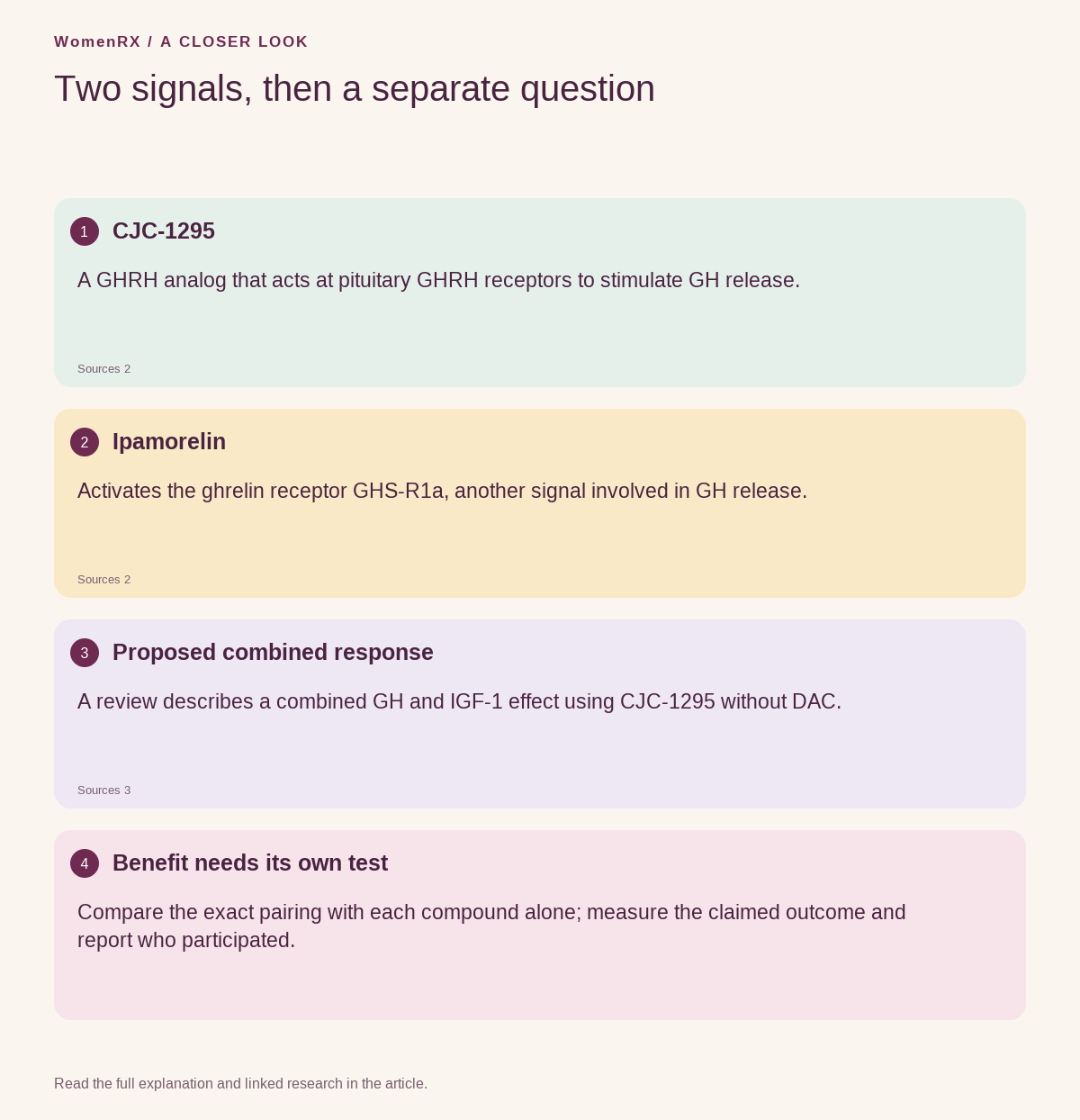
Two signals, then a separate question
CJC-1295: A GHRH analog that acts at pituitary GHRH receptors to stimulate GH release.2
Ipamorelin: Activates the ghrelin receptor GHS-R1a, another signal involved in GH release.2
Proposed combined response: A review describes a combined GH and IGF-1 effect using CJC-1295 without DAC.3
Benefit needs its own test: Compare the exact pairing with each compound alone; measure the claimed outcome and report who participated.
Read the figure as text
The proposed pathways help explain why the peptides are paired. They do not answer whether the pairing improves an outcome.- CJC-1295: A GHRH analog that acts at pituitary GHRH receptors to stimulate GH release.2
- Ipamorelin: Activates the ghrelin receptor GHS-R1a, another signal involved in GH release.2
- Proposed combined response: A review describes a combined GH and IGF-1 effect using CJC-1295 without DAC.3
- Benefit needs its own test: Compare the exact pairing with each compound alone; measure the claimed outcome and report who participated.
More questions, answered
Does a rise in GH or IGF-1 show that the combination builds muscle?
No. It shows a hormonal response, not necessarily a change in muscle strength or body composition. Those outcomes need to be measured directly in people using the specified combination. 1 4
Sources you can check
- The emerging landscape of performance-enhancing peptides modulating GH-IGF1 axis: bridging the gap between clinical evidence and patient self-administration.Dominikowski A, Rękoś Z, Olejarz M, Szczepanek-Parulska E, Domin R, RuchaŁa M. · Frontiers in endocrinology · 2026Return to first citation
- Therapeutic peptides in gerontology: mechanisms and applications for healthy aging.Mavrych V, Shypilova I, Bolgova O. · Frontiers in aging · 2026Return to first citation
- Therapeutic Peptides in Orthopaedics: Applications, Challenges, and Future Directions.Rahman OF, Lee SJ, Seeds WA. · Journal of the American Academy of Orthopaedic Surgeons. Global research & reviews · 2026Return to first citation
- Injectable Peptides in Sports Medicine: A Structured Narrative Review of Evidence, Safety, and Antidoping Implications.Villegas Meza AD, Nocek M, Mitchell BC, Lizarraga M, DeFoor MT, Ruzbarsky JJ, Huard J, Philippon MJ. · JBJS reviews · 2026Return to first citation