Ipamorelin: What Human Studies Actually Show
Ipamorelin has been tested in a small, short-term surgical trial, but that does not establish benefits or long-term safety for women seeking hormone, body-composition, or recovery effects.
The clearest human evidence is a phase 2 trial in adults recovering from bowel surgery. It found no significant improvement in the main recovery outcome, and its short follow-up cannot establish long-term safety or benefits for other uses. The reported results also do not establish a women-specific benefit. Regulatory and antidoping status depend on the product, location, and context, so check the relevant official authority rather than relying on a seller’s claims. 12
The human evidence is narrow
Ipamorelin is a ghrelin-receptor agonist studied for a specific hospital problem: postoperative ileus, a slowdown in gut movement after abdominal surgery. In a randomized, double-blind, placebo-controlled phase 2 trial, 114 adults who had bowel resection were included in the safety and modified intent-to-treat analyses. They received intravenous ipamorelin or placebo during their hospital recovery. 1
The main outcome was time from the first dose to tolerating a standardized solid meal. The median was 25.3 hours with ipamorelin and 32.6 hours with placebo, but the difference was not statistically significant (p = 0.15). The study also found no significant differences in its key or secondary efficacy analyses. So this trial does not show that ipamorelin reliably improved recovery, even in the setting it studied. 1
That distinction matters when a product is promoted for a different goal. A biological effect on a hormone pathway, or a result in one medical setting, is not proof of better muscle recovery, body composition, energy, or another outcome in people using it outside that setting. Reviews describe growth-hormone-axis secretagogues, including ipamorelin, as investigational for sports and musculoskeletal uses, with clinical benefits not established by robust human trials. 24
What the safety findings can, and can’t, tell you
In the postoperative trial, treatment-emergent adverse events occurred in 87.5% of the ipamorelin group and 94.8% of the placebo group. The researchers described ipamorelin as well tolerated in that study. Those percentages refer to any treatment-emergent event during a short hospital trial; they do not show that ipamorelin is safe for long-term use or for people using different products, routes, or treatment plans. 1
Other reviews emphasize that evidence for emerging injectable peptides is limited and that product quality and safety remain concerns. These are broader concerns about the category, not proof that a particular harm has been demonstrated for ipamorelin itself. The available human trial is too limited to settle uncommon effects, long-term effects, or safety in groups it did not study. 24
What is known about women?
The surgical trial enrolled adults, but the reported results do not establish whether women respond differently from men. They also do not establish reproductive or pregnancy-related effects. A proposed effect on the growth-hormone pathway is not, by itself, evidence of a women-specific benefit.
There are studies of ipamorelin in female animals, but animal findings cannot establish a treatment effect or safety in women. For example, a study in female rats measured bone-related outcomes after treatment; it is not a human trial and does not show that ipamorelin improves bone health in women. 3
Check status for the exact product and purpose
Legal, regulatory, and antidoping status are not interchangeable. A review describes regulatory consensus as uncertain for injectable peptides and reports widespread antidoping restrictions for growth-hormone-axis secretagogues, including ipamorelin. That does not determine the legal status of every product in every country or whether a particular product is authorized for a particular use. 2
If you are considering a product, check its exact name and intended use with the official medicines regulator in your jurisdiction. If you compete in sport, also check the current prohibited-substance rules that apply to your sport. A seller’s description of a product as a “supplement,” “research” product, or hormone-support option does not settle its regulatory or sporting status.
A useful way to weigh a claim is to ask three separate questions: Was the outcome studied in humans? Was the study population like you and was the benefit measured directly? Does the evidence concern the same product and use being offered? For ipamorelin, the human trial answers those questions only for a short-term postoperative setting, and even there it did not show a significant improvement in the main outcome. 12
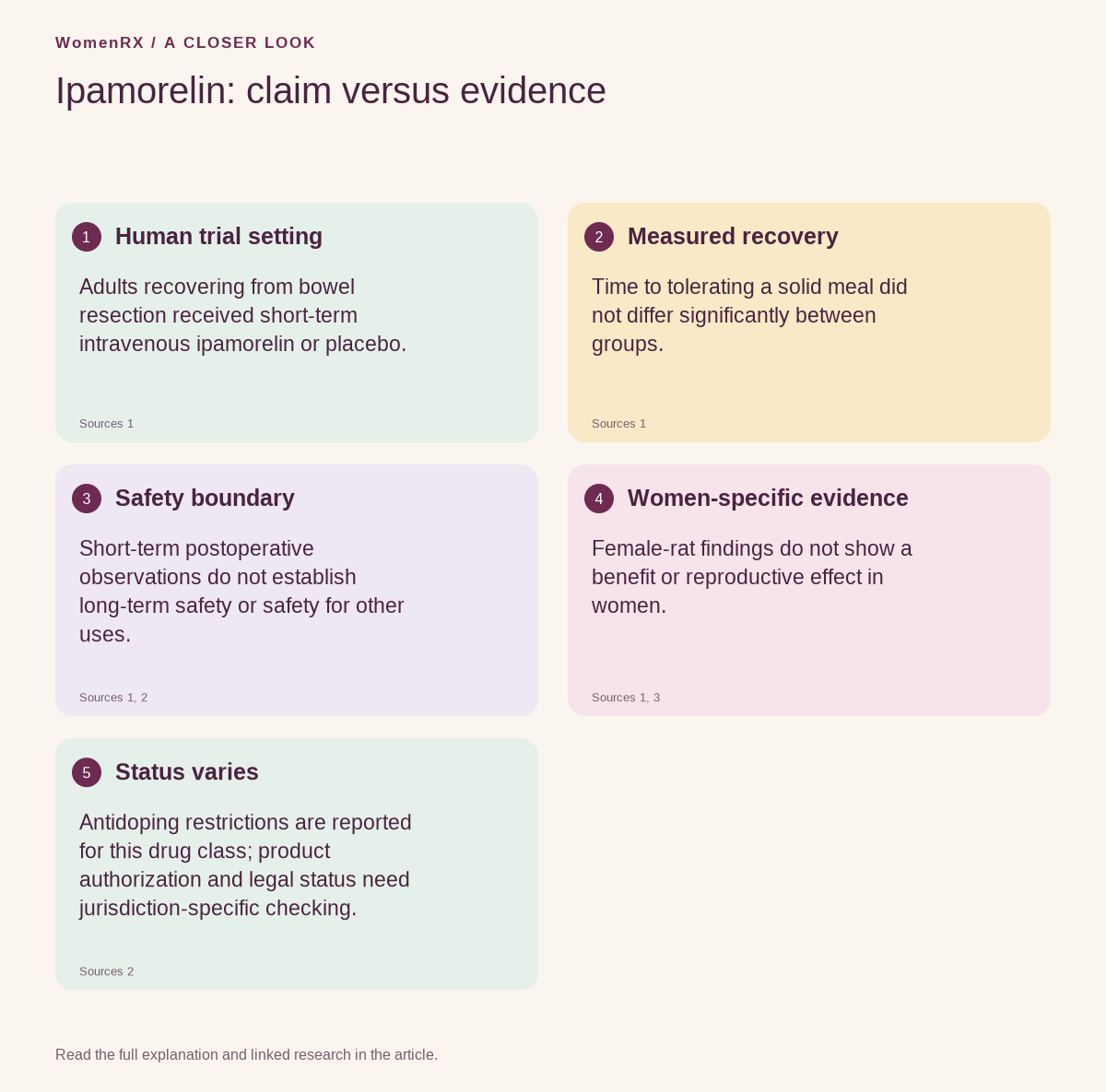
Ipamorelin: claim versus evidence
Human trial setting: Adults recovering from bowel resection received short-term intravenous ipamorelin or placebo.1
Measured recovery: Time to tolerating a solid meal did not differ significantly between groups.1
Safety boundary: Short-term postoperative observations do not establish long-term safety or safety for other uses.12
Women-specific evidence: Female-rat findings do not show a benefit or reproductive effect in women.13
Status varies: Antidoping restrictions are reported for this drug class; product authorization and legal status need jurisdiction-specific checking.2
Read the figure as text
These distinctions show what the human trial measured, what remains unestablished, and why animal or regulatory findings answer different questions.- Human trial setting: Adults recovering from bowel resection received short-term intravenous ipamorelin or placebo.1
- Measured recovery: Time to tolerating a solid meal did not differ significantly between groups.1
- Safety boundary: Short-term postoperative observations do not establish long-term safety or safety for other uses.12
- Women-specific evidence: Female-rat findings do not show a benefit or reproductive effect in women.13
- Status varies: Antidoping restrictions are reported for this drug class; product authorization and legal status need jurisdiction-specific checking.2
Sources you can check
- Prospective, randomized, controlled, proof-of-concept study of the Ghrelin mimetic ipamorelin for the management of postoperative ileus in bowel resection patients.Beck DE, Sweeney WB, McCarter MD, Ipamorelin 201 Study Group. · International journal of colorectal disease · 2014Return to first citation
- Injectable Peptides in Sports Medicine: A Structured Narrative Review of Evidence, Safety, and Antidoping Implications.Villegas Meza AD, Nocek M, Mitchell BC, Lizarraga M, DeFoor MT, Ruzbarsky JJ, Huard J, Philippon MJ. · JBJS reviews · 2026Return to first citation
- The GH secretagogues ipamorelin and GH-releasing peptide-6 increase bone mineral content in adult female rats.Svensson J, Lall S, Dickson SL, Bengtsson BA, Rømer J, Ahnfelt-Rønne I, Ohlsson C, Jansson JO. · The Journal of endocrinology · 2000Return to first citation
- Peptide Supplements and Their Therapeutic Applications in Sports Medicine.Tewari K, Liu TP, Im C, Hamad C, Petrigliano F, Cheung EC, Kremen TJ. · The American journal of sports medicine · 2026Return to first citation