Ipamorelin Safety: What’s Reported and What’s Still Unknown
A short hospital trial gives a narrow view of ipamorelin safety, leaving questions about longer use and products offered for recovery or performance.
In a trial of adults recovering from bowel surgery, overall adverse events were reported in both the ipamorelin and placebo groups during treatment lasting up to seven days. That result can’t establish a complete side-effect list or the safety of longer use. 12 The studies don’t set symptom-specific thresholds for seeking care. If you develop new or worsening symptoms while using ipamorelin, contacting a clinician for an individual assessment is a cautious next step.
What the human trial actually studied
The clearest direct safety finding comes from a randomized, placebo-controlled trial in adults who had undergone small or large bowel surgery. Its safety population included 114 people. In hospital, participants received intravenous ipamorelin or placebo twice daily until discharge or for up to seven days. Researchers monitored adverse events and laboratory tests. 1
During that period, 87.5% of the ipamorelin group and 94.8% of the placebo group had at least one treatment-emergent adverse event. “Treatment-emergent” means an event occurred during the study; it does not mean the treatment caused it. These were patients recovering from bowel surgery, and the reported percentages don’t identify which symptoms, if any, were caused by ipamorelin. The authors described the treatment as well tolerated, while noting that the trial was small. 1
That’s a useful distinction if you’ve seen a confident list of ipamorelin side effects online. This trial reports an overall event rate, not a reliable frequency for each possible reaction. It also cannot tell you whether an injected product used outside a hospital has the same safety profile. 13
Why the setting and duration matter
Ipamorelin was studied in this trial for a specific short-term purpose: treating postoperative ileus, a problem with bowel function after surgery. It was not a trial of ongoing use for muscle gain, injury recovery, or healthy aging. Reviews of peptides promoted for sports and recovery describe ipamorelin and related growth-hormone secretagogues as investigational, with limited rigorous human safety data and product-quality concerns. 123
A short trial can detect some problems that arise during its observation period. It cannot settle what happens with longer use, repeated courses, combinations with other peptides, or a product from a different source. Nor does a proposed mechanism of action establish that a peptide is safe for everyday use. 134
The reported trial findings do not establish whether safety outcomes differ by sex, and they do not answer pregnancy or breastfeeding safety questions. If you’re pregnant, could be pregnant, or are breastfeeding, general findings in adults are not an answer to that separate safety question. 1
If you’re having symptoms now
The trial and reviews don’t establish which symptoms call for assessment or how quickly to seek it. If a symptom is new or getting worse while you’re using ipamorelin, contacting a clinician for an individual assessment is a cautious choice, not a care-seeking threshold established by these studies. Timing is worth reporting, but it cannot by itself show that ipamorelin is the cause.
To make that conversation more useful, have the product or its packaging available if you can, and be ready to say:
- Where the product came from and whether it contains ipamorelin alone or other ingredients
- How you’ve been using it and when you started
- What changed, when it began, and whether it is worsening
- What other medicines, supplements, or peptides you use
- Whether pregnancy or breastfeeding could be relevant
These aren’t steps for diagnosing a reaction yourself. The exact product and pattern of use matter because the controlled hospital trial cannot answer safety questions about every product or combination sold elsewhere. 13
If ipamorelin has been offered to you but you haven’t started it, a direct question is: “What human safety findings apply to this particular product, route, and intended length of use?” The short postoperative trial provides one piece of that answer, not the whole picture. 123
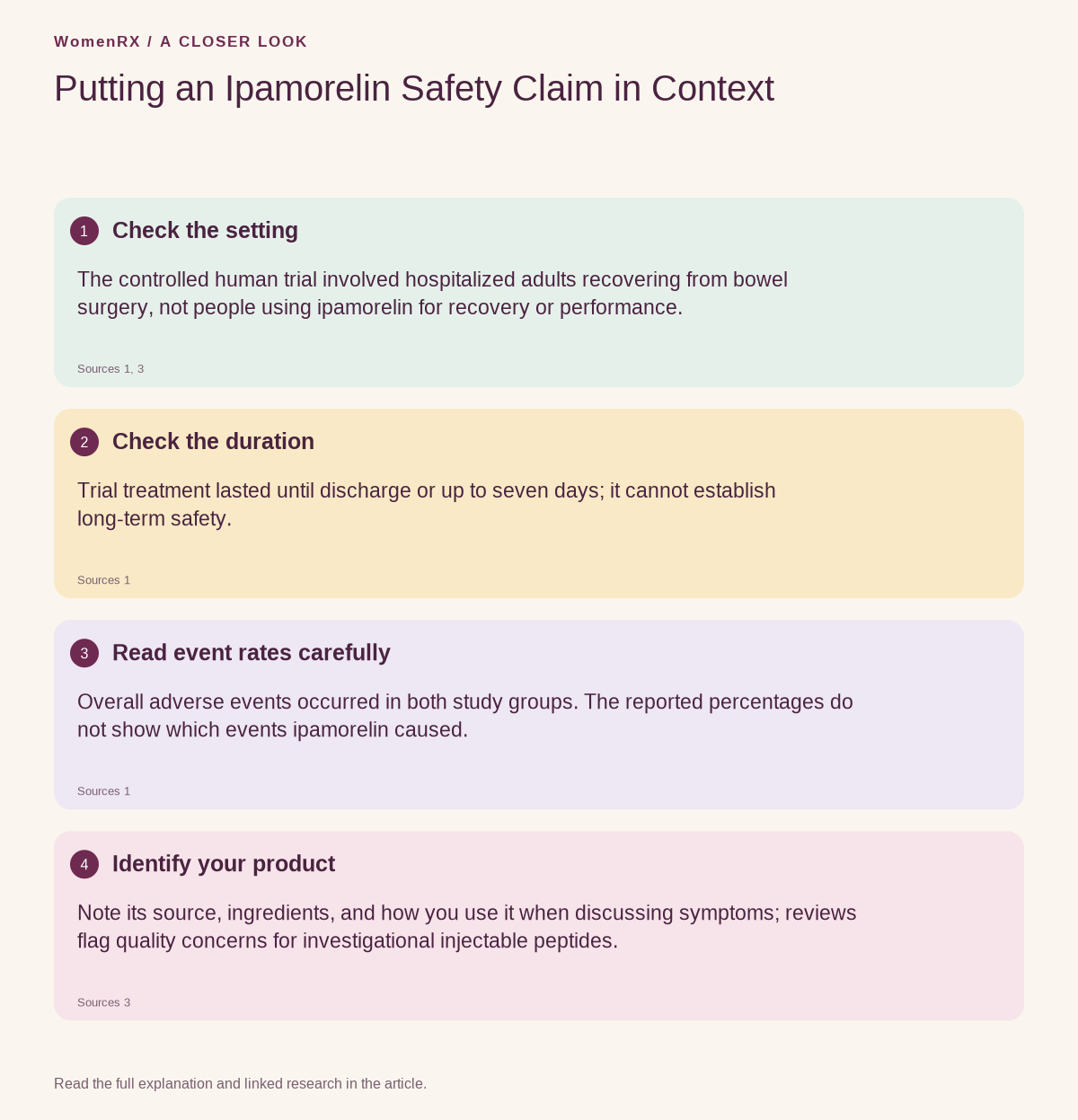
Putting an Ipamorelin Safety Claim in Context
Check the setting: The controlled human trial involved hospitalized adults recovering from bowel surgery, not people using ipamorelin for recovery or performance.13
Check the duration: Trial treatment lasted until discharge or up to seven days; it cannot establish long-term safety.1
Read event rates carefully: Overall adverse events occurred in both study groups. The reported percentages do not show which events ipamorelin caused.1
Identify your product: Note its source, ingredients, and how you use it when discussing symptoms; reviews flag quality concerns for investigational injectable peptides.3
Read the figure as text
Use these checks to distinguish what was observed in a trial from questions to raise about a product or symptom.- Check the setting: The controlled human trial involved hospitalized adults recovering from bowel surgery, not people using ipamorelin for recovery or performance.13
- Check the duration: Trial treatment lasted until discharge or up to seven days; it cannot establish long-term safety.1
- Read event rates carefully: Overall adverse events occurred in both study groups. The reported percentages do not show which events ipamorelin caused.1
- Identify your product: Note its source, ingredients, and how you use it when discussing symptoms; reviews flag quality concerns for investigational injectable peptides.3
More questions, answered
Does research on ipamorelin combined with CJC-1295 establish safety for the combination?
No. A review describes a finding for that combination in mice, not a human safety trial of combined use. Results from the short human ipamorelin trial cannot be assumed to apply to a combination product. 14
Sources you can check
- Prospective, randomized, controlled, proof-of-concept study of the Ghrelin mimetic ipamorelin for the management of postoperative ileus in bowel resection patients.Beck DE, Sweeney WB, McCarter MD, Ipamorelin 201 Study Group. · International journal of colorectal disease · 2014Return to first citation
- Safety and Efficacy of Approved and Unapproved Peptide Therapies for Musculoskeletal Injuries and Athletic Performance.Mendias CL, Awan TM. · Sports medicine (Auckland, N.Z.) · 2026Return to first citation
- Injectable Peptides in Sports Medicine: A Structured Narrative Review of Evidence, Safety, and Antidoping Implications.Villegas Meza AD, Nocek M, Mitchell BC, Lizarraga M, DeFoor MT, Ruzbarsky JJ, Huard J, Philippon MJ. · JBJS reviews · 2026Return to first citation
- Injectable Peptide Therapy: A Primer for Orthopaedic and Sports Medicine Physicians.Mayfield CK, Bolia IK, Feingold CL, Lin EH, Liu JN, Rick Hatch GF, Gamradt SC, Weber AE. · The American journal of sports medicine · 2026Return to first citation