Milk Thistle Safety: What Studies Have Reported
Short-term studies of a few specific products offer limited reassurance, but they don’t establish a complete side-effect or interaction profile for every milk thistle supplement.
Human studies have reported mild effects that weren’t named, a rash considered possibly related to silymarin, and vomiting and fever recorded as serious events in one participant. These reports don’t establish which effects milk thistle causes. A rat study found an interaction signal with the cancer medicine pexidartinib, but it does not establish an interaction in people. 4 5 6
Milk thistle is sold in products that can differ in their extracts and ingredients. Silymarin is an extract from milk thistle, and research on a particular standardized or combined extract doesn’t automatically tell you how another supplement will affect you. That matters when weighing both side effects and medicine interactions. 3 4 5
What side effects have been reported?
The clinical studies described here don’t establish a reliable list of common side effects or a dependable rate for milk thistle alone. In a 24-week randomized trial of 50 people with metabolic fatty liver disease, mild adverse effects were reported in 4 of 25 people taking a combination of milk thistle and alpha-lipoic acid, and in 4 of 25 taking placebo. The report doesn’t identify those mild effects by type. Because the product contained two active ingredients, the findings can’t show whether milk thistle caused any of them. 4
A separate six-month observational study of silymarin alongside lifestyle changes described a rash as possibly related to the study product. It also reported vomiting and fever as serious events in one participant. Without a control group, these reports don’t establish that silymarin caused those events. The study authors also said the safety data they collected were limited. 5
Another 36-week trial described a product combining milk thistle with a different herb as well tolerated, but that result applies to the tested combination, not to every milk thistle product. 3
Taken together, these studies name a few reported events but don’t establish a complete side-effect profile. They also don’t provide a sex-specific comparison of adverse effects. One small trial included mostly women, but it didn’t report whether side effects differed by sex. 3 4
What is known about medicine interactions?
A study in rats found that silybinin, a milk-thistle compound, increased exposure to the cancer medicine pexidartinib. That’s a reason to flag the combination for a medication review, not proof that milk thistle changes pexidartinib levels or causes harm in people. It doesn’t establish interactions with other medicines, either. 6
The human studies described here do not establish a medicine interaction. If you take pexidartinib, or any prescription medicine, don’t assume a supplement is interaction-free because it’s plant-based. Bring your pharmacist the exact product label, including the listed ingredients and extract, along with your complete medication list. Evidence from a defined extract or combination can’t be confidently transferred to a different formulation. 3 4 5 6
The health conditions represented in a study matter, too. The combination-product trial excluded people receiving kidney replacement therapy and people known to be sensitive to its ingredients. The observational silymarin study excluded people with cirrhosis or other known liver diseases, major conditions affecting liver function, and those using potentially liver-toxic medicines or supplements. These exclusions aren’t proven reasons to avoid milk thistle. They mean those studies offer less reassurance if one of these circumstances applies to you. 4 5
Pregnancy and breastfeeding need an individual review
These studies don’t establish milk thistle safety during pregnancy or breastfeeding. One silymarin study excluded pregnant and breastfeeding participants, so it can’t answer safety questions for these groups. 5
For pregnancy, federal guidance includes herbs and supplements among products to review before use and advises against starting or stopping medicines without discussing the risks and benefits. 2 For breastfeeding, general guidance notes that some medicines can pass into breast milk, but that does not tell us specifically whether milk thistle does or what it might mean for a nursing infant. 1
If you’re pregnant, trying to become pregnant, or breastfeeding, have your obstetric or primary care clinician or pharmacist review the specific product before you use it. Don’t stop a prescribed medicine on your own to make room for a supplement. 2
Make the review specific
When you ask about milk thistle, bring the bottle or a clear photo of the label. Include prescription and over-the-counter medicines and other supplements, especially if you take pexidartinib or a medicine you’ve been told may affect your liver. Mention a known liver condition, kidney replacement treatment, or a past reaction to an ingredient, as well as whether you’re pregnant or breastfeeding. Ask whether the exact ingredients raise a concern with your medicines and whether the available evidence applies to that product and your circumstances. That’s more useful than asking only whether “milk thistle” is safe in general. 2 4 5 6
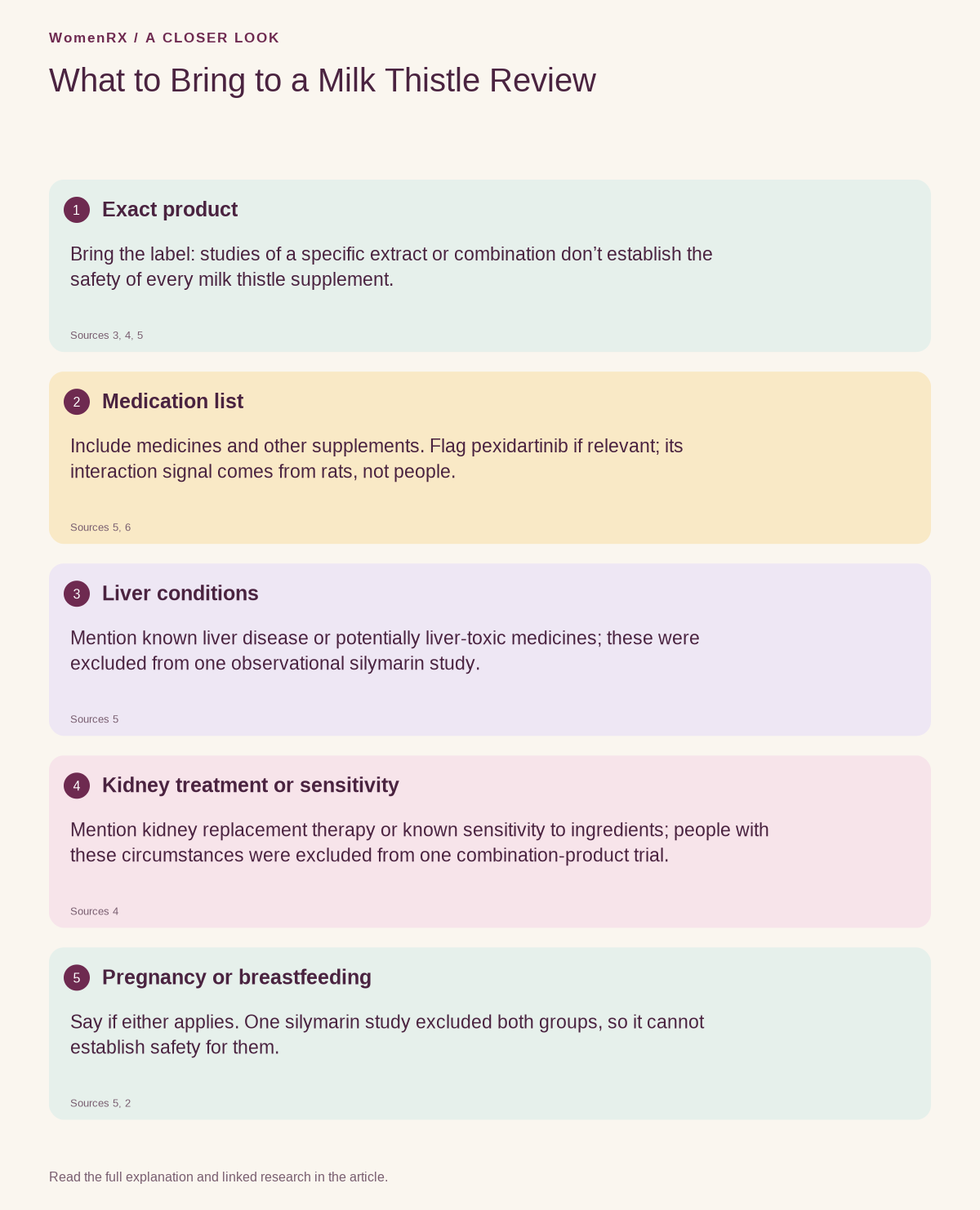
What to Bring to a Milk Thistle Review
Exact product: Bring the label: studies of a specific extract or combination don’t establish the safety of every milk thistle supplement.345
Medication list: Include medicines and other supplements. Flag pexidartinib if relevant; its interaction signal comes from rats, not people.56
Liver conditions: Mention known liver disease or potentially liver-toxic medicines; these were excluded from one observational silymarin study.5
Kidney treatment or sensitivity: Mention kidney replacement therapy or known sensitivity to ingredients; people with these circumstances were excluded from one combination-product trial.4
Pregnancy or breastfeeding: Say if either applies. One silymarin study excluded both groups, so it cannot establish safety for them.52
Read the figure as text
These details help make a safety review about your product, medicines, and circumstances rather than milk thistle in the abstract.- Exact product: Bring the label: studies of a specific extract or combination don’t establish the safety of every milk thistle supplement.345
- Medication list: Include medicines and other supplements. Flag pexidartinib if relevant; its interaction signal comes from rats, not people.56
- Liver conditions: Mention known liver disease or potentially liver-toxic medicines; these were excluded from one observational silymarin study.5
- Kidney treatment or sensitivity: Mention kidney replacement therapy or known sensitivity to ingredients; people with these circumstances were excluded from one combination-product trial.4
- Pregnancy or breastfeeding: Say if either applies. One silymarin study excluded both groups, so it cannot establish safety for them.52
More questions, answered
Does milk thistle interact with all medicines processed by the liver?
There’s no basis for assuming it interacts with every liver-processed medicine. A rat study found an interaction signal involving silybinin and pexidartinib, but it can’t tell us which medicines do or don’t interact with milk thistle in people. 6
Do side-effect findings for one milk thistle product apply to another?
Not necessarily. The clinical studies described here used specific products, including combinations with other ingredients. Their results don’t establish the safety profile of every extract or supplement on sale. 3 4
Sources you can check
- Breastfeeding | Benefits of Breastfeeding | MedlinePlusAccessed 2026-09-25Return to first citation
- Pregnancy and Medicines | MedlinePlusAccessed 2026-09-25Return to first citation
- The activity of a herbal medicinal product of Phyllanthus niruri and Silybum marianum powdered extracts (Heptex®) in patients with apparent risk factors for nonalcoholic steatohepatitis: a phase II, multicentered, randomized, double-blind, placebo-controlled clinical trial.Shaker MK, Hassany M, Eysa B, Adel A, Zidan A, Mohamed S. · BMC complementary medicine and therapies · 2025Return to first citation
- Effect of alpha-lipoic acid and Silybum marianum supplementation with a Mediterranean diet on metabolic dysfunction-associated steatosis.Cano Contreras AD, Del Rocío Francisco M, Vargas Basurto JL, Gonzalez-Gomez KD, Amieva-Balmori M, Roesch Dietlen F, Remes-Troche JM. · World journal of hepatology · 2025Return to first citation
- Effectiveness of silymarin with lifestyle intervention in NAFLD and metabolic syndrome: a prospective single-arm study.Sukeepaisarnjaroen W, Chaiteerakij R, Gonzalez EV, Alcasid MA, Rani RA, Andal Gamutan MTR, Cloa MM, Salgado L, Sripariwuth E, Labio ME, Chirapongsathorn S, Chitapanarux T, Colombo ... · Drugs in context · 2026Return to first citation
- Exploring the Effect of Compound Glycyrrhizin and Silybinin on the Metabolism of Pexidartinib in Rats Based on CYP3A4 and CYP2C9.Su Y, Wei X, Cheng Q, Qi H, Chen J, Qiu XJ. · Advances in pharmacological and pharmaceutical sciences · 2023Return to first citation