Milk Thistle: What Human Studies Actually Show
Milk thistle has been studied for several conditions, but results depend on the exact preparation and outcome, and promising lab findings aren’t the same as proven health benefits.
Milk thistle is a plant; silymarin is a mixture of compounds found in its extract. Human studies have tested particular silymarin products, not one interchangeable supplement. In a randomized trial for fatty liver disease, silymarin did not outperform placebo on the main liver-tissue outcome. Some small studies found other effects, but they don’t establish a general benefit or a women-specific recommendation. 3 5
What “milk thistle” and “silymarin” mean
Milk thistle is the plant Silybum marianum. Silymarin is a mixture of compounds in milk thistle extract, including silybin. So a bottle labeled “milk thistle” and a study describing a standardized silymarin product may not refer to identical preparations. The studies below tested particular extracts, tablets, or enhanced-absorption formulations; their findings shouldn’t automatically be applied to every product with milk thistle on the label. 3 6
Formulation can affect how much of a compound reaches the bloodstream. In a small crossover study of 23 healthy volunteers, a silybin-phosphatidylcholine capsule produced higher blood levels of silybin than a conventional silymarin tablet. A separate trial in 16 healthy participants found higher silymarin blood levels after a micellar product than after a standard formulation. These were absorption studies, not tests of whether either product improved liver health or treated disease. Higher absorption alone doesn’t show that a supplement works better for a health outcome. 3 7
Liver claims need an outcome, not just a theory
Silymarin is often promoted for liver health, but “protects the liver” can refer to different things: a change in a blood test, a change in liver tissue, or a meaningful improvement in illness. Those aren’t interchangeable results.
One relevant randomized, placebo-controlled trial enrolled adults with non-cirrhotic non-alcoholic steatohepatitis (NASH) and tested a standardized silymarin product for 48 weeks. Its main outcome was improvement of at least two points in a liver-tissue activity score. That occurred in 4 of 27 participants assigned to the higher tested amount, 5 of 26 assigned to the other tested amount, and 3 of 25 assigned to placebo; the difference wasn’t statistically significant. The researchers also reported that many participants did not meet the study’s liver-tissue entry criteria on central review, which complicates interpretation. The trial did not demonstrate a benefit on its primary outcome. 5
A different small study tested silymarin in 48 people with multiple sclerosis who were taking fingolimod. After six months, the silymarin group had lower ALT and AST levels than the placebo group. That finding is specific to people taking that medication and to liver-enzyme measurements; it doesn’t show that milk thistle treats liver disease or prevents liver injury generally. 1
Taken together, these results don’t establish a general liver benefit: a liver-enzyme change in a medication-specific study is not evidence that silymarin treats liver disease broadly. 1 5
Other studied uses are not established benefits
Some human research has looked beyond the liver. A small randomized trial in 27 people receiving radiation for head and neck cancer found lower mucositis severity scores with the tested silymarin tablets. That result is specific to this treatment setting and small study; it isn’t evidence that milk thistle prevents or treats mouth sores in other situations. 2
For trichotillomania, a placebo-controlled crossover trial included 20 people, 19 of them women. It did not find a significant advantage over placebo on its main measure, though some secondary measures changed. The small sample and mixed child-and-adult population don’t establish an effective treatment or a women-specific benefit. 4
These examples illustrate why the condition, preparation, participants, and measured outcome matter. Traditional use or antioxidant activity in laboratory research doesn’t establish a clinical benefit in people.
Safety, pregnancy, and breastfeeding
A safety review reports that silymarin is generally well tolerated in human studies, with stomach-related effects such as nausea and diarrhea reported. It also advises caution when silymarin is used with medicines that have a narrow therapeutic range. If you take a medicine where small changes in its level can matter, check with your prescriber or pharmacist before adding a milk thistle product. The review doesn’t establish that every formulation has the same safety profile. 6
Pregnancy evidence is limited. The safety review describes one clinical trial with no reported anomalies, but says more human research is needed and recommends caution. That is not enough to conclude that milk thistle is safe in pregnancy. The review and studies described here do not address breastfeeding safety, so they cannot establish whether it is safe while nursing. 6
For women specifically, one small study of healthy volunteers included 11 women and measured blood levels after different formulations, not health benefits. Another small study, in which most participants were women, did not show a significant benefit on its main treatment outcome. These results don’t support a tailored recommendation for women, and they don’t answer whether effects or risks differ by menstrual stage or menopause. 4 7
How to judge a product claim
Before taking milk thistle, compare the claim with what was actually studied: Is the product a defined silymarin extract or a different preparation? Was it tested in people with the condition you’re concerned about? Did the study measure a meaningful health outcome, or only absorption or a blood marker? Those distinctions can help you avoid treating a promising mechanism, a product-specific result, or a change in one lab value as proof of a broad benefit.
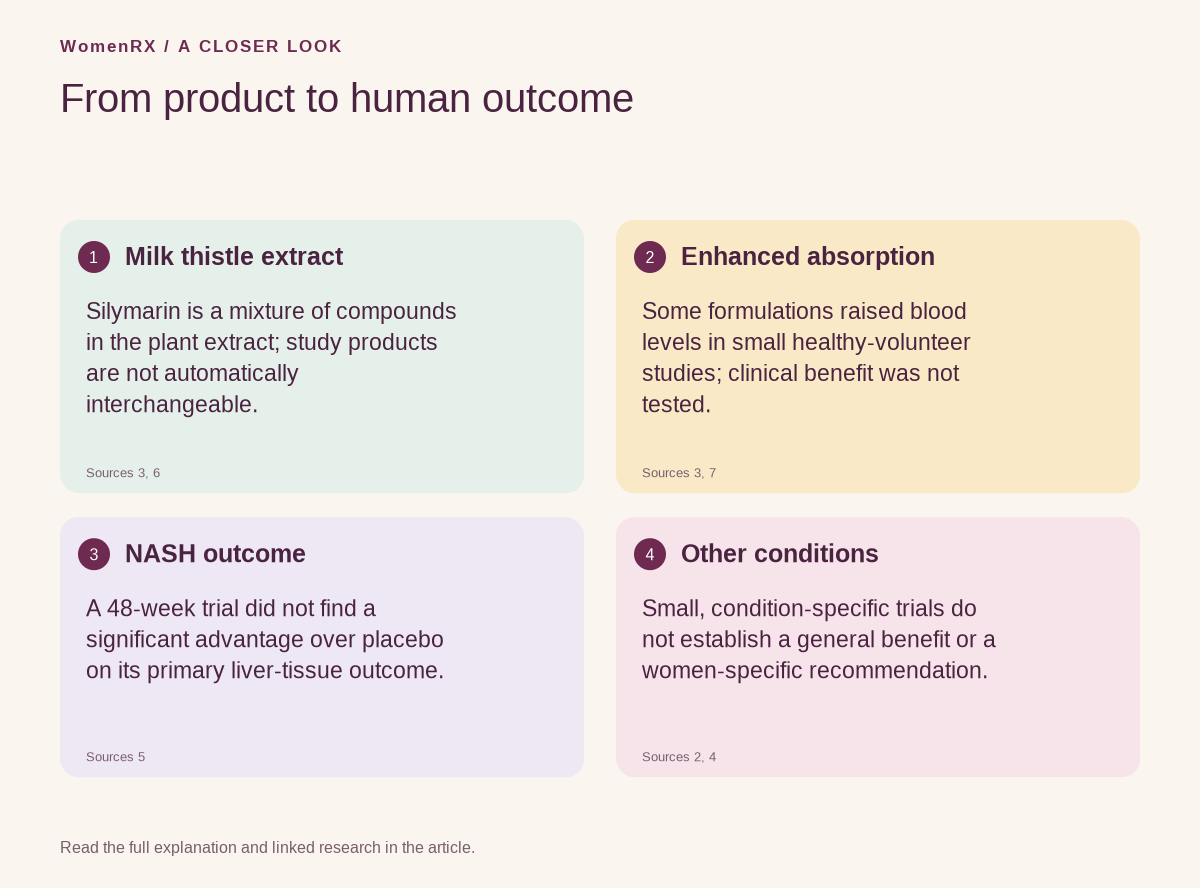
From product to human outcome
Milk thistle extract: Silymarin is a mixture of compounds in the plant extract; study products are not automatically interchangeable.36
Enhanced absorption: Some formulations raised blood levels in small healthy-volunteer studies; clinical benefit was not tested.37
NASH outcome: A 48-week trial did not find a significant advantage over placebo on its primary liver-tissue outcome.5
Other conditions: Small, condition-specific trials do not establish a general benefit or a women-specific recommendation.24
Read the figure as text
The same plant name can refer to different preparations and very different kinds of evidence. This map separates absorption findings from condition-specific clinical outcomes.- Milk thistle extract: Silymarin is a mixture of compounds in the plant extract; study products are not automatically interchangeable.36
- Enhanced absorption: Some formulations raised blood levels in small healthy-volunteer studies; clinical benefit was not tested.37
- NASH outcome: A 48-week trial did not find a significant advantage over placebo on its primary liver-tissue outcome.5
- Other conditions: Small, condition-specific trials do not establish a general benefit or a women-specific recommendation.24
More questions, answered
Does better absorption mean a milk thistle product works better?
No. Small studies found that certain formulations led to higher blood levels of silybin or silymarin, but they did not test whether those products improved a health condition. 3 7
Is milk thistle proven safe during pregnancy?
No. A safety review describes one pregnancy trial with no reported anomalies, but says more human research is needed. That limited finding doesn’t establish safety. The review and studies described here do not address breastfeeding safety, either. 6
Sources you can check
- Antioxidative effects of silymarin on the reduction of liver complications of fingolimod in patients with relapsing-remitting multiple sclerosis: A clinical trial study.Ghiasian M, Nafisi H, Ranjbar A, Mohammadi Y, Ataei S. · Journal of biochemical and molecular toxicology · 2021Return to first citation
- Effect of Oral Silymarin Administration on Prevention of Radiotherapy Induced Mucositis: A Randomized, Double-Blinded, Placebo-Controlled Clinical Trial.Elyasi S, Hosseini S, Niazi Moghadam MR, Aledavood SA, Karimi G. · Phytotherapy research : PTR · 2016Return to first citation
- Novel Micellar Formulation of Silymarin (Milk Thistle) with Enhanced Bioavailability in a Double-Blind, Randomized, Crossover Human Trial.Chang C, Zhang Y, Kuo YC, Du M, Roh K, Gahler R, Ibi A, Solnier J. · Pharmaceutics · 2025Return to first citation
- Milk Thistle Treatment for Children and Adults with Trichotillomania: A Double-Blind, Placebo-Controlled, Crossover Negative Study.Grant JE, Redden SA, Chamberlain SR. · Journal of clinical psychopharmacology · 2019Return to first citation
- Silymarin in non-cirrhotics with non-alcoholic steatohepatitis: A randomized, double-blind, placebo controlled trial.Navarro VJ, Belle SH, D'Amato M, Adfhal N, Brunt EM, Fried MW, Reddy KR, Wahed AS, Harrison S, Silymarin in NASH and C Hepatitis (SyNCH) Study Group. · PloS one · 2019Return to first citation
- Safety and toxicity of silymarin, the major constituent of milk thistle extract: An updated review.Soleimani V, Delghandi PS, Moallem SA, Karimi G. · Phytotherapy research : PTR · 2019Return to first citation
- Superior silybin bioavailability of silybin-phosphatidylcholine complex in oily-medium soft-gel capsules versus conventional silymarin tablets in healthy volunteers.Méndez-Sánchez N, Dibildox-Martinez M, Sosa-Noguera J, Sánchez-Medal R, Flores-Murrieta FJ. · BMC pharmacology & toxicology · 2019Return to first citation