Milk Thistle for Liver Health: What Trials Show
Milk thistle has been tested for liver disease, but changes in blood tests have not consistently translated into better results on more substantial measures.
Milk thistle extract, often called silymarin, has been studied in people with hepatitis C and fatty liver disease. Results are mixed: several randomized trials did not find a significant benefit on their main outcomes, including liver-enzyme targets or liver-tissue scores. One trial found a possible improvement in fibrosis measures, but that finding needs confirmation. These studies don’t establish that supplements prevent liver failure or replace diagnosis and treatment. 2 4 5
What “working” means in a liver study
Milk thistle is a plant; silymarin is a mixture of compounds extracted from it. Trials have tested particular silymarin preparations, not every tea, capsule, or “liver support” blend sold to consumers. A result from one preparation cannot automatically be applied to a different product or dose. 4 6
It also matters what researchers measure. Alanine aminotransferase (ALT) and aspartate aminotransferase (AST) are blood tests that can reflect liver-cell injury. A lower enzyme reading may be encouraging, but by itself it doesn’t show that scarring has improved or that a person is less likely to develop liver failure. Liver biopsy scores and fibrosis estimates are different measures, too; they are not the same as proving fewer symptoms, complications, or deaths.
The results depend on the liver condition and outcome
In a US randomized, placebo-controlled trial, 154 people with chronic hepatitis C who had not responded to interferon-based treatment took silymarin or placebo for 24 weeks. Only two participants in each group met the trial’s main ALT-improvement target. The study also found no significant difference between groups in average ALT change, hepatitis C viral levels, or quality-of-life measures. This is evidence about that specific group and preparation, not every person with liver disease. 2
Trials in nonalcoholic steatohepatitis (NASH), a more active form of fatty liver disease, have not produced a consistent answer. In one randomized trial of 78 participants, higher-than-customary doses of a standardized silymarin product did not significantly outperform placebo on the main liver-tissue activity outcome after about a year. Many participants were later found not to meet the study’s tissue-based entry criteria, which complicates interpretation. 4
A separate randomized trial of 99 people with biopsy-confirmed NASH also did not find a significant difference between silymarin and placebo on its main liver-tissue outcome after 48 weeks. It did find a greater proportion of participants with a one-point or larger reduction in fibrosis on biopsy in the silymarin group than in the placebo group. That is a potentially interesting signal, but the trial’s main outcome was not met, and the authors said the fibrosis finding needed confirmation in a larger study. 5
A more recent trial tested a combination capsule containing milk thistle and another herb, rather than milk thistle alone, in people at risk of NASH. Some enzyme values fell within treatment groups over 36 weeks, but the trial found no significant difference between groups in the relative change in ALT or AST, or in the change in the Fib-4 score. Because it was a combination product, the results cannot tell us what milk thistle alone did. 3
Taken together, the evidence is mixed and condition-specific. Blood-test changes are not a reliable stand-in for proven improvement in how a person feels, liver scarring, or long-term complications. These studies mainly assessed enzymes, tissue scores, or fibrosis estimates; they do not establish that milk thistle prevents liver failure, the need for transplant, or death.
Why a product label matters
Silymarin is a complex plant extract, and clinical trials have emphasized choosing a preparation with defined product chemistry. Some research used a named, standardized extract; another tested a product combining milk thistle with a different plant. Those are not interchangeable tests of every product labeled “milk thistle.” 4 6
If you’re considering a supplement, check whether the label identifies the extract and its amount, and whether it includes other ingredients. Bring the actual product or a clear photo of the label to a pharmacist or the clinician managing your liver care. The studies summarized here don’t establish which prescription medicines may interact with milk thistle, so don’t assume that a plant-based product is automatically compatible with hormonal contraception or other prescriptions.
Pregnancy and breastfeeding need extra caution
One trial of a milk-thistle-containing combination excluded people who were pregnant or breastfeeding. That means its results don’t establish safety during pregnancy or lactation; it doesn’t prove harm, either. If you’re pregnant, breastfeeding, or trying to conceive, get advice about the specific product before using it. 3
Don’t let a supplement delay finding the cause
Liver conditions have different causes and treatments. Some may need medication, and treatment depends on the type and severity of disease. A supplement marketed for “liver support” can’t tell you whether you have hepatitis, fatty liver disease, or another problem, and the trials above don’t show that it treats those conditions reliably. If you think you may have liver disease, arrange an evaluation rather than waiting to see whether a supplement changes a lab result. 1
A useful way to judge a claim is to ask: Which liver condition was studied? Was the product milk thistle alone or a blend? What was the main outcome, and did it differ from placebo? A claim based only on a change in enzymes deserves more caution than one supported by a well-designed study of meaningful outcomes.
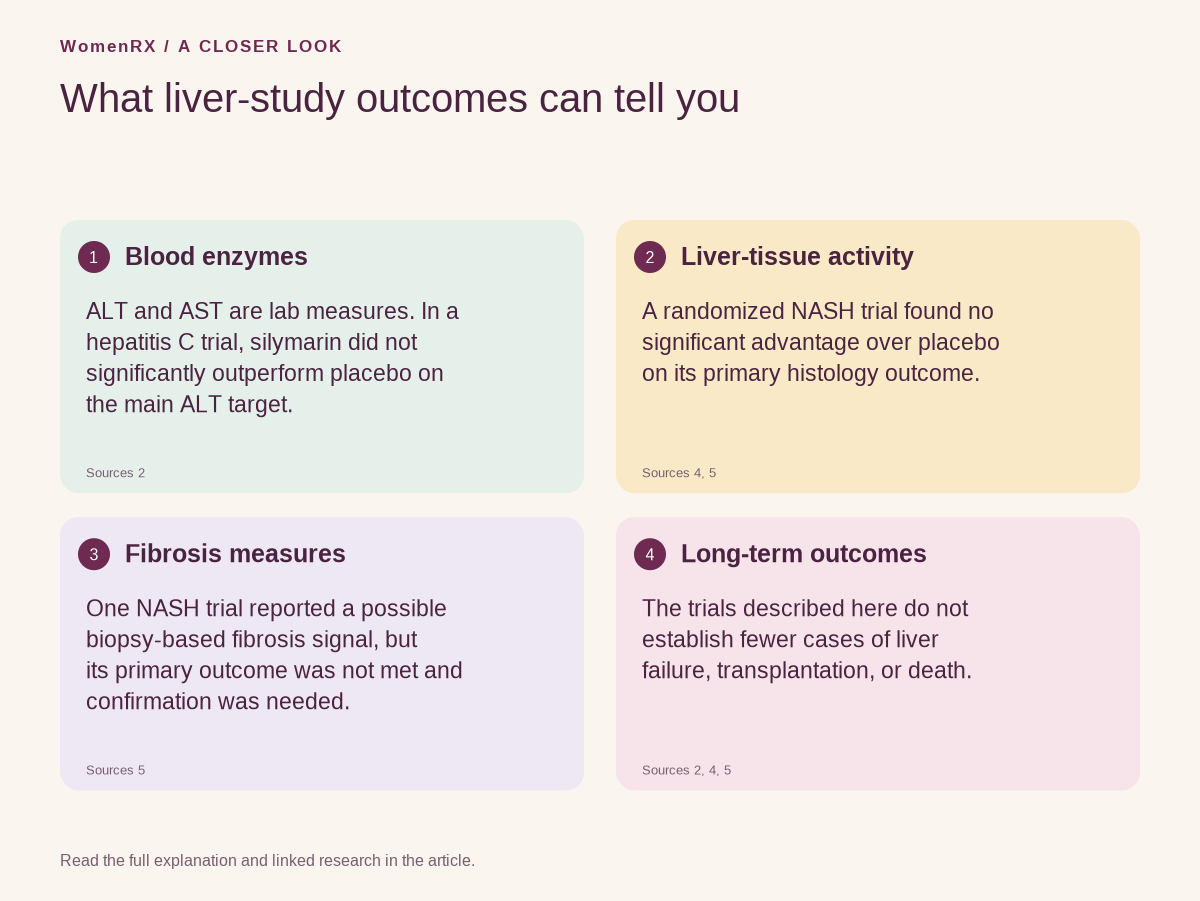
What liver-study outcomes can tell you
Blood enzymes: ALT and AST are lab measures. In a hepatitis C trial, silymarin did not significantly outperform placebo on the main ALT target.2
Liver-tissue activity: A randomized NASH trial found no significant advantage over placebo on its primary histology outcome.45
Fibrosis measures: One NASH trial reported a possible biopsy-based fibrosis signal, but its primary outcome was not met and confirmation was needed.5
Long-term outcomes: The trials described here do not establish fewer cases of liver failure, transplantation, or death.245
Read the figure as text
These measures answer different questions; a change in a lab value is not the same as proof of less liver damage or fewer complications.- Blood enzymes: ALT and AST are lab measures. In a hepatitis C trial, silymarin did not significantly outperform placebo on the main ALT target.2
- Liver-tissue activity: A randomized NASH trial found no significant advantage over placebo on its primary histology outcome.45
- Fibrosis measures: One NASH trial reported a possible biopsy-based fibrosis signal, but its primary outcome was not met and confirmation was needed.5
- Long-term outcomes: The trials described here do not establish fewer cases of liver failure, transplantation, or death.245
More questions, answered
Does a lower ALT mean milk thistle is repairing the liver?
Not by itself. ALT is a blood-test measure, and a change in ALT doesn’t establish that liver scarring has improved or that the risk of serious complications has fallen. In a randomized hepatitis C trial, silymarin did not significantly outperform placebo on the study’s ALT target. 2
Can I use milk thistle with hormonal birth control?
The clinical studies summarized here don’t establish whether milk thistle interacts with hormonal contraception. Show a pharmacist or your prescriber the exact product label before starting it rather than assuming there is no interaction.
Sources you can check
- Liver disease - NHSAccessed 2026-09-25Return to first citation
- Effect of silymarin (milk thistle) on liver disease in patients with chronic hepatitis C unsuccessfully treated with interferon therapy: a randomized controlled trial.Fried MW, Navarro VJ, Afdhal N, Belle SH, Wahed AS, Hawke RL, Doo E, Meyers CM, Reddy KR, Silymarin in NASH and C Hepatitis (SyNCH) Study Group. · JAMA · 2012Return to first citation
- The activity of a herbal medicinal product of Phyllanthus niruri and Silybum marianum powdered extracts (Heptex®) in patients with apparent risk factors for nonalcoholic steatohepatitis: a phase II, multicentered, randomized, double-blind, placebo-controlled clinical trial.Shaker MK, Hassany M, Eysa B, Adel A, Zidan A, Mohamed S. · BMC complementary medicine and therapies · 2025Return to first citation
- Silymarin in non-cirrhotics with non-alcoholic steatohepatitis: A randomized, double-blind, placebo controlled trial.Navarro VJ, Belle SH, D'Amato M, Adfhal N, Brunt EM, Fried MW, Reddy KR, Wahed AS, Harrison S, Silymarin in NASH and C Hepatitis (SyNCH) Study Group. · PloS one · 2019Return to first citation
- A Randomized Trial of Silymarin for the Treatment of Nonalcoholic Steatohepatitis.Wah Kheong C, Nik Mustapha NR, Mahadeva S. · Clinical gastroenterology and hepatology : the official clinical practice journal of the American Gastroenterological Association · 2017Return to first citation
- Rationale, challenges, and participants in a Phase II trial of a botanical product for chronic hepatitis C.Reddy KR, Belle SH, Fried MW, Afdhal N, Navarro VJ, Hawke RL, Wahed AS, Doo E, Meyers CM, SyNCH Study Group. · Clinical trials (London, England) · 2012Return to first citation