Milk Thistle for Liver Health: What Timing Can Tell You
Milk thistle may shift some liver-test results, but it hasn’t been shown reliably to improve how liver disease affects your health, and the best time of day to take it is unclear.
Milk thistle’s active mixture, silymarin, has been tested in people with fatty liver disease, but the evidence is very uncertain. Some studies found changes in liver enzymes or liver stiffness, which aren’t proof of fewer complications or better quality of life. The studies don’t establish an ideal time of day or whether to take it with food. Don’t let a supplement delay finding out what’s causing a liver concern. 2 4
What the liver studies actually show
Milk thistle is a plant; silymarin is a group of compounds extracted from it. In a 2025 Cochrane review of 17 randomized trials involving 2,069 adults with metabolic dysfunction-associated steatotic liver disease (MASLD), silymarin alone may have lowered ALT by an average of about 7 U/L compared with placebo or no intervention. But the review rated that evidence very low certainty. Results for silymarin products combined with other ingredients were also very uncertain. 4
A change in an enzyme is a change in a blood test, not proof that a person feels better or has less liver damage. One 24-week placebo-controlled trial of 83 people with MASLD found a small improvement in liver stiffness and GGT with silymarin, but no significant change in several other measures, including liver fat measured by FibroScan, aminotransferases, or fibrosis indices. The study does not establish that silymarin prevents complications or changes the course of disease. 2
Results aren’t consistent across trials. In a separate four-week randomized trial of 56 people with severe obesity, silymarin did not significantly improve liver enzymes or liver size compared with placebo. About 70% of participants were women, but the trial did not establish a different effect for women. 3
The product matters, and timing is unanswered
“Silymarin” doesn’t describe one identical preparation. Trials have studied silymarin on its own and in combinations with other ingredients, and the Cochrane review assessed those as separate treatment groups. That means evidence for one preparation shouldn’t automatically be treated as evidence for every milk thistle product on a store shelf. 4
Timing is a different question from whether a product changes a test result. These studies measured outcomes after weeks of use; they don’t compare morning with evening or taking a product with food versus on an empty stomach. There’s no evidence here to identify a best time for results. A schedule used in one trial is a study protocol, not a proven timing advantage. 2 3
What to review before trying it
If you’re considering milk thistle for a liver concern, bring the product label and your list of medicines and supplements to a clinician or pharmacist. Ask what is known about the specific preparation, whether it fits your situation, and how the underlying liver concern will be evaluated. The trials don’t establish safety during pregnancy or breastfeeding, so don’t assume it’s safe in either situation; raise it with your prenatal or primary-care clinician before using it. 4
Most types of liver disease don’t cause symptoms early, and treatment depends on the cause and severity. If you’re worried about liver disease or have an abnormal liver test, arrange an evaluation rather than waiting to see whether a supplement helps. Milk thistle isn’t a substitute for finding and treating the cause. 1
What we know, and what remains open
The most defensible takeaway is modest: some trials report changes in selected liver tests, but confidence in those findings is low or very low, and the evidence doesn’t show that milk thistle improves patient-important outcomes. The Cochrane review’s summary reports that men made up an average 55.6% of participants in trials that reported sex, and it doesn’t provide a women-specific estimate. That leaves the evidence less informative about whether results differ for women. 4
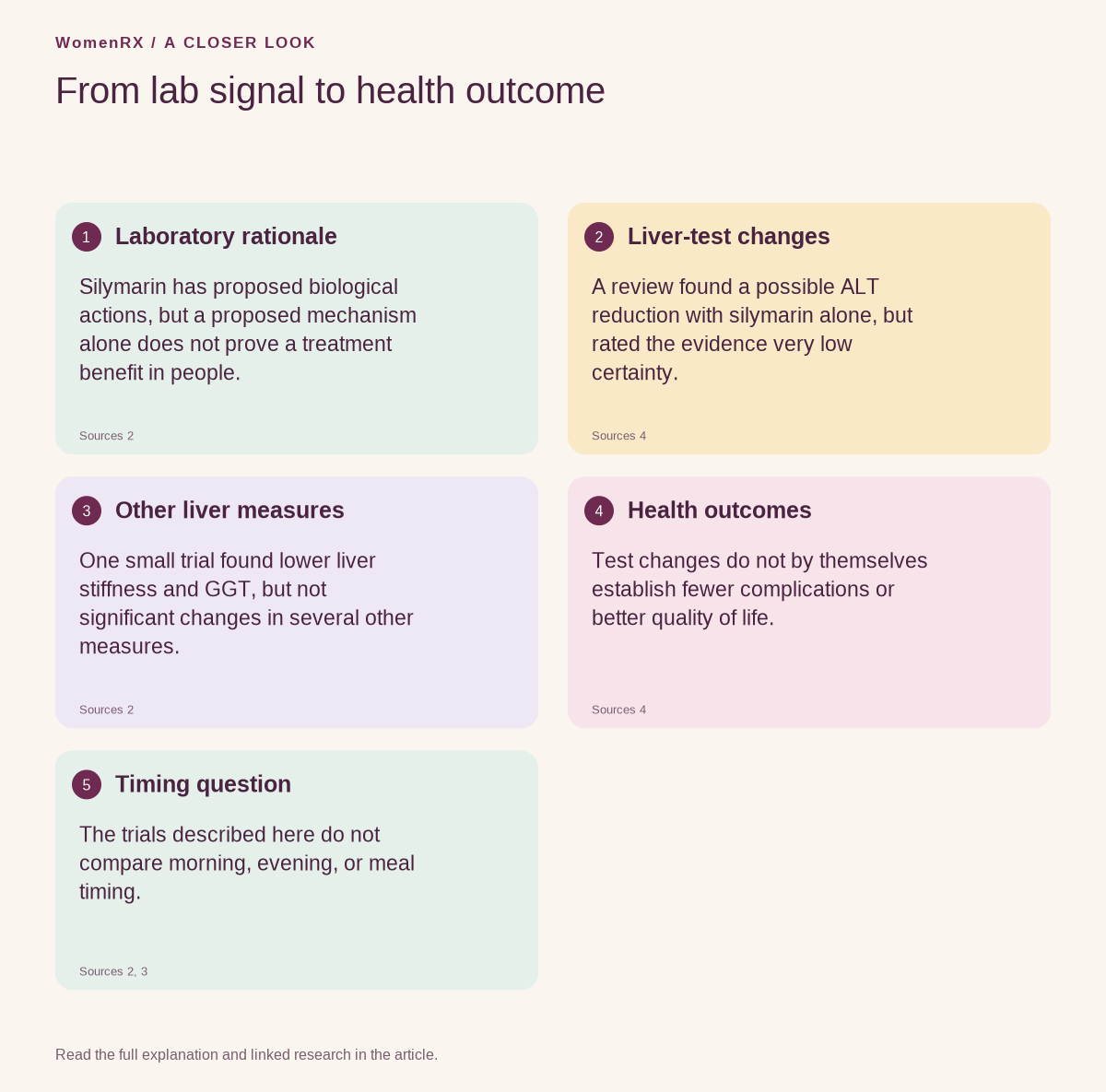
From lab signal to health outcome
Laboratory rationale: Silymarin has proposed biological actions, but a proposed mechanism alone does not prove a treatment benefit in people.2
Liver-test changes: A review found a possible ALT reduction with silymarin alone, but rated the evidence very low certainty.4
Other liver measures: One small trial found lower liver stiffness and GGT, but not significant changes in several other measures.2
Health outcomes: Test changes do not by themselves establish fewer complications or better quality of life.4
Timing question: The trials described here do not compare morning, evening, or meal timing.23
Read the figure as text
A changed liver test is one step in an evidence chain, not the same as proof that a supplement improves health or that a particular schedule works.- Laboratory rationale: Silymarin has proposed biological actions, but a proposed mechanism alone does not prove a treatment benefit in people.2
- Liver-test changes: A review found a possible ALT reduction with silymarin alone, but rated the evidence very low certainty.4
- Other liver measures: One small trial found lower liver stiffness and GGT, but not significant changes in several other measures.2
- Health outcomes: Test changes do not by themselves establish fewer complications or better quality of life.4
- Timing question: The trials described here do not compare morning, evening, or meal timing.23
More questions, answered
Should I take milk thistle in the morning or at night?
These studies don’t compare times of day or meal timing, so they can’t establish a best schedule. Follow the product’s directions only after reviewing the specific product with a clinician or pharmacist.
Is milk thistle safe during pregnancy or breastfeeding?
The adult liver-disease trials don’t establish safety during pregnancy or breastfeeding. Don’t assume it’s safe; discuss the specific product with your prenatal or primary-care clinician before using it. 4
Sources you can check
- Liver disease - NHSAccessed 2026-09-25Return to first citation
- Silymarin decreases liver stiffness associated with gut microbiota in patients with metabolic dysfunction-associated steatotic liver disease: a randomized, double-blind, placebo-controlled trial.Jin Y, Wang X, Chen K, Chen Y, Zhou L, Zeng Y, Zhou Y, Pan Z, Wang D, Li Z, Liang Y, Ling W, Li D. · Lipids in health and disease · 2024Return to first citation
- Effect of silymarin on liver size and nonalcoholic fatty liver disease in morbidly obese patients: A randomized double-blind clinical trial.Atarodi H, Pazouki A, Gholizadeh B, Karami R, Kabir A, Sadri G, Kassir R, Kermansaravi M. · Journal of research in medical sciences : the official journal of Isfahan University of Medical Sciences · 2022Return to first citation
- Silymarin for adults with metabolic dysfunction-associated steatotic liver disease.Wang C, Shang Y, Kanaan G, Chai L, Li H, Qi X. · The Cochrane database of systematic reviews · 2025Return to first citation