Milk Thistle: What to Know Before You Take It
Milk thistle is usually described as well tolerated, but liver benefits and medication interactions depend on what has actually been tested.
Milk thistle extract, often labeled silymarin, is a mixture of compounds including silybin. Human research generally describes silymarin as well tolerated, with digestive upset among the reported side effects, but evidence of liver benefit is mixed. Interaction concerns are not equally proven: some are based on lab tests or models, so check the exact product with a pharmacist or prescriber, especially if you take raloxifene or a medicine with a narrow safety margin. 2 3 4
First, what’s in the bottle?
Milk thistle is the plant; silymarin is an extract of its seeds, made up of several flavonolignans. Silybin, also called silibinin, is one of those compounds and a major component of silymarin. So a label that says “milk thistle,” “silymarin,” or “silybin” may be describing different things, not interchangeable names for one ingredient. 3
When comparing products, look for the exact ingredient name and the amount listed for it. Keep the package or a clear photo of the label when you ask about interactions. That helps someone check the product you actually plan to take rather than making assumptions from the words “milk thistle” alone.
A proposed liver effect isn’t the same as a proven benefit
Silymarin is studied for antioxidant and other possible liver effects. But mechanisms that look promising in laboratory research don’t establish that a supplement prevents or treats liver disease in people. A review of the clinical and preclinical research describes varied liver-related clinical outcomes and notes that few promising preclinical findings have translated into clinical studies. 3 A later review also calls for more research to clarify silymarin’s role in chronic liver disease. 5
That leaves a practical distinction: milk thistle may be marketed for “liver support,” but that phrase doesn’t tell you whether a particular extract improves a health outcome that matters to you. Don’t use it as a liver detox or as a replacement for evaluating or treating liver disease.
Side effects and life stages
A safety review describes silymarin as generally well tolerated in people, with digestive complaints such as nausea and diarrhea reported. That is reassuring, but it doesn’t mean every product or every person will have the same experience. 2
If you’re pregnant, don’t assume a supplement is safe because it’s plant-based. The review describes one pregnancy trial without reported anomalies, but still says more human research is needed and recommends caution during pregnancy. 2 If you’re considering milk thistle during pregnancy, have the specific product reviewed before using it.
Breastfeeding is a separate question. The pregnancy finding does not establish whether milk thistle is safe while breastfeeding. 2 If you’re breastfeeding, have the specific product reviewed before using it.
Interactions: separate a warning signal from a proven problem
The interaction evidence is mixed. A review found that milk thistle can affect some drug-metabolizing enzymes and transporters in experimental studies, while concluding that many such effects are unlikely to show up clinically. It also stresses that clinical evidence is limited, so it cannot establish that interactions never occur. 3
One finding is particularly relevant if you take raloxifene. Researchers tested milk thistle compounds in human intestinal enzyme systems and used a model to predict that silymarin or silibinin could increase raloxifene exposure by four to five times. That was a model prediction, not a measured increase in women taking both products, and it does not prove harm. Still, it’s a specific reason to check the combination rather than assume it’s harmless. 4
Another study found a milk-thistle-related change in pitavastatin exposure in rats. That’s an animal finding, not proof of the same interaction in people. 1 For medicines with a narrow therapeutic window, a safety review advises extra caution. 2
If you take raloxifene or a narrow-therapeutic-window medicine, show a pharmacist or prescriber the exact supplement label before combining them. Don’t stop a prescribed medicine to make room for a supplement. The useful question is whether the specific extract and your medication have a known or plausible interaction, and what to do about that uncertainty.
A quick way to weigh the decision
Milk thistle’s usual side effects appear mostly digestive in the human safety review, but the benefit for liver disease is not settled. Interaction worries range from laboratory findings and animal studies to a modeled concern involving raloxifene; those are not all equivalent to a demonstrated clinical interaction. 2 3 4
If the reason you’re considering it is a liver condition or a test result, treat the supplement question separately from the question of what the condition or result means. Milk thistle is not a proven detox, and the evidence does not make it a substitute for diagnosis or treatment.
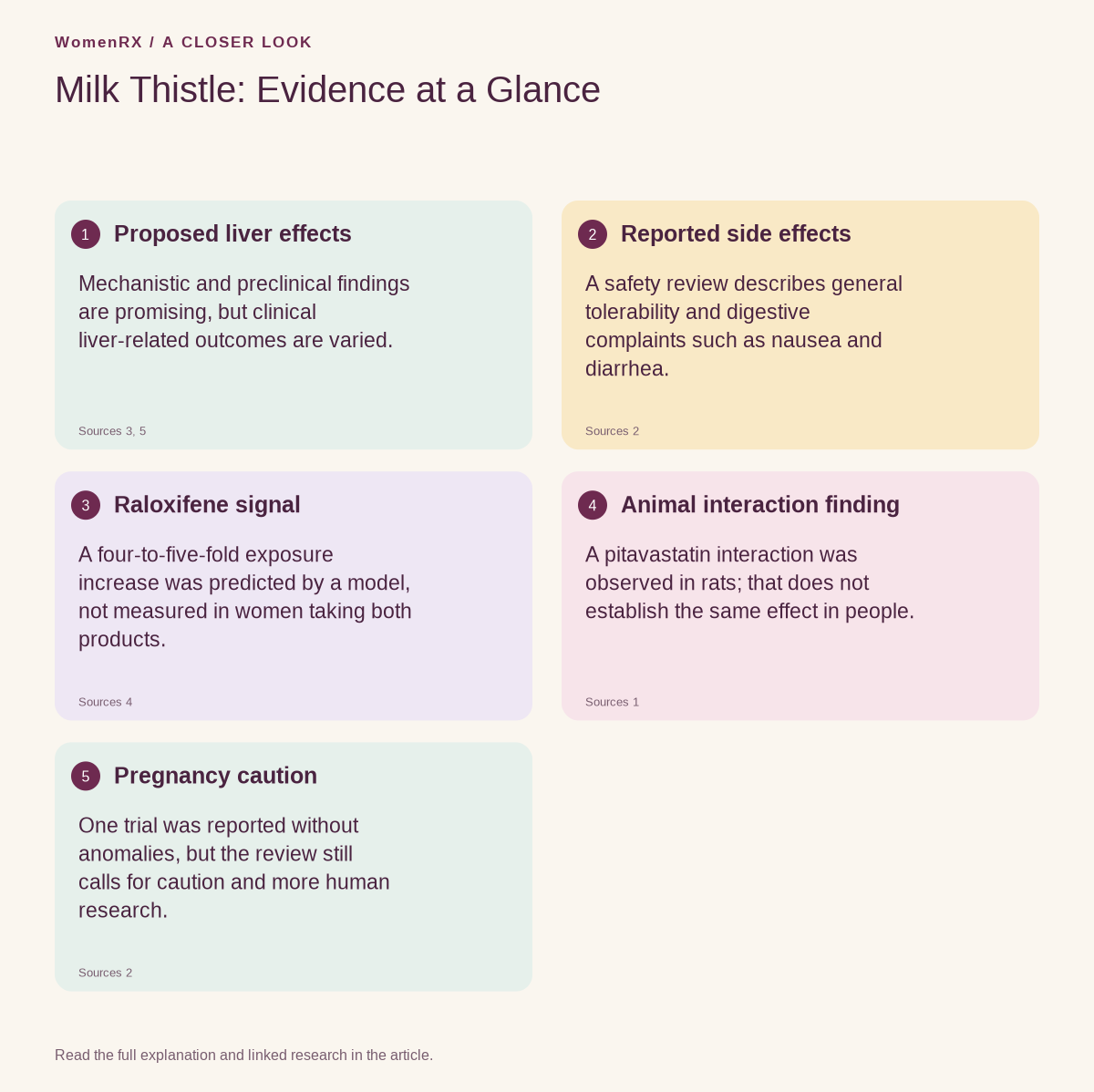
Milk Thistle: Evidence at a Glance
Proposed liver effects: Mechanistic and preclinical findings are promising, but clinical liver-related outcomes are varied.35
Reported side effects: A safety review describes general tolerability and digestive complaints such as nausea and diarrhea.2
Raloxifene signal: A four-to-five-fold exposure increase was predicted by a model, not measured in women taking both products.4
Animal interaction finding: A pitavastatin interaction was observed in rats; that does not establish the same effect in people.1
Pregnancy caution: One trial was reported without anomalies, but the review still calls for caution and more human research.2
Read the figure as text
These are different kinds of evidence, not interchangeable proof of benefit or harm.- Proposed liver effects: Mechanistic and preclinical findings are promising, but clinical liver-related outcomes are varied.35
- Reported side effects: A safety review describes general tolerability and digestive complaints such as nausea and diarrhea.2
- Raloxifene signal: A four-to-five-fold exposure increase was predicted by a model, not measured in women taking both products.4
- Animal interaction finding: A pitavastatin interaction was observed in rats; that does not establish the same effect in people.1
- Pregnancy caution: One trial was reported without anomalies, but the review still calls for caution and more human research.2
More questions, answered
Is milk thistle the same as silymarin?
No. Milk thistle is the plant, while silymarin is a seed extract containing several flavonolignans, including silybin. Check which one the product label names. 3
Is the raloxifene interaction confirmed in women?
The cited study tested human intestinal enzyme systems and used a model to predict a possible increase in raloxifene exposure. It did not measure that increase in women taking both products. 4
Sources you can check
- Hepatic organic anion transporting polypeptides mediate disposition of milk thistle flavonolignans and pharmacokinetic silymarin-drug interactions.Lynch KD, Montonye ML, Tian DD, Arman T, Oyanna VO, Bechtold BJ, Graf TN, Oberlies NH, Paine MF, Clarke JD. · Phytotherapy research : PTR · 2021Return to first citation
- Safety and toxicity of silymarin, the major constituent of milk thistle extract: An updated review.Soleimani V, Delghandi PS, Moallem SA, Karimi G. · Phytotherapy research : PTR · 2019Return to first citation
- Metabolism, Transport and Drug-Drug Interactions of Silymarin.Xie Y, Zhang D, Zhang J, Yuan J. · Molecules (Basel, Switzerland) · 2019Return to first citation
- Milk Thistle Constituents Inhibit Raloxifene Intestinal Glucuronidation: A Potential Clinically Relevant Natural Product-Drug Interaction.Gufford BT, Chen G, Vergara AG, Lazarus P, Oberlies NH, Paine MF. · Drug metabolism and disposition: the biological fate of chemicals · 2015Return to first citation
- Silymarin as an Antioxidant Therapy in Chronic Liver Diseases: A Comprehensive Review.Dhande D, Dhok A, Anjankar A, Nagpure S. · Cureus · 2024Return to first citation