Milk Thistle After 40: Is Age a Reason to Take It?
Being over 40 or going through menopause doesn’t, by itself, show that milk thistle will help you.
No: age alone isn’t a reason supported by these clinical studies to take milk thistle. Research has tested silymarin in specific settings, including alongside a multiple-sclerosis medicine and as part of a combination product for people at risk of fatty liver disease. Those results don’t show that women need a liver supplement after 40, or that milk thistle prevents age-related disease. 1 2
Age isn’t the health concern
Milk thistle is the plant Silybum marianum; silymarin is a mixture of compounds from the plant. The clinical findings don’t establish that turning 40, entering perimenopause, or being postmenopausal creates a need for it.
That distinction matters. A supplement may be studied for a particular diagnosis, in people taking a particular medicine, or as one ingredient in a larger formula. That’s a different question from whether a healthy woman should take it because of her age. These studies tested other questions, not milk thistle as menopause care.
What the human studies actually tested
One randomized trial assigned 48 people with relapsing-remitting multiple sclerosis to receive silymarin or placebo alongside fingolimod for six months. The researchers reported lower liver-enzyme levels in the silymarin group than in the placebo group. That is a result in a specific medication-and-disease setting, not evidence that milk thistle supports every person’s liver or is useful because of menopause. 1
A separate randomized trial tested Heptex, a product combining milk thistle with Phyllanthus niruri, in 146 people considered at risk for nonalcoholic steatohepatitis. Some liver-enzyme levels fell within treatment groups, but the study found no significant difference between groups in the relative change in ALT or AST, or in the change in Fib-4 score. Because the product had two herbal extracts, its results can’t show what milk thistle alone did. Most participants were women, but this study tested a combination product in people at risk for NASH, not milk thistle as menopause care. 2
These examples make the key tradeoff clear: a study can make a supplement sound promising while still not answering whether a particular person should buy it. The participants, health problem, formulation, and comparison all matter.
Why a supplement label isn’t the same as a trial
Studies of an extract or a combination product don’t automatically tell you what to expect from a different bottle. For example, a small human study compared blood levels after a single dose of standard silymarin and a micellar formulation in 16 healthy participants. It examined how much of the compound entered the bloodstream, not whether either product improved a liver condition or helped women around menopause. Higher absorption is not, by itself, proof of better health outcomes. 3
So a claim such as “liver support after 40” skips several steps: it assumes age creates a problem, that milk thistle addresses that problem, and that the product being sold matches the one studied. Those studies don’t establish those steps.
A useful way to decide
If you’re considering milk thistle for a specific reason, start with that reason rather than your age. Is it a diagnosed liver condition, a concern about a medicine, or a general “detox” claim? The studies above don’t show that a supplement can replace evaluation or treatment for a liver condition, and one tested it specifically alongside a prescription medicine. 1 2
A focused question for your prescriber or pharmacist could be: “Is there evidence for this exact product for my health concern, and could it affect the medicines I take?” The reported results don’t answer whether a particular retail product could affect your medicines, so don’t assume a trial-tested extract and an over-the-counter supplement are interchangeable.
If you don’t have a specific health concern and are considering milk thistle only because you’re over 40, age alone isn’t a research-backed reason to start it. If you do have a liver concern, the more useful next step is to identify what needs attention rather than rely on a broad detox promise.
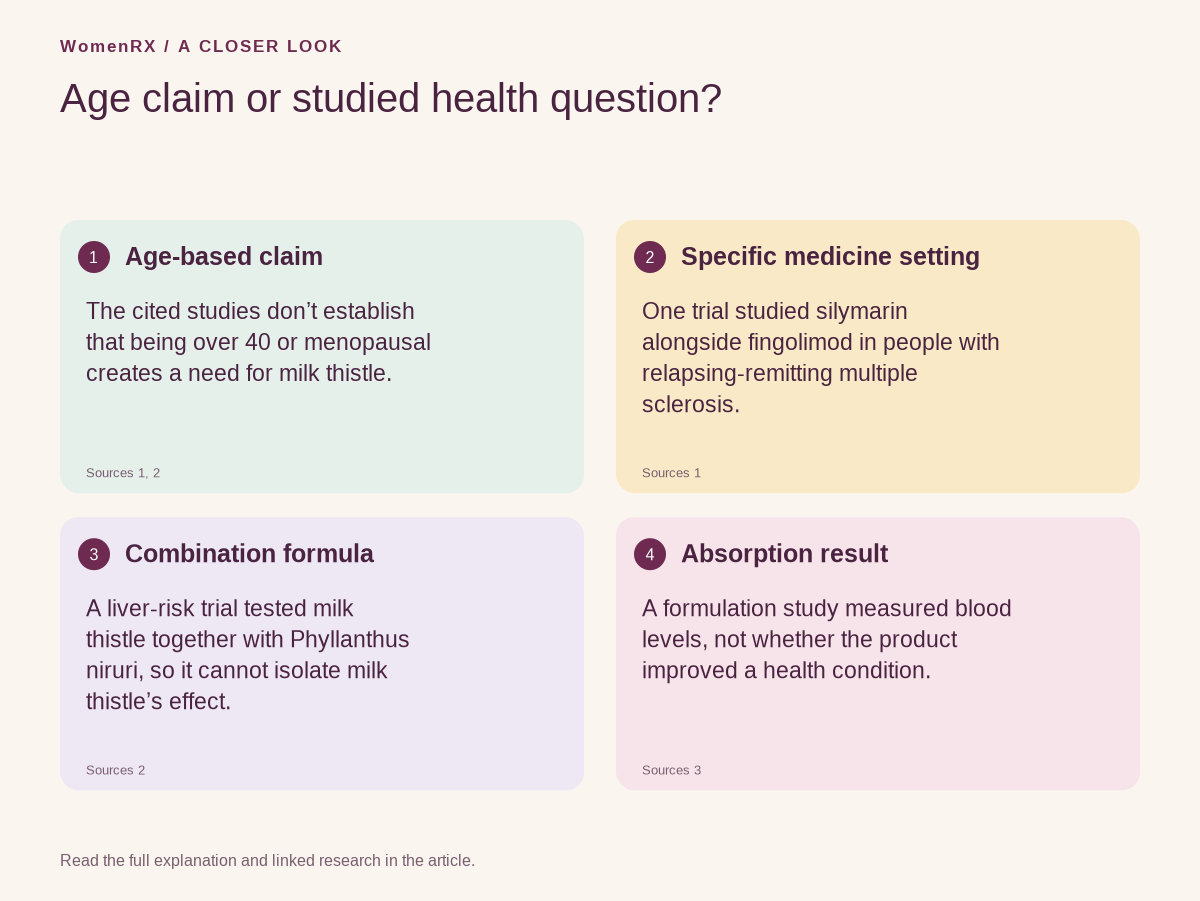
Age claim or studied health question?
Age-based claim: The cited studies don’t establish that being over 40 or menopausal creates a need for milk thistle.12
Specific medicine setting: One trial studied silymarin alongside fingolimod in people with relapsing-remitting multiple sclerosis.1
Combination formula: A liver-risk trial tested milk thistle together with Phyllanthus niruri, so it cannot isolate milk thistle’s effect.2
Absorption result: A formulation study measured blood levels, not whether the product improved a health condition.3
Read the figure as text
Separate the reason a supplement is being marketed from the specific questions human studies have tested.- Age-based claim: The cited studies don’t establish that being over 40 or menopausal creates a need for milk thistle.12
- Specific medicine setting: One trial studied silymarin alongside fingolimod in people with relapsing-remitting multiple sclerosis.1
- Combination formula: A liver-risk trial tested milk thistle together with Phyllanthus niruri, so it cannot isolate milk thistle’s effect.2
- Absorption result: A formulation study measured blood levels, not whether the product improved a health condition.3
More questions, answered
Do these studies show a menopause-specific benefit?
The study information described here focuses on people with relapsing-remitting multiple sclerosis taking fingolimod and people at risk for NASH taking a combination product. Those are different questions from using milk thistle as menopause care. 1 2
Does better absorption mean a supplement works better?
Not necessarily. A small study found that a micellar formulation produced higher blood levels than a standard formulation after a single dose, but it measured absorption, not improvement in a health condition. 3
Sources you can check
- Antioxidative effects of silymarin on the reduction of liver complications of fingolimod in patients with relapsing-remitting multiple sclerosis: A clinical trial study.Ghiasian M, Nafisi H, Ranjbar A, Mohammadi Y, Ataei S. · Journal of biochemical and molecular toxicology · 2021Return to first citation
- The activity of a herbal medicinal product of Phyllanthus niruri and Silybum marianum powdered extracts (Heptex®) in patients with apparent risk factors for nonalcoholic steatohepatitis: a phase II, multicentered, randomized, double-blind, placebo-controlled clinical trial.Shaker MK, Hassany M, Eysa B, Adel A, Zidan A, Mohamed S. · BMC complementary medicine and therapies · 2025Return to first citation
- Novel Micellar Formulation of Silymarin (Milk Thistle) with Enhanced Bioavailability in a Double-Blind, Randomized, Crossover Human Trial.Chang C, Zhang Y, Kuo YC, Du M, Roh K, Gahler R, Ibi A, Solnier J. · Pharmaceutics · 2025Return to first citation