Milk Thistle: Trial Timelines and Uncertain Benefits
Studies have checked liver enzymes, imaging, and biopsy findings, but their follow-up periods don’t establish when milk thistle starts helping.
There isn’t a proven time-to-benefit for milk thistle in liver disease. Trials have followed people for periods ranging from 60 days to 48 weeks, but they studied different preparations and outcomes. Some reported changes in blood tests or imaging; a US trial in people with non-cirrhotic NASH found no significant benefit on its main biopsy-based outcome after 48 weeks. 3 5
A study’s duration is not a benefit timeline
A trial that checks results after 60 days, six months, or 48 weeks tells you when researchers measured an outcome. It doesn’t show that milk thistle begins working by that point, or that taking it for the same length of time will help you. The answer also depends on what was measured and what liver condition was being studied.
Milk thistle products aren’t interchangeable in these studies. Trials tested a standardized silymarin extract, or combinations containing milk thistle alongside other herbs. Results from one preparation or condition can’t automatically be applied to another.
What the different outcomes can tell you
Liver enzymes such as ALT and AST are blood-test measures. A change in those numbers is not the same as showing that liver scarring improved, that symptoms got better, or that the risk of serious liver complications went down. Imaging, fibrosis estimates, and biopsy findings assess different things, and a trial’s result on one measure does not prove benefit on the others.
That distinction matters because many people with steatotic liver disease have no symptoms, and the condition can range from fat buildup with little damage to inflammation and scarring. The cause and severity of liver disease affect what care is appropriate. 1
What trials in fatty liver conditions found
In a US randomized trial, 78 adults with biopsy-diagnosed, non-cirrhotic NASH were assigned to a standardized silymarin extract or placebo for 48 weeks. The main outcome was an improvement of at least two points on a biopsy-based activity score. It occurred in 4 of 27 people in one silymarin group, 5 of 26 in the other, and 3 of 25 in the placebo group; the difference was not statistically significant. A central review also found that 63% of participants did not meet the study’s biopsy-based entry criteria, which complicates interpretation. The trial did not establish a meaningful benefit on its main outcome. 5
A much smaller, preliminary MASLD trial followed 30 participants for 60 days. The tested liquid combined milk thistle with turmeric, dandelion, and ginger. Imaging showed improvement in fatty-liver grade in 9 of 15 people taking the blend and 2 of 15 taking placebo. That finding is about the combination product, not milk thistle alone; the study was small and short, and 83.3% of participants were men. It can’t establish a milk-thistle benefit for women or a lasting clinical outcome. 3
A 36-week trial tested another combination, milk thistle plus Phyllanthus niruri, in people considered at risk of NASH. Some liver-enzyme values fell within treatment groups, but changes in ALT and AST did not differ significantly between the three groups. The groups also did not differ in change in the FIB-4 score, a fibrosis estimate. This trial does not show that milk thistle alone improved liver disease. 4
Taken together, these studies don’t provide a reliable countdown to benefit. They also don’t support treating an enzyme change as proof of recovery.
A study in a different setting is not a liver-disease treatment trial
One six-month study included people with relapsing-remitting multiple sclerosis who were taking fingolimod. It reported lower ALT and AST in the group assigned silymarin alongside the medicine. That study asked about liver-enzyme changes in people taking fingolimod, not whether milk thistle treats MASLD, NASH, or another liver disease. It also doesn’t establish that combining milk thistle with other medicines is generally safe. 2
Why the cause of a liver problem matters
Abnormal liver tests can have different causes, and liver diseases differ in how they progress and what treatment they need. MedlinePlus advises checking with a health care provider before using supplements because some can damage the liver. 1 If you’re considering milk thistle, you could bring the exact supplement label and a list of your medicines to discuss with a health care provider or pharmacist.
The trials discussed here don’t establish safety during pregnancy or breastfeeding. They also don’t provide a general list of medicine interactions. The fingolimod study is a specific example of co-use, not a broad safety finding. 2
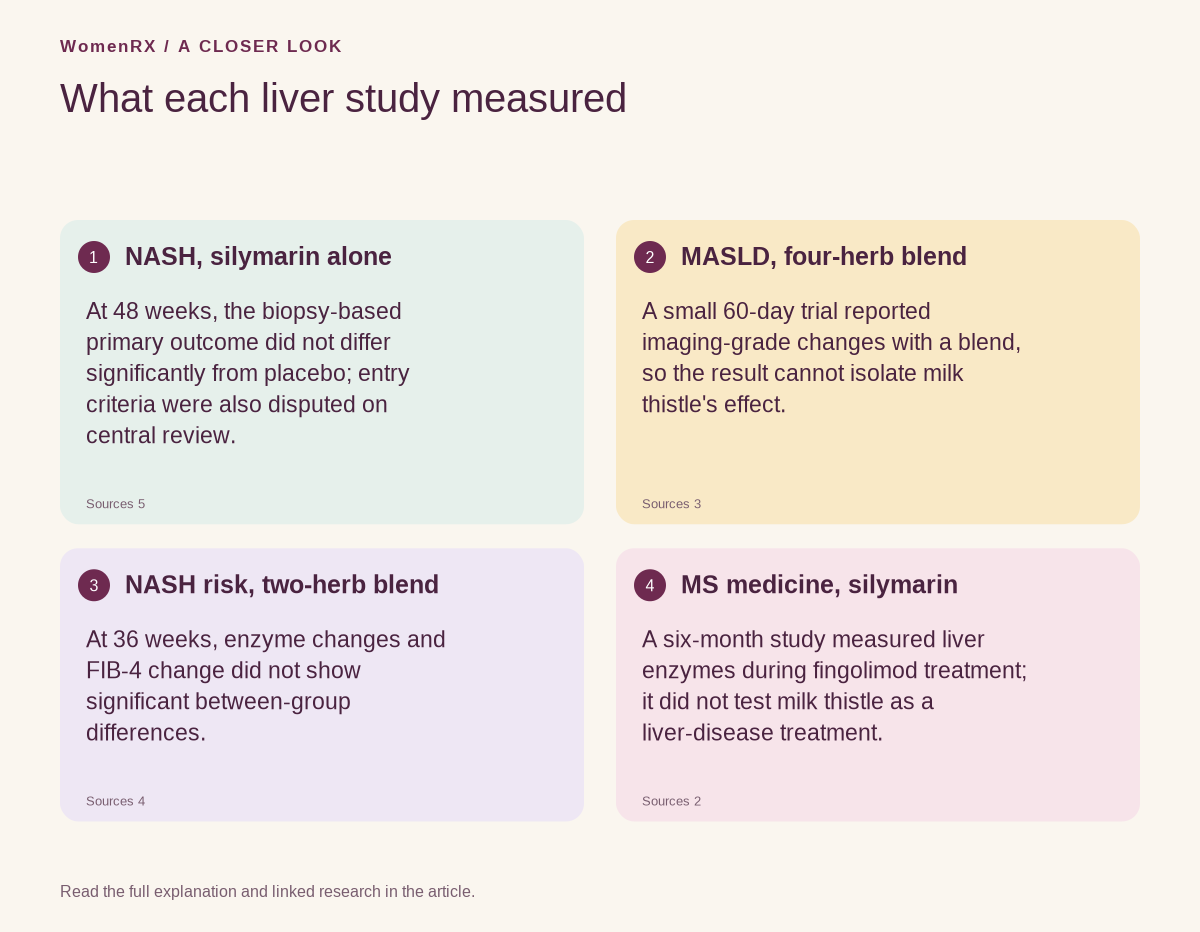
What each liver study measured
NASH, silymarin alone: At 48 weeks, the biopsy-based primary outcome did not differ significantly from placebo; entry criteria were also disputed on central review.5
MASLD, four-herb blend: A small 60-day trial reported imaging-grade changes with a blend, so the result cannot isolate milk thistle's effect.3
NASH risk, two-herb blend: At 36 weeks, enzyme changes and FIB-4 change did not show significant between-group differences.4
MS medicine, silymarin: A six-month study measured liver enzymes during fingolimod treatment; it did not test milk thistle as a liver-disease treatment.2
Read the figure as text
The condition, product, outcome, and follow-up all shape what a trial can tell you. A study period is not a proven time-to-benefit.- NASH, silymarin alone: At 48 weeks, the biopsy-based primary outcome did not differ significantly from placebo; entry criteria were also disputed on central review.5
- MASLD, four-herb blend: A small 60-day trial reported imaging-grade changes with a blend, so the result cannot isolate milk thistle's effect.3
- NASH risk, two-herb blend: At 36 weeks, enzyme changes and FIB-4 change did not show significant between-group differences.4
- MS medicine, silymarin: A six-month study measured liver enzymes during fingolimod treatment; it did not test milk thistle as a liver-disease treatment.2
More questions, answered
Does a lower ALT or AST mean my liver is recovering?
Not by itself. ALT and AST are blood-test measures, while studies may also assess liver fat on imaging, fibrosis estimates, or biopsy findings. A change in one measure doesn’t establish improvement in the others or show that symptoms or long-term outcomes changed. 4 5
Do these studies show milk thistle is safe during pregnancy or breastfeeding?
The trial findings discussed here don’t answer whether milk thistle is safe during pregnancy or breastfeeding.
Sources you can check
- Steatotic Liver Disease | Fatty Liver Disease | MedlinePlusAccessed 2026-09-25Return to first citation
- Antioxidative effects of silymarin on the reduction of liver complications of fingolimod in patients with relapsing-remitting multiple sclerosis: A clinical trial study.Ghiasian M, Nafisi H, Ranjbar A, Mohammadi Y, Ataei S. · Journal of biochemical and molecular toxicology · 2021Return to first citation
- Effectiveness and safety of an ayurvedic nutraceutical for improving clinical parameters of liver function in participants with metabolic dysfunction-associated steatotic liver disease: a randomized, placebo-controlled, preliminary phase 2 exploratory clinical trial.Messier H, Patel J, Bhomia V, Kataria D, Patel G. · Frontiers in nutrition · 2026Return to first citation
- The activity of a herbal medicinal product of Phyllanthus niruri and Silybum marianum powdered extracts (Heptex®) in patients with apparent risk factors for nonalcoholic steatohepatitis: a phase II, multicentered, randomized, double-blind, placebo-controlled clinical trial.Shaker MK, Hassany M, Eysa B, Adel A, Zidan A, Mohamed S. · BMC complementary medicine and therapies · 2025Return to first citation
- Silymarin in non-cirrhotics with non-alcoholic steatohepatitis: A randomized, double-blind, placebo controlled trial.Navarro VJ, Belle SH, D'Amato M, Adfhal N, Brunt EM, Fried MW, Reddy KR, Wahed AS, Harrison S, Silymarin in NASH and C Hepatitis (SyNCH) Study Group. · PloS one · 2019Return to first citation