How to Compare Milk Thistle Supplements: Labels, Testing, and Evidence
A clear silymarin label can help you compare products, but it cannot show that a supplement will work for your intended use.
Compare the amount and form of milk thistle extract, what the label means by “silymarin,” and whether independent testing applies to the exact product and batch. Silymarin is a mixture of compounds, not a synonym for every milk thistle ingredient. Standardization can make the contents clearer, but it does not prove a health benefit. Evidence for uses and for pregnancy or breastfeeding remains limited or specific to particular preparations. 235
Start with what the product actually contains
On the Supplement Facts panel, look for the plant name (Silybum marianum), the plant part, and the amount of extract per serving. A label that says only “milk thistle” leaves more unanswered than one that identifies a seed extract and states how much is in each serving. Milk thistle supplements can use inconsistent terms for their ingredients, and a review of commercial products found that labels sometimes use “flavonoids,” “silymarin,” and “silybin” interchangeably. Those names do not mean the same thing. 3
Silymarin is a mixture of milk thistle seed compounds, including silybin A and B, silychristin, and silydianin. Silybin, also called silibinin, is one constituent of that mixture. So if a label lists a quantity of “milk thistle extract” and a separate percentage of silymarin, check whether it states the amount of silymarin you get per serving. A percentage alone does not tell you the amount unless the extract amount is also clear. 23
Read standardization as a contents claim
A standardized extract is intended to have a specified amount or profile of compounds. That detail can make two labels easier to compare, but it is not proof that a product treats a condition. Milk thistle extracts vary with growing conditions and how they are prepared or handled; researchers have developed chemical methods to authenticate and measure their constituents. A laboratory method that works for research extracts, however, does not establish that a particular retail product has been tested or that it improves health. 2
A useful label comparison is therefore narrow: Does the manufacturer state the extract amount? Does it identify what the standardization refers to, such as silymarin rather than an unexplained “active” amount? Can you tell the amount per serving? If a proprietary blend obscures the amount of milk thistle or its constituents, you cannot make a direct dose comparison from the label alone.
Look for testing you can verify
Independent testing is most useful when you can verify the exact product and understand what the test covers. Look for a recognizable third-party certification mark, then check the certifier’s own product listing or database rather than relying on a logo alone. The mark is a quality-screening clue, not proof that milk thistle will help with your intended use. A US case series of 44 weight-loss supplements found frequent label inaccuracies, but those results do not establish how common mislabeling is in milk thistle products. 1
If a company provides a certificate of analysis, check whether it identifies the product and batch you have, who performed the testing, and what was measured. A test that confirms identity or silymarin content answers a different question from one that checks contaminants. A review of milk thistle products describes discrepancies between labeled and detected content, as well as reports of contaminants in some preparations. This supports checking what was tested, not assuming that one test or seal covers every quality concern. 3
Match the evidence to your reason for taking it
Standardized content and clinical benefit are separate questions. A review of milk thistle chemistry notes that findings on therapeutic benefit remain inconclusive, in part because clinical studies have not always used adequately standardized extracts. A review of research in chronic liver disease describes possible benefits but also calls for further high-quality studies. Neither makes a specific retail product a proven treatment. 24
Before comparing products, name the intended use. Evidence about one condition, outcome, or extract does not automatically apply to another. For example, laboratory findings about a compound or a product standardized to silymarin do not show that a supplement will “detox” the liver or prevent liver disease. Look for human studies of the same preparation and the same outcome you care about, and treat broad claims on a label as claims to verify rather than evidence.
Pregnancy, breastfeeding, and hormonal medicines
Women-specific benefits should not be assumed. In a systematic review of trials involving mothers of preterm babies, evidence for a silymarin-containing product combined with other ingredients was low certainty; another trial of a different, micronized milk thistle preparation did not significantly increase milk volume at day seven. Those results do not establish that milk thistle alone increases milk supply, or that other products will have the same effect. 5
This evidence does not establish safety during pregnancy. If you are pregnant, breastfeeding, or taking hormonal medicines, a label comparison alone cannot settle whether a particular product is appropriate. Bring the exact product label to a pharmacist or prescriber, especially if it contains other herbs or combines ingredients. A mechanistic discussion of a milk thistle compound and estrogen-related pathways is not evidence of a clinical interaction or a proven effect on hormones in people. 6
A quick comparison that avoids false certainty
Put two products side by side and ask: Are the plant part and extract amount clear? Is the silymarin amount stated in a way you can compare? Can you verify independent testing for the exact product, and what did it test? Finally, is there human evidence for the specific use and preparation you have in mind? If a label answers the first questions but the evidence does not answer the last, you may be comparing product descriptions, not proven benefits.
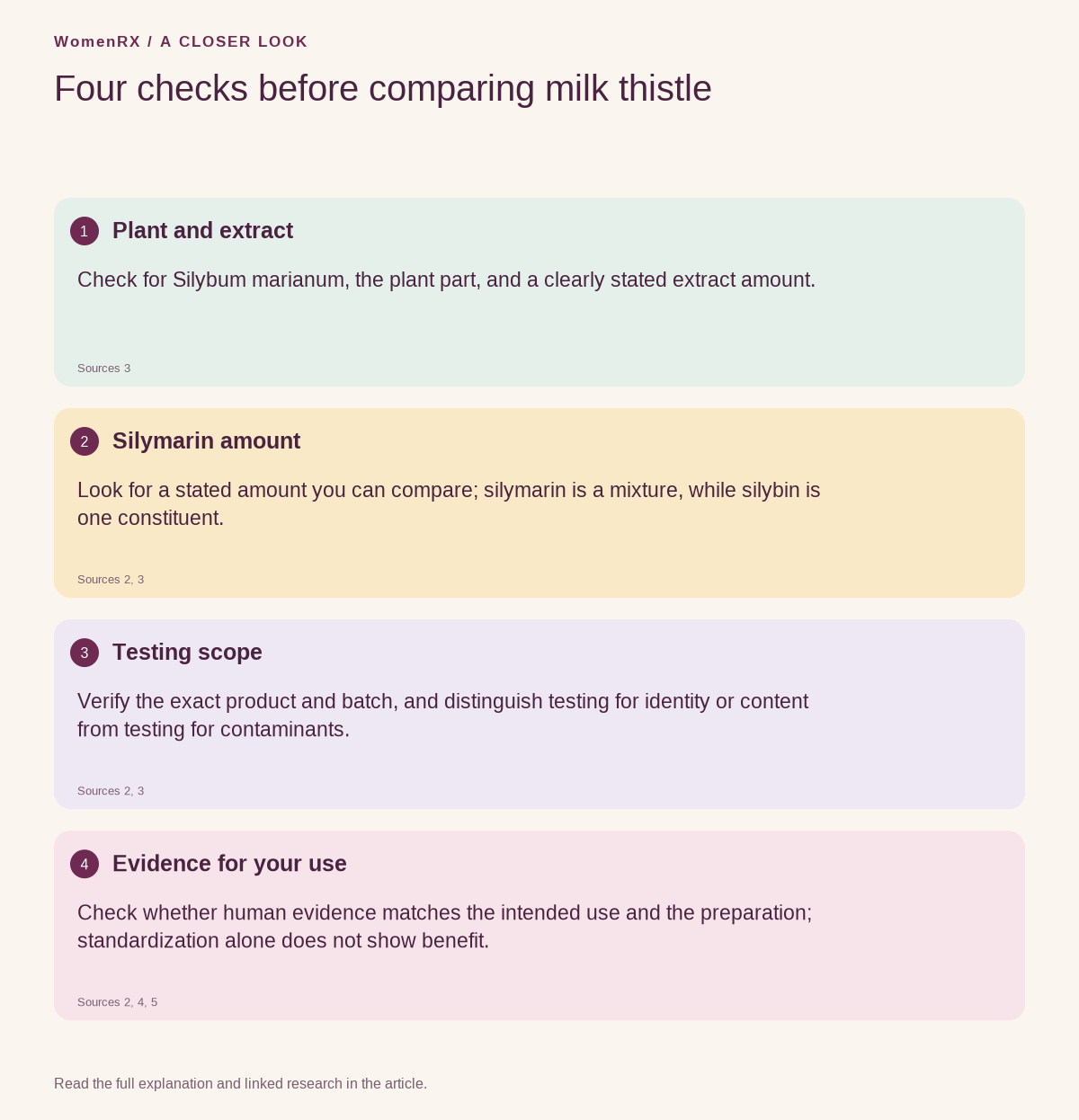
Four checks before comparing milk thistle
Plant and extract: Check for Silybum marianum, the plant part, and a clearly stated extract amount.3
Silymarin amount: Look for a stated amount you can compare; silymarin is a mixture, while silybin is one constituent.23
Testing scope: Verify the exact product and batch, and distinguish testing for identity or content from testing for contaminants.23
Evidence for your use: Check whether human evidence matches the intended use and the preparation; standardization alone does not show benefit.245
Read the figure as text
Separate what the label says from what product testing and human evidence can establish.- Plant and extract: Check for Silybum marianum, the plant part, and a clearly stated extract amount.3
- Silymarin amount: Look for a stated amount you can compare; silymarin is a mixture, while silybin is one constituent.23
- Testing scope: Verify the exact product and batch, and distinguish testing for identity or content from testing for contaminants.23
- Evidence for your use: Check whether human evidence matches the intended use and the preparation; standardization alone does not show benefit.245
Sources you can check
- Label Accuracy and Quality of Select Weight-Loss Dietary Supplements Sold on or near US Military Bases.Crawford C, Lindsey AT, Avula B, Katragunta K, Khan IA, Deuster PA. · Nutrients · 2024Return to first citation
- Chemical Standardization of Milk Thistle (Silybum marianum L.) Extract Using UHPLC-MS/MS and the Method of Standard Addition.Muchiri RN, van Breemen RB. · Journal of the American Society for Mass Spectrometry · 2024Return to first citation
- Detecting and Profiling of Milk Thistle Metabolites in Food Supplements: A Safety-Oriented Approach by Advanced Analytics.Raclariu-Manolică AC, Socaciu C. · Metabolites · 2023Return to first citation
- Silymarin as an Antioxidant Therapy in Chronic Liver Diseases: A Comprehensive Review.Dhande D, Dhok A, Anjankar A, Nagpure S. · Cureus · 2024Return to first citation
- Herbal galactagogues to improve breastmilk production and lactation in mothers of preterm babies: a systematic review of clinical trials.Cragg A, Levene I, Darabi S, Willcox M. · European journal of clinical nutrition · 2026Return to first citation
- Mechanistic Insights into the Anti-Inflammatory and Anti-Proliferative Effects of Selected Medicinal Plants in Endometriosis.Burdan O, Picheta N, Piekarz J, Daniłowska K, Gajewski F, Kułak K, Tarkowski R. · International journal of molecular sciences · 2025Return to first citation