Milk Thistle: What to Check Before Choosing a Dose
A small study comparing two milk-thistle formulations measured different silymarin blood levels, but it didn’t test liver outcomes or establish a dose for prevention.
A small study in 16 healthy participants found that one micellar milk-thistle formulation produced higher blood levels of silymarin than the standard formulation it was compared with. It measured absorption, not liver-health benefit, and cannot establish a dose for prevention. 3 Before choosing a product, check what form and amount it lists, what you hope it will do, and whether your medicines or pregnancy or breastfeeding status change the safety questions.
Start with the reason you’re considering it
If you’re thinking about milk thistle for liver health, first separate prevention from treatment. The small study discussed below compared blood levels after a single dose; it did not establish a dose for preventing liver disease. Nor does a product’s dose on the label show that it can prevent or treat a particular liver condition. Liver disease has different causes, and treatment depends on the type and how severe it is. 13
Milk thistle contains silymarin, a mixture of plant compounds. Research on silymarin has included people with liver conditions, but a review of that research isn’t the same as proof that any retail product works for your situation. The small human study discussed below measured how much silymarin entered the bloodstream, not whether it improved liver disease. 35
Read the label for what it actually says
Look for the amount of milk-thistle extract and, if listed, the amount of silymarin. These are not necessarily the same quantity: silymarin is a mixture of compounds within milk-thistle extract. Note the named extract or delivery form too. Check whether the label states a standardized silymarin content or percentage. That detail may help describe what’s in the product, but it doesn’t prove a liver benefit. If the label doesn’t make clear what the amount refers to, don’t assume it can be compared directly with a research preparation.
That distinction matters because a small randomized crossover study in 16 healthy participants compared a micellar formulation with a standard formulation after a single dose. The micellar product produced higher measured blood exposure to silymarin. The study did not test liver outcomes, long-term use, or whether one preparation benefits people more than another. Higher absorption alone does not establish better treatment. 3
Treat a study dose as a description of that study’s preparation, not as a universal recommendation. This comparison does not establish a preventive dose or show that other products can be substituted milligram for milligram. 3
Review medicines and health circumstances
Before using a product, make a complete list of prescription medicines, over-the-counter medicines, and supplements. Ask a pharmacist or prescriber to check the specific product against that list, especially if you take a medicine where small changes in drug levels could matter. A safety review describes silymarin as having relatively few drug interactions overall, but advises caution with medicines that have a narrow therapeutic window. That’s a reason to check, not proof that a particular interaction will occur. 4
Also mention any diagnosed liver condition and why you’re considering the supplement. Don’t use it as a substitute for finding out what is causing a liver problem or for treatment already recommended for you. Liver conditions have different causes and treatments. 1
A practical product-and-safety check:
- Extract: What form of milk thistle does the label name?
- Amount and standardization: Is the listed amount extract, silymarin, or both? Does the label state a standardized silymarin content or percentage?
- Purpose: Is this for general interest, or are you trying to address a diagnosed condition?
- Medicines: Has someone checked the exact product alongside your medicines, especially any with a narrow therapeutic window? 4
- Life stage: Are you pregnant, trying to become pregnant, or breastfeeding?
Pregnancy and breastfeeding deserve their own check
For pregnancy, a safety review describes one clinical trial that reported no anomalies, but also says more human research is needed. One study is not enough to establish that milk thistle is safe in pregnancy or to choose a dose. 4
Breastfeeding raises a separate question. Some substances, including some medicines, can pass into breast milk, so don’t assume a plant-based product is automatically suitable while nursing. Ask about the exact product and your circumstances before using it. 2
The useful bottom line
The cited single-dose comparison can’t tell you what dose, if any, prevents liver disease. 3 If you’re comparing products, focus on whether the label clearly identifies the extract, the amount of silymarin, and any stated standardization. Don’t equate a higher absorbed amount with a proven liver benefit. 3 If you have liver disease or take medicines where drug levels matter, have the specific product reviewed before starting it. 14
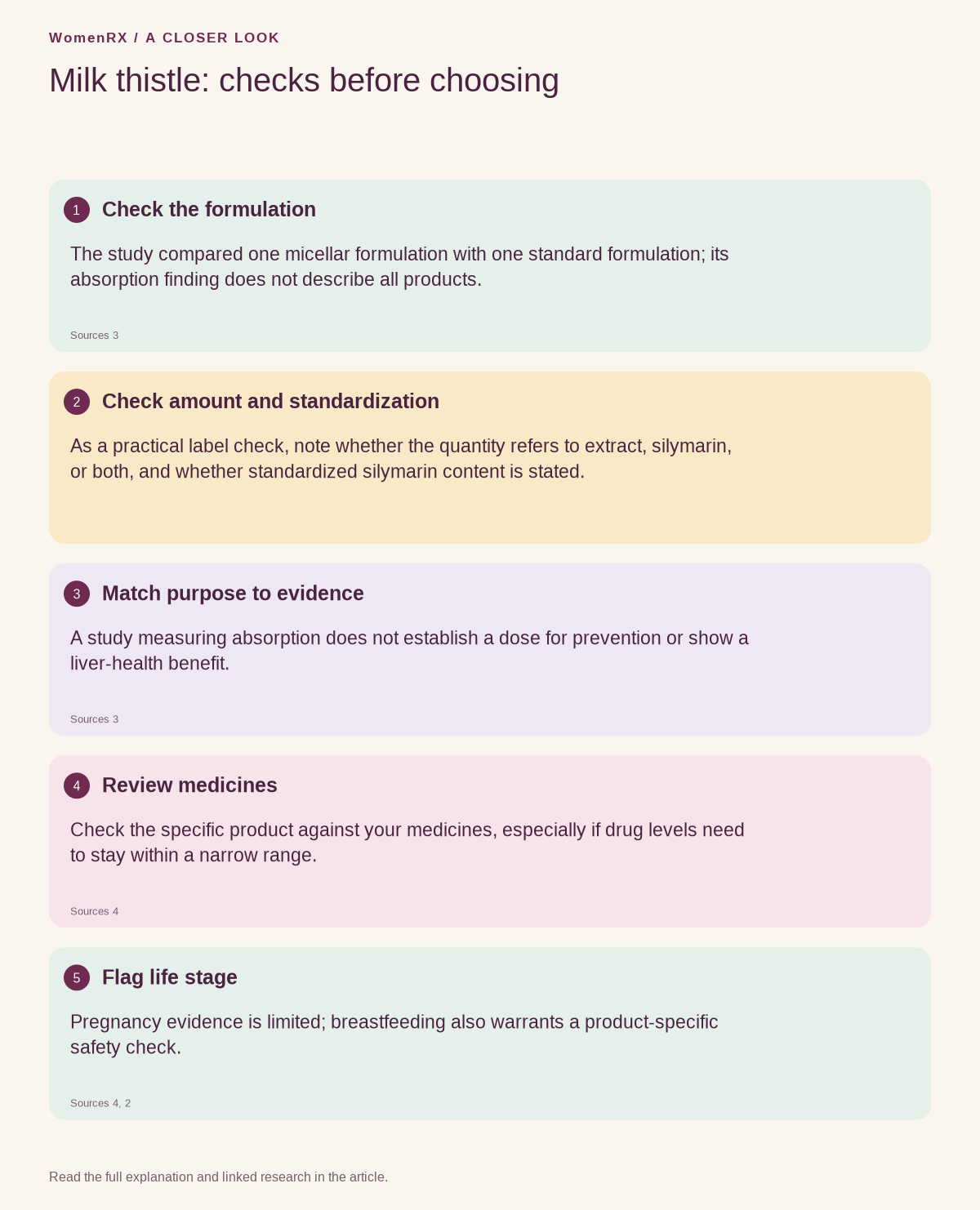
Milk thistle: checks before choosing
Check the formulation: The study compared one micellar formulation with one standard formulation; its absorption finding does not describe all products.3
Check amount and standardization: As a practical label check, note whether the quantity refers to extract, silymarin, or both, and whether standardized silymarin content is stated.
Match purpose to evidence: A study measuring absorption does not establish a dose for prevention or show a liver-health benefit.3
Review medicines: Check the specific product against your medicines, especially if drug levels need to stay within a narrow range.4
Flag life stage: Pregnancy evidence is limited; breastfeeding also warrants a product-specific safety check.42
Read the figure as text
Use these distinctions to compare a product label and identify questions that depend on your medicines, health, or life stage.- Check the formulation: The study compared one micellar formulation with one standard formulation; its absorption finding does not describe all products.3
- Check amount and standardization: As a practical label check, note whether the quantity refers to extract, silymarin, or both, and whether standardized silymarin content is stated.
- Match purpose to evidence: A study measuring absorption does not establish a dose for prevention or show a liver-health benefit.3
- Review medicines: Check the specific product against your medicines, especially if drug levels need to stay within a narrow range.4
- Flag life stage: Pregnancy evidence is limited; breastfeeding also warrants a product-specific safety check.42
More questions, answered
Does a higher-absorption product mean a better liver-health result?
No. The small study showing higher blood levels compared absorption after a single dose in 16 healthy participants. It did not test whether the formulation improved liver outcomes. 3
Can I use a dose from a study as my daily dose?
Not as a universal recommendation. A study dose describes its particular preparation and design; this single-dose comparison does not establish a dose for preventing liver problems or show that other products can be substituted milligram for milligram. 3
Sources you can check
- Liver disease - NHSAccessed 2026-09-25Return to first citation
- Breastfeeding | Benefits of Breastfeeding | MedlinePlusAccessed 2026-09-25Return to first citation
- Novel Micellar Formulation of Silymarin (Milk Thistle) with Enhanced Bioavailability in a Double-Blind, Randomized, Crossover Human Trial.Chang C, Zhang Y, Kuo YC, Du M, Roh K, Gahler R, Ibi A, Solnier J. · Pharmaceutics · 2025Return to first citation
- Safety and toxicity of silymarin, the major constituent of milk thistle extract: An updated review.Soleimani V, Delghandi PS, Moallem SA, Karimi G. · Phytotherapy research : PTR · 2019Return to first citation
- Chronic liver disease and management with silymarin: an introductory review of a clinical case collection.Angelico F. · Drugs in context · 2024Return to first citation