Milk Thistle: What a Studied Dose Can’t Tell You
A milk thistle study can help you understand a particular extract, but it can’t tell you that a different bottle will work the same way.
There’s no established milk thistle dose that works for everyone. One trial used 140 mg of silymarin three times daily for four weeks in people with acute hepatitis, but its results don’t make that a recommended dose for other purposes. To compare a product with a study, check the preparation, stated silymarin content and serving size. If you’re pregnant, breastfeeding or taking medicine, get an individual safety review first. 56
First, find out what the study actually tested
“Milk thistle” can mean the plant, a plant extract or a product containing silymarin. Silymarin is a mixture of compounds in milk thistle extract, not another name for every ingredient in the plant. That distinction matters when you’re trying to match a bottle to a study. 26
For a concrete example, a randomized, placebo-controlled trial enrolled 105 people with acute clinical hepatitis at two hospitals in Egypt. Researchers tested a named preparation containing 140 mg of silymarin, taken three times daily for four weeks, with another four weeks of follow-up. Some signs and symptoms, including dark urine and jaundice, resolved sooner in the silymarin group. The trial did not find a significant reduction in the liver enzymes ALT or AST. Its dose describes what researchers tested in that group; it isn’t a general dose recommendation or evidence that a retail supplement treats liver disease. The cited results do not establish a dose or outcome specifically for women. 5
Across liver conditions, clinical findings have been conflicting or too limited for definite conclusions. Two trials highlighted by the National Center for Complementary and Integrative Health (NCCIH), one in chronic hepatitis C and one in nonalcoholic steatohepatitis, did not show benefit from silymarin supplementation. A promising result in one condition should not be carried over to another. 6
Read the label as a comparison, not a guarantee
Start with the amount beside the ingredient name. A label that states a weight of milk thistle extract is not necessarily stating that same weight of silymarin. Look for a stated silymarin amount, rather than relying on the extract weight or the word standardized. A standardization claim does not independently verify the bottle’s contents. Then check whether those amounts refer to one capsule or the label’s full serving.
Those details can show that two bottles make different claims about their contents. They cannot establish that either bottle is equivalent to the named preparation in a trial. Formulation may differ, and a label claim is not independent verification. NCCIH reports that some milk thistle supplements have contained substantially different amounts of silymarin from those stated on their labels; quality concerns have also included contamination. 56
If the label gives only an extract weight and no silymarin content, you can’t make a direct silymarin-amount comparison with the acute-hepatitis trial. If it does give a silymarin amount, you’ve answered one question, not all of them: the study’s population, purpose, formulation and duration still matter. 56
Safety depends on your situation
The four-week acute-hepatitis trial reported no adverse events, with side effects gathered by self-report. That’s reassuring for that small study, but it cannot settle longer-term safety, safety in pregnancy, or what happens when milk thistle is combined with someone’s medicines. NCCIH says little is known about safety during pregnancy or breastfeeding. There is no women-specific dose established by the clinical findings discussed here. 56
Breastfeeding deserves a closer distinction. A systematic review of trials in mothers of preterm infants found low-certainty evidence for increased milk volume with a combination containing silymarin, phosphatidylserine and Galega. It does not show that an ordinary milk thistle capsule has the same effect, nor does it establish safety for every breastfeeding parent and infant. If milk supply is the reason you’re considering it, discuss the specific product and your situation with your maternity or infant-care team rather than treating that combination finding as a dosing guide. 46
Medicines also warrant a specific check. Milk thistle constituents have been studied for effects on pathways that process drugs, but laboratory effects don’t always become clinically meaningful interactions in people. For example, a review of cancer-treatment interactions describes a human irinotecan study in which milk thistle produced a statistically insignificant decrease in drug clearance, judged unlikely to have clinical impact. That result is about one drug and study, not a safety clearance for every medicine. Bring the bottle or its full ingredient list to a pharmacist or prescribing clinician, particularly if you take treatment for a serious condition. 136
The most useful question isn’t “How much milk thistle do people usually take?” It’s “What, exactly, was studied for my reason for taking it, and does this product meaningfully match?” If the answer is unclear, increasing the amount on your own won’t close the evidence gap. 56
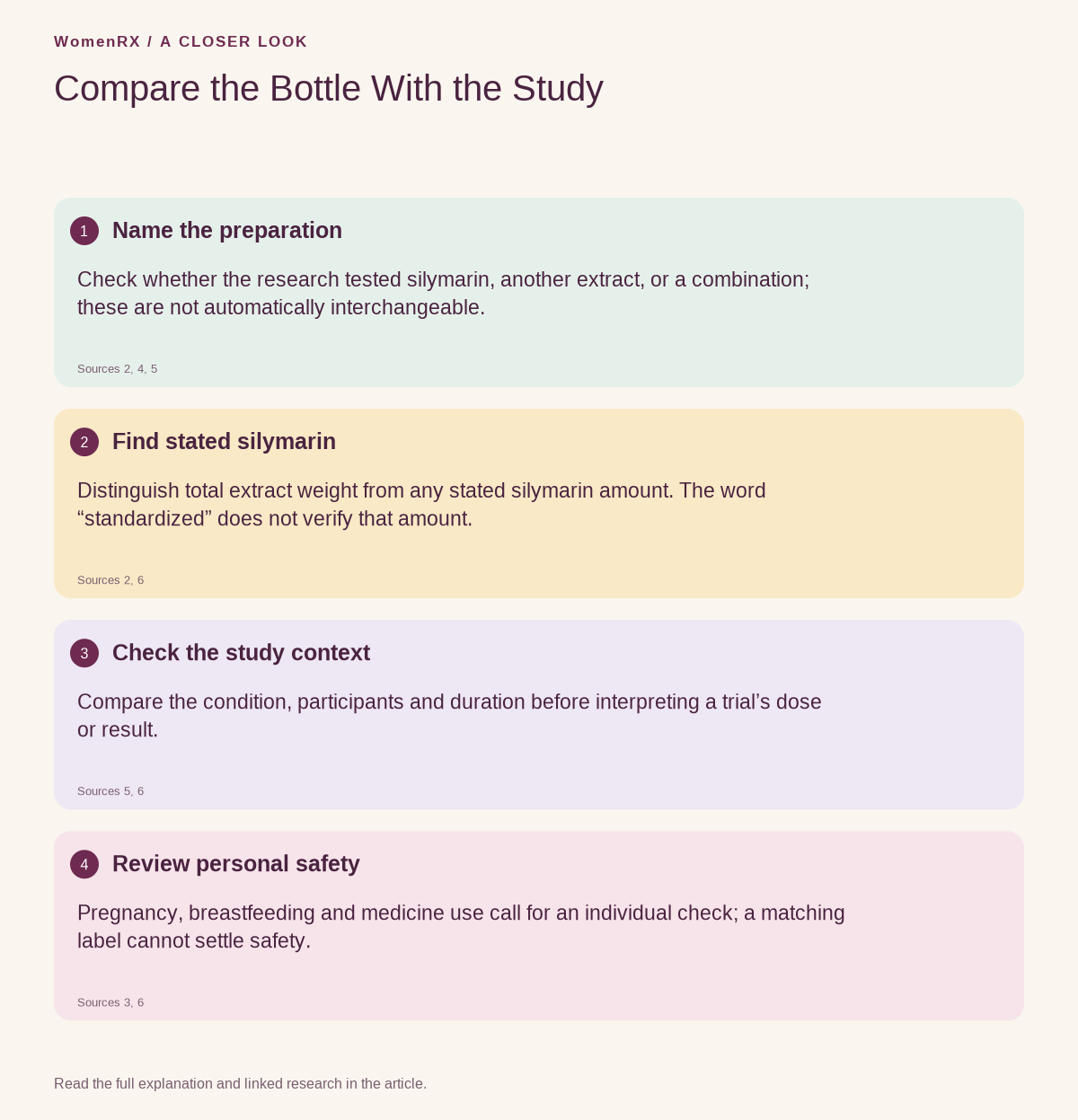
Compare the Bottle With the Study
Name the preparation: Check whether the research tested silymarin, another extract, or a combination; these are not automatically interchangeable.245
Find stated silymarin: Distinguish total extract weight from any stated silymarin amount. The word “standardized” does not verify that amount.26
Check the study context: Compare the condition, participants and duration before interpreting a trial’s dose or result.56
Review personal safety: Pregnancy, breastfeeding and medicine use call for an individual check; a matching label cannot settle safety.36
Read the figure as text
Four separate checks help you see what a product label can tell you, and what it cannot.- Name the preparation: Check whether the research tested silymarin, another extract, or a combination; these are not automatically interchangeable.245
- Find stated silymarin: Distinguish total extract weight from any stated silymarin amount. The word “standardized” does not verify that amount.26
- Check the study context: Compare the condition, participants and duration before interpreting a trial’s dose or result.56
- Review personal safety: Pregnancy, breastfeeding and medicine use call for an individual check; a matching label cannot settle safety.36
More questions, answered
Does “standardized” mean the product has been proven effective?
No. Look for a stated silymarin amount, but neither that amount nor a standardization claim verifies the bottle’s contents, establishes a match with a studied preparation or proves benefit for your health condition. 56
Sources you can check
- Herbal Medicines and Drugs Interactions: Cytochrome P450 Responsibility.Shanaida M, Oleshchuk O, Shevchuk O, Posokhova K, Ivankiv Y, Mocherniuk K, Klantsa M, Korda M. · Current medicinal chemistry · 2026Return to first citation
- Silymarin as an Antioxidant Therapy in Chronic Liver Diseases: A Comprehensive Review.Dhande D, Dhok A, Anjankar A, Nagpure S. · Cureus · 2024Return to first citation
- Herbal Interaction With Chemotherapeutic Drugs-A Focus on Clinically Significant Findings.Fasinu PS, Rapp GK. · Frontiers in oncology · 2019Return to first citation
- Herbal galactagogues to improve breastmilk production and lactation in mothers of preterm babies: a systematic review of clinical trials.Cragg A, Levene I, Darabi S, Willcox M. · European journal of clinical nutrition · 2026Return to first citation
- A randomized controlled trial to assess the safety and efficacy of silymarin on symptoms, signs and biomarkers of acute hepatitis.El-Kamary SS, Shardell MD, Abdel-Hamid M, Ismail S, El-Ateek M, Metwally M, Mikhail N, Hashem M, Mousa A, Aboul-Fotouh A, El-Kassas M, Esmat G, Strickland GT. · Phytomedicine : international journal of phytotherapy and phytopharmacology · 2009Return to first citation
- Milk Thistle: Usefulness and Safety | NCCIHAccessed 2026-09-25Return to first citation