Fibromyalgia: Sorting Facts From Unsettled Claims
Fibromyalgia is a real, symptom-based diagnosis, even though no single test confirms it and its exact causes remain unclear.
Fibromyalgia is diagnosed from a pattern of symptoms, especially widespread pain, rather than a definitive blood test or scan. Tests may help check for other conditions, which can also exist alongside fibromyalgia. Symptoms often fluctuate. The exact cause isn’t settled, and treatment can ease symptoms without guaranteeing they disappear. These facts don’t make pain less real. 1 3 4

The diagnosis is real, even without a confirming test
Myth: If there’s no positive test, fibromyalgia isn’t real.
Fact: There’s no specific blood test, scan, or other single test that confirms fibromyalgia. Diagnosis relies on the person’s symptoms and how they affect daily life. A clinician may use an examination or tests to look for other explanations, because several conditions can cause similar symptoms. That process doesn’t mean the pain is imagined or that a normal result disproves it. 1 6
Fibromyalgia also doesn’t have to be an all-or-nothing choice between one diagnosis and another. Someone can have fibromyalgia alongside another condition. Finding a second cause for some symptoms doesn’t automatically rule out the first diagnosis. 1
Myth: Every possible cause has to be ruled out first.
Fact: Looking for other conditions can be part of a careful assessment, but fibromyalgia is not established by finding nothing else. It is identified through a symptom pattern. The specific evaluation depends on what a person is experiencing; tests are meant to help answer relevant questions, not to prove that symptoms are real. 1 6
Symptoms can change without becoming less credible
Widespread pain is the main symptom, but it may be worse in some areas than others. Fatigue, stiffness, poor or unrefreshing sleep, trouble with memory or concentration, and headaches can also occur. People don’t all have the same combination, and symptoms may improve or flare. 3 4
Myth: Fibromyalgia looks the same in everyone, every day.
Fact: Symptoms vary between people and can shift over time. A better day doesn’t erase a difficult one, and having a different mix of symptoms from someone else doesn’t by itself settle the diagnosis. 3 4
Fibromyalgia is reported more often in women than men, but a population pattern isn’t a test for an individual. A UK Biobank study of 4,197 people who met fibromyalgia criteria found that 72.6% reported not having received a clinician’s diagnosis. Men were among the groups less likely to report a diagnosis. The finding raises questions about recognition, but it does not show that every missed diagnosis was caused by bias or establish how often this happens in the US. 3 5
A plausible explanation isn’t a settled cause
Myth: One trigger or one abnormality explains every case.
Fact: The exact cause remains uncertain. One proposed explanation is that the nervous system processes pain differently, making pain signals feel more intense. Genes and physical or emotional stressors may also contribute for some people. These are possible pieces of a complex picture, not a proven single cause that explains everyone’s fibromyalgia. Some people have no clear trigger. 2 6
That distinction matters: uncertainty about the mechanism is not evidence that symptoms aren’t happening. It means research hasn’t established one explanation that accounts for all the ways fibromyalgia can present. 2 6
Treatment can help, but it isn’t a cure or a diagnostic test
Myth: There’s nothing that can help unless symptoms disappear.
Fact: There is no cure described in the clinical overview, but treatment can ease some symptoms and make the condition easier to live with. Care may combine approaches, including exercise and medicine. Exercise is reported to have benefits, including helping reduce pain, but a treatment response doesn’t prove the diagnosis, and lack of a complete response doesn’t disprove it. 3
The useful question isn’t whether a treatment works for everyone. It’s whether the plan is helping with the symptoms and daily difficulties that matter to you, and whether it needs adjusting. Because symptoms and possible coexisting conditions differ, a single treatment claim shouldn’t be treated as a universal answer. 1 3
If you’re weighing information about fibromyalgia, separate three questions: what symptoms are established, what a proposed explanation can and can’t prove, and what a treatment has actually been shown to improve. That keeps uncertainty in its proper place without asking you to doubt your own experience.
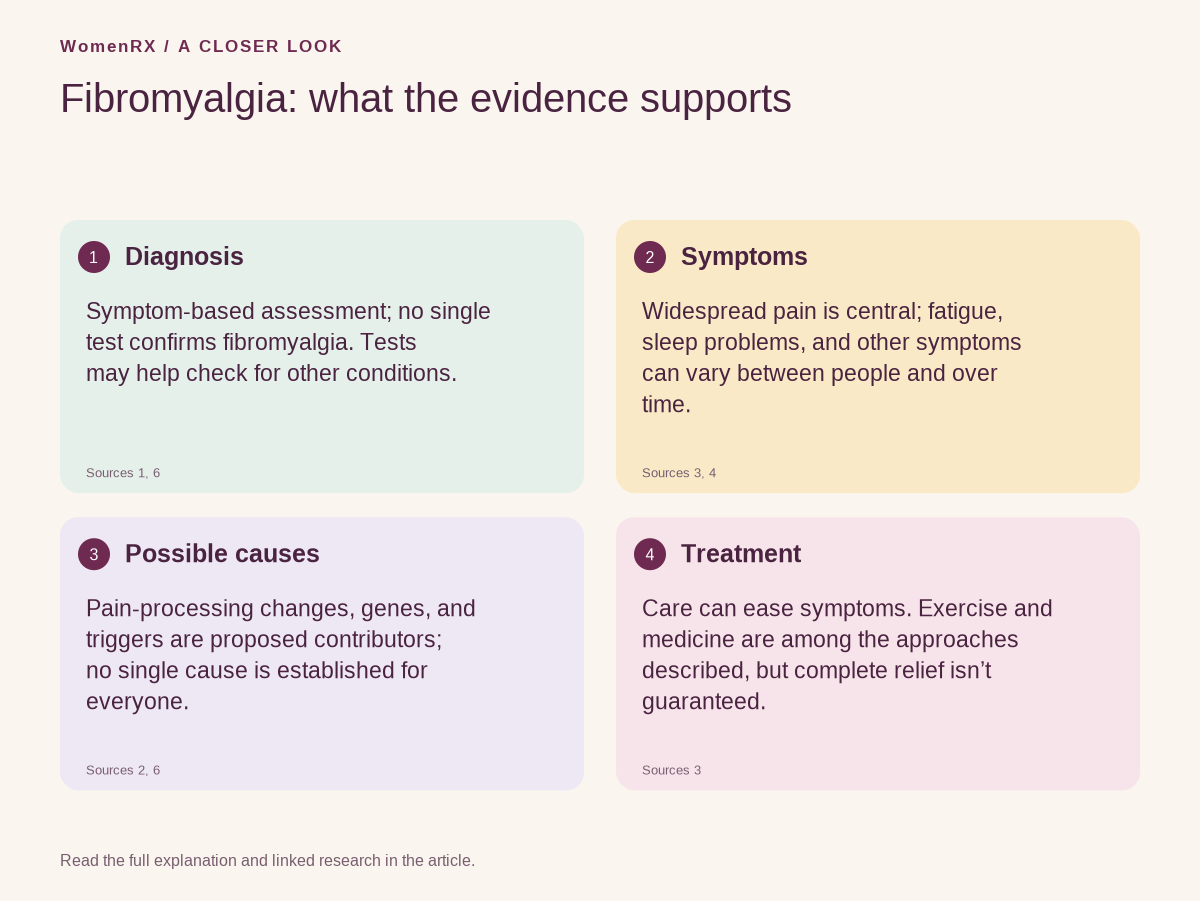
Fibromyalgia: what the evidence supports
Diagnosis: Symptom-based assessment; no single test confirms fibromyalgia. Tests may help check for other conditions.16
Symptoms: Widespread pain is central; fatigue, sleep problems, and other symptoms can vary between people and over time.34
Possible causes: Pain-processing changes, genes, and triggers are proposed contributors; no single cause is established for everyone.26
Treatment: Care can ease symptoms. Exercise and medicine are among the approaches described, but complete relief isn’t guaranteed.3
Read the figure as text
Separate established clinical features from explanations and treatment claims that remain less certain.- Diagnosis: Symptom-based assessment; no single test confirms fibromyalgia. Tests may help check for other conditions.16
- Symptoms: Widespread pain is central; fatigue, sleep problems, and other symptoms can vary between people and over time.34
- Possible causes: Pain-processing changes, genes, and triggers are proposed contributors; no single cause is established for everyone.26
- Treatment: Care can ease symptoms. Exercise and medicine are among the approaches described, but complete relief isn’t guaranteed.3
Sources you can check
- Fibromyalgia - Diagnosis - NHSAccessed 2026-09-25Return to first citation
- Fibromyalgia - Causes - NHSAccessed 2026-09-25Return to first citation
- Fibromyalgia - NHSAccessed 2026-09-25Return to first citation
- Fibromyalgia - Symptoms - NHSAccessed 2026-09-25Return to first citation
- Factors Associated With Fibromyalgia Diagnosis Among People Meeting Criteria: Results From UK Biobank.Kim SA, Macfarlane GJ, Beasley MJ. · Arthritis care & research · 2026Return to first citation
- Fibromyalgia: A Multifactorial Pain Disorder.Aoe T. · International journal of molecular sciences · 2026Return to first citation