Fibromyalgia Signs and Conditions That Can Overlap
Widespread pain paired with unrefreshing sleep or fatigue can point toward fibromyalgia, but no single symptom confirms it.
Fibromyalgia often involves pain across the body along with fatigue, sleep that doesn’t leave you refreshed, stiffness, or trouble concentrating. Symptoms can fluctuate, and pain or fatigue alone isn’t enough to identify the cause. There’s no specific test for fibromyalgia; an assessment looks at the overall pattern and considers other explanations without assuming every test must be normal. 2 3 5
Look at the combination, not one symptom
The clearest clue is pain that affects many parts of the body, sometimes with certain areas worse than others. It may be persistent but change in intensity. Some people also notice unusual sensitivity: light touch or a minor bump can hurt more than expected. Stiffness, especially after staying in one position, can be part of the picture. 3
Fatigue, waking unrefreshed despite time in bed, and difficulty concentrating or remembering things may occur alongside the pain. Symptoms vary between people and can flare or ease. Taken together, these features may suggest fibromyalgia; none of them alone establishes the diagnosis. 2 3
What else may explain part of the picture?
Fatigue has many possible causes, including too little sleep, anemia, thyroid disease, sleep apnea, depression, anxiety, and other medical conditions. That doesn’t mean any one of them is the explanation for widespread pain, or that having one rules out fibromyalgia. It does mean persistent tiredness deserves a broader look rather than being automatically attributed to pain. 1
Some conditions can overlap with fibromyalgia. A person may have fibromyalgia alongside another chronic pain condition or an autoimmune disorder. Fatigue, sleep disruption, and cognitive symptoms can also resemble features of ME/CFS or occur after viral illness; some people may meet criteria for both fibromyalgia and ME/CFS. Similar symptoms are a reason to consider the whole history, not proof that the conditions are interchangeable. 4 5
How an assessment can help
There is no single specific test for fibromyalgia, and its symptoms can resemble those of other conditions. Diagnosis is based on the symptom pattern rather than a lab result or scan that confirms it. A clinician can ask how widespread and persistent the pain is, what is happening with sleep and energy, and how symptoms affect daily activities. Depending on your symptoms and history, an exam or tests may help look for other contributors. The goal isn’t to prove that every test is normal; fibromyalgia can also coexist with other conditions. 1 2 4 5
A short note before a visit can make the pattern easier to describe: mark where pain occurs, note whether sleep feels refreshing, and write down how fatigue or concentration problems affect ordinary activities. This is a conversation aid, not a diagnostic score. If fatigue has continued for several weeks, MedlinePlus advises contacting a health care provider to help find its cause. 1
Fibromyalgia is reported more often in women than men, but it can affect anyone. That difference in who is affected doesn’t make the symptoms uniquely female. The useful question is whether the combination of widespread pain and related symptoms fits your experience and merits assessment. 2
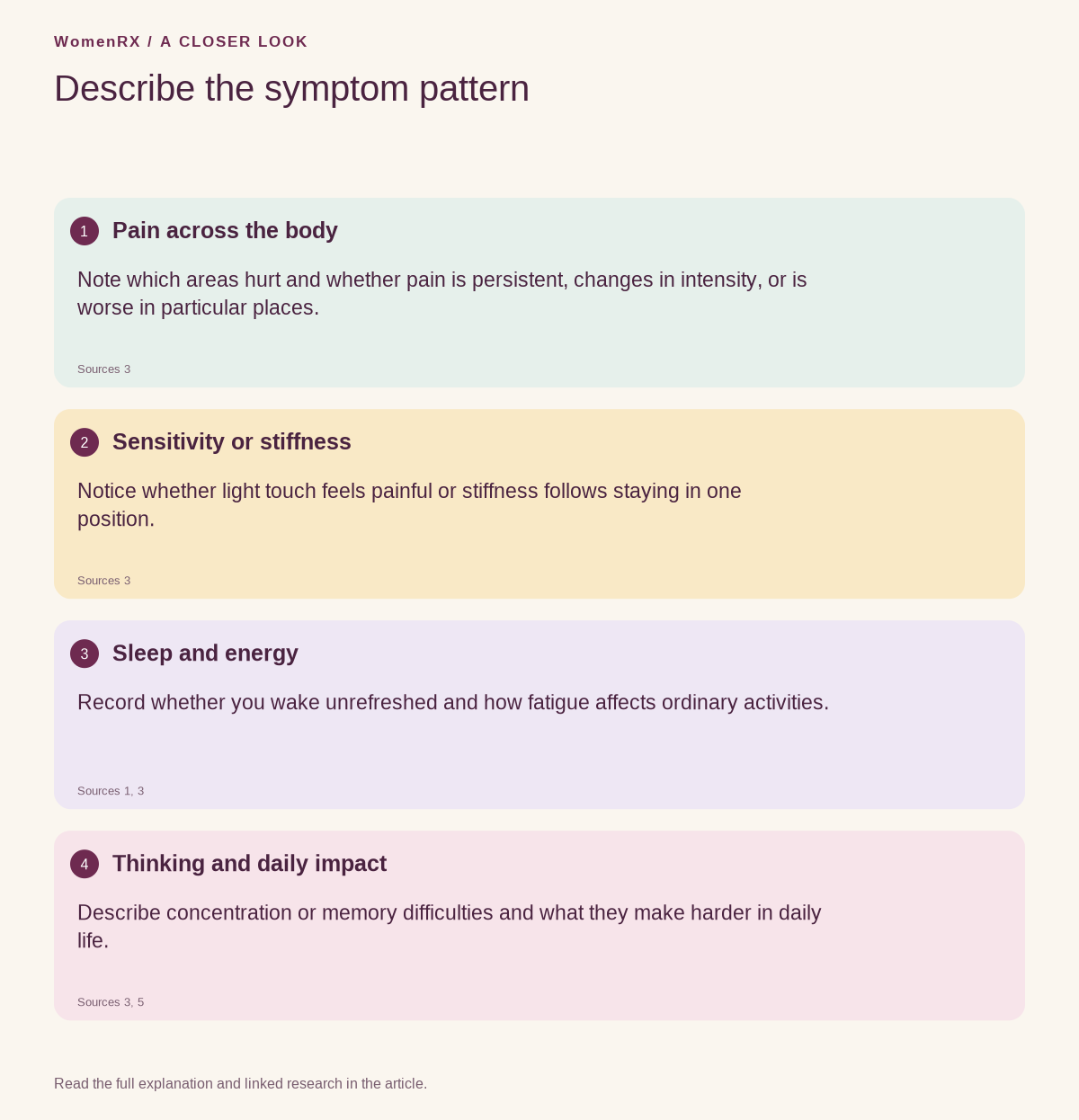
Describe the symptom pattern
Pain across the body: Note which areas hurt and whether pain is persistent, changes in intensity, or is worse in particular places.3
Sensitivity or stiffness: Notice whether light touch feels painful or stiffness follows staying in one position.3
Sleep and energy: Record whether you wake unrefreshed and how fatigue affects ordinary activities.13
Thinking and daily impact: Describe concentration or memory difficulties and what they make harder in daily life.35
Read the figure as text
Use these prompts to organize what you’ve noticed. They can support a conversation, but they do not diagnose fibromyalgia.- Pain across the body: Note which areas hurt and whether pain is persistent, changes in intensity, or is worse in particular places.3
- Sensitivity or stiffness: Notice whether light touch feels painful or stiffness follows staying in one position.3
- Sleep and energy: Record whether you wake unrefreshed and how fatigue affects ordinary activities.13
- Thinking and daily impact: Describe concentration or memory difficulties and what they make harder in daily life.35
More questions, answered
Can fatigue by itself mean I have fibromyalgia?
No. Fatigue has many possible causes, including sleep problems, anemia, thyroid disease, and depression. Fibromyalgia is more suggestive when fatigue occurs with widespread pain and other symptoms, but an assessment is needed to consider the whole picture. 1 3
Does a normal test result rule fibromyalgia in or out?
No single specific test confirms fibromyalgia. Tests may help assess other possible causes, and fibromyalgia can coexist with other conditions, so normal results aren’t a requirement for the diagnosis. 2 5
Sources you can check
- Fatigue: MedlinePlusAccessed 2026-09-25Return to first citation
- Fibromyalgia - NHSAccessed 2026-09-25Return to first citation
- Fibromyalgia - Symptoms - NHSAccessed 2026-09-25Return to first citation
- Fibromyalgia: A Multifactorial Pain Disorder.Aoe T. · International journal of molecular sciences · 2026Return to first citation
- Fibromyalgia.Williams DA, Clauw DJ. · The New England journal of medicine · 2026Return to first citation