Fibromyalgia Supplements: How to Weigh the Evidence
No single supplement stands out as the best choice, so start with the symptom you most want to change and check the evidence and safety for that exact product.
A review of randomized trials found an overall pain benefit from dietary supplements in adults with fibromyalgia, but the estimate was highly uncertain, quality of life did not improve significantly, and the results don’t identify a best ingredient. 4 Before trying one, match it to a specific symptom, check the exact product with a pharmacist against your medicines, and discuss it first if you’re pregnant or breastfeeding.
Start with the symptom, not the supplement
Fibromyalgia can involve widespread pain, fatigue, poor sleep, and other symptoms, and the mix can vary from person to person. 2 So “Does this help fibromyalgia?” is a broad question. A more useful one is: “Is there good evidence that this exact ingredient helps the symptom I most want to improve?”
A 2022 systematic review and meta-analysis of randomized trials in adults with fibromyalgia found an overall reduction in pain with supplements. But the estimate had a very wide confidence interval, the analysis did not find a significant improvement in quality of life, and it cannot tell you which specific supplement, if any, is a good fit. 4 That’s a reason to be cautious about a product advertised as the fibromyalgia supplement, not proof that no supplement could help anyone.
The pooled pain finding does not establish whether supplements improve sleep or fatigue. 4 Reviews describe research on several supplements, including vitamin D, magnesium, iron, and probiotics, as promising in places but still controversial; the evidence is not strong enough to recommend one as a general fibromyalgia treatment. 5
Decide what a worthwhile result would look like
Before considering a product, name one outcome you care about. For example, you might want to see whether pain makes it easier to do a usual daily activity, or whether you wake feeling more rested. This makes it less likely that a vague change in a fluctuating condition will be mistaken for a supplement effect. Fibromyalgia symptoms can vary over time, and sleep and fatigue are symptoms in their own right, not just alternate ways of describing pain. 2
Look for research on the exact ingredient and the outcome you care about. A study measuring pain does not establish a benefit for sleep or fatigue. And a pooled result across trials of supplements does not establish that every ingredient works, or that a product on a store shelf matches what was studied. The pooled pain finding and nutritional review do not establish a best ingredient or benefits for sleep or fatigue. 45
You can also ask what would count as enough benefit to continue and how you’ll judge that. Agreeing on a simple, realistic measure with your care team can help you weigh a possible change against cost, inconvenience, or unwanted effects without adding several new products at once.
Check the exact product against your medicines
Bring the product label, or a clear photo of it, to a pharmacist or the clinician who manages your medicines. Ask them to check the exact ingredients and amounts against your full list, including prescriptions, over-the-counter medicines, and other supplements. If a label uses a blend or unfamiliar ingredient name, ask for help identifying what it contains rather than assuming it is harmless. This matters because reported adverse effects in supplement trials varied, and the review does not establish that every product is safe for every person. 4
Don’t stop or change a prescribed medicine to make room for a supplement without discussing it. Fibromyalgia care may combine different approaches, and no single treatment works for every symptom or person. 3 Reported adverse events do not tell you whether a particular supplement interacts with your medicines, so a product-specific check is more useful than relying on a general interaction list.
If you’re pregnant, trying to conceive, or breastfeeding, mention that before starting a supplement. The reported trial findings do not establish whether particular fibromyalgia supplements are safe during those periods. That uncertainty is a reason to get an individualized product check, not to assume every supplement has the same risk.
Keep the supplement in perspective
Fibromyalgia is reported more often in women than men. 1 That does not show that a supplement works differently in women: the pooled findings in adults with fibromyalgia do not establish whether supplement effects differ by sex. 4
Supplements are only one possible part of symptom management. Guidance also describes exercise and talking therapies as approaches used for fibromyalgia, and medicines such as duloxetine may be considered for some people with long-term pain. 3 Those options address different needs, so the practical comparison is not simply “supplement or nothing.” It’s whether the likely benefit for your chosen symptom is worth the product’s uncertainties, costs, and possible downsides alongside the care you already use.
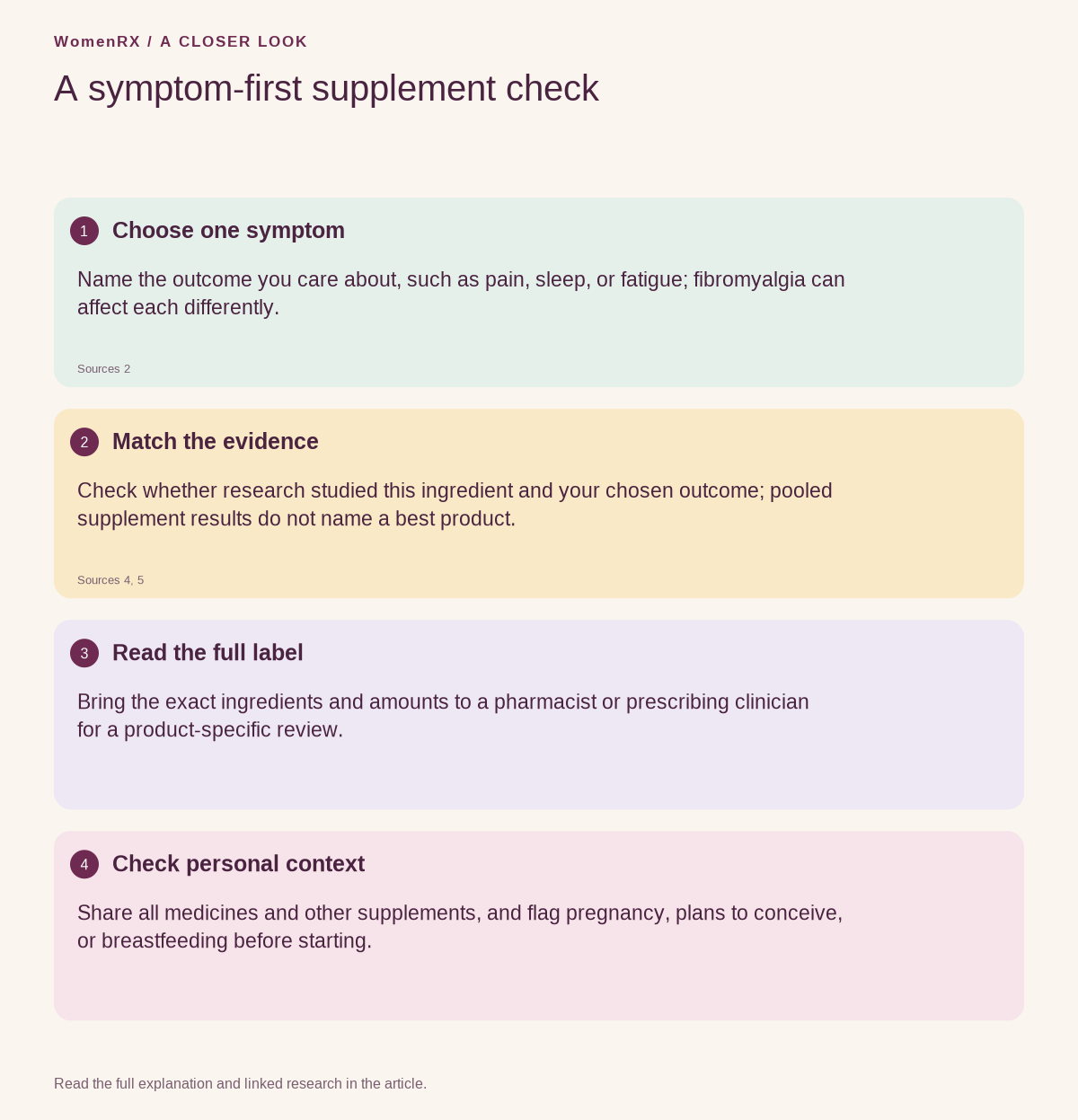
A symptom-first supplement check
Choose one symptom: Name the outcome you care about, such as pain, sleep, or fatigue; fibromyalgia can affect each differently.2
Match the evidence: Check whether research studied this ingredient and your chosen outcome; pooled supplement results do not name a best product.45
Read the full label: Bring the exact ingredients and amounts to a pharmacist or prescribing clinician for a product-specific review.
Check personal context: Share all medicines and other supplements, and flag pregnancy, plans to conceive, or breastfeeding before starting.
Read the figure as text
Use these steps to move from a broad product claim to a more useful, safety-aware question.- Choose one symptom: Name the outcome you care about, such as pain, sleep, or fatigue; fibromyalgia can affect each differently.2
- Match the evidence: Check whether research studied this ingredient and your chosen outcome; pooled supplement results do not name a best product.45
- Read the full label: Bring the exact ingredients and amounts to a pharmacist or prescribing clinician for a product-specific review.
- Check personal context: Share all medicines and other supplements, and flag pregnancy, plans to conceive, or breastfeeding before starting.
More questions, answered
Does research show that magnesium is the best supplement for fibromyalgia?
No. Reviews describe magnesium research as promising but controversial, and they do not establish it as the best option or a reliable treatment for fibromyalgia symptoms. 5
Can I check supplement interactions online?
An online interaction checker may help you prepare questions, but take the exact product label and your complete medicine list to a pharmacist or your prescribing clinician for a product-specific review. Reported adverse events do not tell you whether a particular supplement interacts with your medicines.
Sources you can check
- Fibromyalgia - NHSAccessed 2026-09-25Return to first citation
- Fibromyalgia - Symptoms - NHSAccessed 2026-09-25Return to first citation
- Fibromyalgia - Treatment - NHSAccessed 2026-09-25Return to first citation
- Dietary Supplements for Pain Relief in Patients with Fibromyalgia: A Systematic Review and Meta-Analysis of Randomized Controlled Trials.Lim KT, Lim KH, Zhou X, Yang J, Shin KM, Mohabbat AB, Baude WW, Nanda S, Bauer D, Theberath M, Theberath N, Bauer BA, Ganesh R. · The American journal of Chinese medicine · 2022Return to first citation
- Nutritional Interventions in the Management of Fibromyalgia Syndrome.Pagliai G, Giangrandi I, Dinu M, Sofi F, Colombini B. · Nutrients · 2020Return to first citation