Fibromyalgia and Weight: What the Research Shows
Some studies link higher BMI with greater fibromyalgia impact, but they can’t show that weight causes symptoms or that changing weight will relieve them.
Research is limited on whether weight causes fibromyalgia symptoms or determines their severity. Studies have found associations between higher BMI and greater fibromyalgia impact, but they don’t establish cause or show that changing weight would relieve symptoms. BMI also can’t tell you what your body is made of. It’s more useful to ask how pain, fatigue, sleep, and everyday function are affecting you than to treat the scale as an explanation. 2 4 6
What a link between BMI and symptoms can tell you
A few studies report that people with higher body mass index (BMI) also report greater fibromyalgia impact. In one study of 169 patients with fibromyalgia, a higher BMI was associated with greater impact on a questionnaire; the mean age of the full study sample was 49.3, and researchers recorded menopausal status. The finding describes a relationship in that sample. It doesn’t show which came first, or whether changing weight would change symptoms. 4
A separate study of 311 adults with fibromyalgia found a positive association between BMI and scores on a Greek version of the Revised Fibromyalgia Impact Questionnaire. That study’s main purpose was to validate the questionnaire, rather than test whether weight causes symptoms. 6
These questionnaires measure more than pain alone. A score reflecting overall impact shouldn’t be read as proof that weight explains a particular person’s pain, fatigue, or difficulty with daily activities.
Why the direction of the relationship is unclear
Fibromyalgia’s exact cause isn’t known. One proposed explanation involves changes in how the nervous system processes pain, and symptoms can vary over time. 1 3 A relationship between BMI and symptom scores could have more than one explanation: weight might affect some aspects of health, symptoms might influence what activity feels manageable, or other factors could relate to both. Those are possibilities to consider, not causes established by the studies above.
The distinction matters because BMI is a rough measure based on height and weight. It doesn’t separate fat, muscle, bone, or water, and it can misrepresent body composition in some people. 2 A single number can’t describe pain sensitivity, stamina, sleep, or what you can do day to day.
Life stage may also matter to the way symptoms are experienced. The study of 169 patients recorded menopausal status, but its reported BMI findings don’t show whether the association differs by life stage or establish that menopause causes the link. 4
Separate pain, function, and activity
When you’re trying to understand what’s changing, it helps to name the outcome rather than bundle everything together as “severity.” Is the concern pain at rest, pain during errands or household tasks, fatigue, sleep, or a change in what you can do? Fibromyalgia can involve widespread pain, tiredness, poor sleep, and stiffness, and symptoms can fluctuate. 3
One study of 124 women with fibromyalgia examined pain during daily activities. After accounting for resting pain and other factors, pain hypervigilance was associated with activity-related pain; the study also included BMI in its adjusted model. It was observational, so it cannot establish cause, and its finding about hypervigilance does not prove BMI has no role. It does illustrate why pain during activity is a distinct question from pain at rest. 5
For example, if walking feels harder, the useful question is what makes it harder: pain during movement, fatigue, stiffness after staying in one position, or something else? That answer points to a more specific conversation about function than assuming weight is the explanation.
What to take from the evidence
These studies support a cautious conclusion: higher BMI and fibromyalgia impact have been associated in some patient and adult samples, but association is not proof that body weight causes fibromyalgia or determines an individual’s symptoms. The findings also don’t establish weight loss as a fibromyalgia treatment. 4 6
If weight is part of your concern, you can separate two questions: “What health factors matter for me overall?” and “What is affecting my pain and function?” BMI may be one piece of a broader health picture, but it doesn’t answer the second question on its own. 2 For fibromyalgia, describing which symptoms interfere with which activities gives a clearer starting point than treating the scale as a verdict.
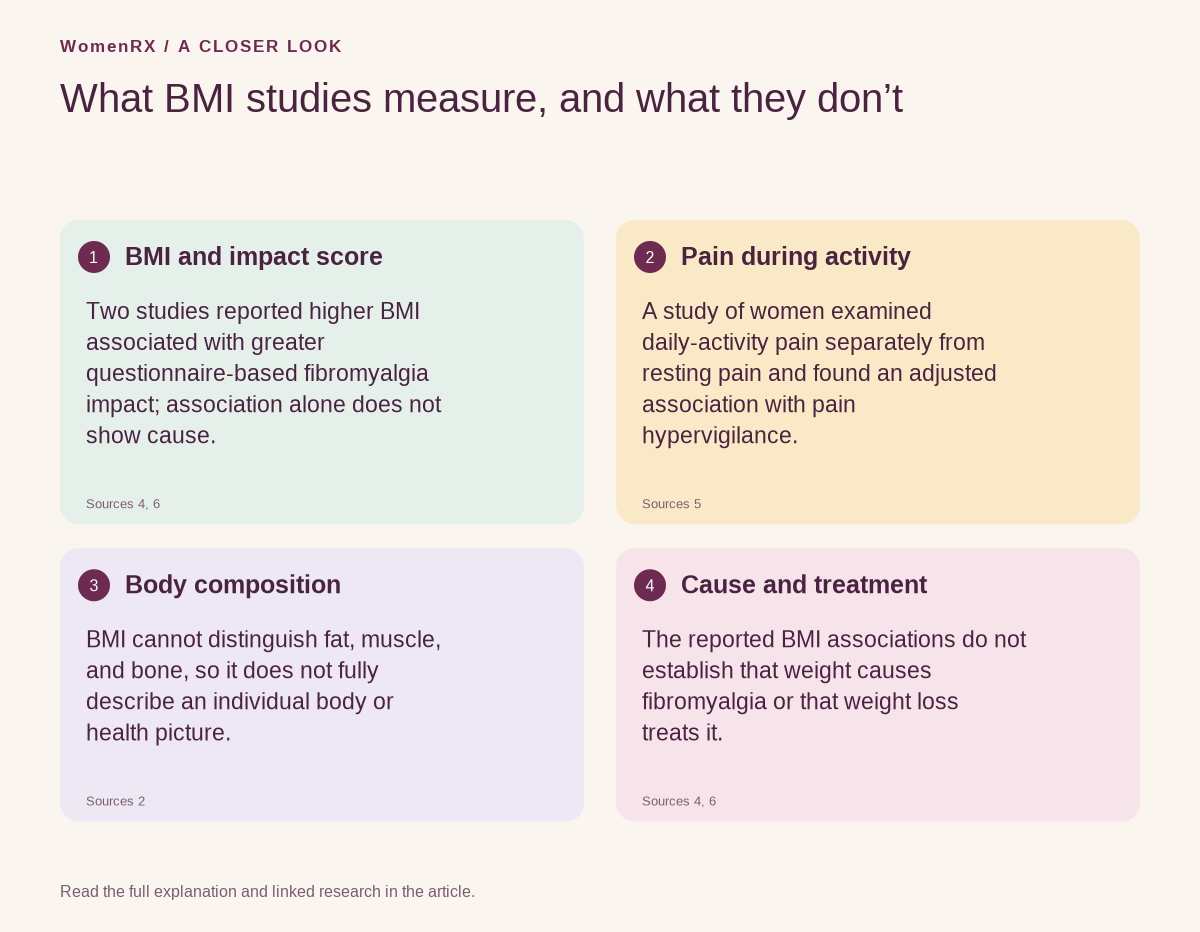
What BMI studies measure, and what they don’t
BMI and impact score: Two studies reported higher BMI associated with greater questionnaire-based fibromyalgia impact; association alone does not show cause.46
Pain during activity: A study of women examined daily-activity pain separately from resting pain and found an adjusted association with pain hypervigilance.5
Body composition: BMI cannot distinguish fat, muscle, and bone, so it does not fully describe an individual body or health picture.2
Cause and treatment: The reported BMI associations do not establish that weight causes fibromyalgia or that weight loss treats it.46
Read the figure as text
Separate the observed BMI associations from pain, function, and causal conclusions.- BMI and impact score: Two studies reported higher BMI associated with greater questionnaire-based fibromyalgia impact; association alone does not show cause.46
- Pain during activity: A study of women examined daily-activity pain separately from resting pain and found an adjusted association with pain hypervigilance.5
- Body composition: BMI cannot distinguish fat, muscle, and bone, so it does not fully describe an individual body or health picture.2
- Cause and treatment: The reported BMI associations do not establish that weight causes fibromyalgia or that weight loss treats it.46
More questions, answered
Does a higher BMI mean my fibromyalgia will be worse?
Not necessarily. Some studies found higher BMI associated with greater overall fibromyalgia impact, but they don’t show that BMI caused an individual’s symptoms or predict how one person will feel. BMI also doesn’t measure body composition or function. 2 4 6
Does this research show that losing weight treats fibromyalgia?
No. These studies report associations between BMI and symptom-impact scores; they don’t test whether weight loss improves fibromyalgia. These findings alone can’t establish weight loss as a treatment. 4 6
Sources you can check
- Fibromyalgia - Causes - NHSAccessed 2026-09-25Return to first citation
- Body Weight: MedlinePlusAccessed 2026-09-25Return to first citation
- Fibromyalgia - Symptoms - NHSAccessed 2026-09-25Return to first citation
- Fibromyalgia and menopause: Friends with benefits?Gkouvi A, Kontouli KM, Pardali EC, Patrikiou E, Lambrinoudaki I, Goulis DG, Bogdanos DP, Grammatikopoulou MG. · Maturitas · 2026Return to first citation
- Pain hypervigilance is associated with daily-activity pain beyond resting pain in women with fibromyalgia: a cross-sectional observational study.Fernández-Palacios FG, Pacho-Hernández JC. · Clinical rheumatology · 2026Return to first citation
- Translation and Validation of the Greek Version of the Revised Fibromyalgia Impact Questionnaire (FIQR).Gkouvi A, Pardali EC, Kontouli KM, Patrikiou E, Bogdanos DP, Goulis DG, Grammatikopoulou MG. · Mediterranean journal of rheumatology · 2026Return to first citation