Can Fibromyalgia Be Reversed? What Improvement Can Mean
There’s no established cure, but symptoms can shift, and a tailored mix of non-drug strategies may help you feel and function better.
Fibromyalgia doesn’t currently have a cure, so “reversed” isn’t a promise anyone can make. But symptoms can improve or worsen over time, and treatment can aim for meaningful changes in pain, sleep, energy, and daily function. Regular movement, sleep support, and approaches such as CBT or ACT may help; no single strategy works for everyone. 1 2 3

What “reversed” can mean
Fibromyalgia is a long-term condition involving widespread pain and often fatigue, poor sleep, stiffness, or trouble concentrating. Researchers think changes in how the brain and nervous system process pain may be involved, but the exact cause isn’t known. 1 6
There isn’t an established cure, and symptoms may not disappear completely. Still, they can vary, with periods of feeling better or worse. Improvement can mean less pain, more restorative sleep, or being able to do more of what matters to you, even if some symptoms remain. 1 2 3
“Natural” can mean choosing non-drug approaches. You can use them alongside medication if that combination fits your symptoms and preferences. Guidance supports a tailored mix of approaches, not a guaranteed cure. 3 4
Choose an approach by what’s getting in your way
Movement may be worth exploring when pain and function are the main concerns. Exercise is recommended as part of fibromyalgia care, and regular activity can help reduce pain and improve quality of life. The useful question isn’t whether you’re doing the “right” workout; it’s what kind of activity fits your health, abilities, preferences, and life well enough to continue. If pain or fatigue makes activity hard, those constraints belong in the plan rather than being treated as a lack of effort. 3 As a practical starting point, pick an activity you enjoy and an amount that fits a lower-energy day. Notice whether you can still manage a routine task afterward, and use that observation to adjust your plan.
Sleep support fits when you wake unrefreshed or have trouble falling or staying asleep. Fibromyalgia can interfere with restorative sleep, and a clinical review identifies sleep hygiene as part of non-drug management. Sleep hygiene means considering habits and routines around sleep, not a cure for pain or proof that poor sleep is your fault. 2 5 You might choose one sleep concern to focus on, such as trouble staying asleep or waking unrefreshed, and notice whether it changes.
Psychological support can help with the burden of persistent symptoms. CBT can help people manage long-term pain, while ACT focuses on making room for what can’t be controlled and committing to changes that support life. These approaches don’t imply that pain is imaginary. They address how pain and distress affect daily life, and may be more or less useful depending on your needs. 3
A combination may fit better than a single “natural” fix. Fibromyalgia symptoms often overlap, and no one treatment addresses them all. 3 As a practical way to notice whether a strategy is helping, you might choose a concrete personal goal first: for example, getting through a routine task with less disruption, sleeping more soundly, or taking part in an activity you value. These are examples for noticing change, not a validated test or a promise of improvement.
Women, men, and the evidence
Fibromyalgia is diagnosed more often in women, but that doesn’t show that non-drug strategies work only for women. A review of treatment and sex differences reported that treatment benefits appeared largely independent of sex. It’s an older review, so it can’t settle every question about how treatment works across sexes or life stages. 7
Fatigue, pain, and competing responsibilities can make a plan difficult to sustain. For example, if caregiving demands at a particular life stage leave less time for activity, the plan can be adjusted to fit. That’s a reason to tailor the approach to your actual capacity and priorities, not a reason to conclude that you’ve failed. Exercise is described in guidance as something to choose with personal preference, lifestyle, health needs, and physical ability in mind. 3
Make “better” specific
Rather than asking only whether fibromyalgia is gone, ask what has changed: Is pain less disruptive? Is sleep more refreshing? Can you do more, or recover more comfortably afterward? A strategy that improves one area while another remains difficult may still be useful. If a plan isn’t fitting your symptoms or daily life, it can be adjusted; finding a workable combination may take trying different approaches. 3
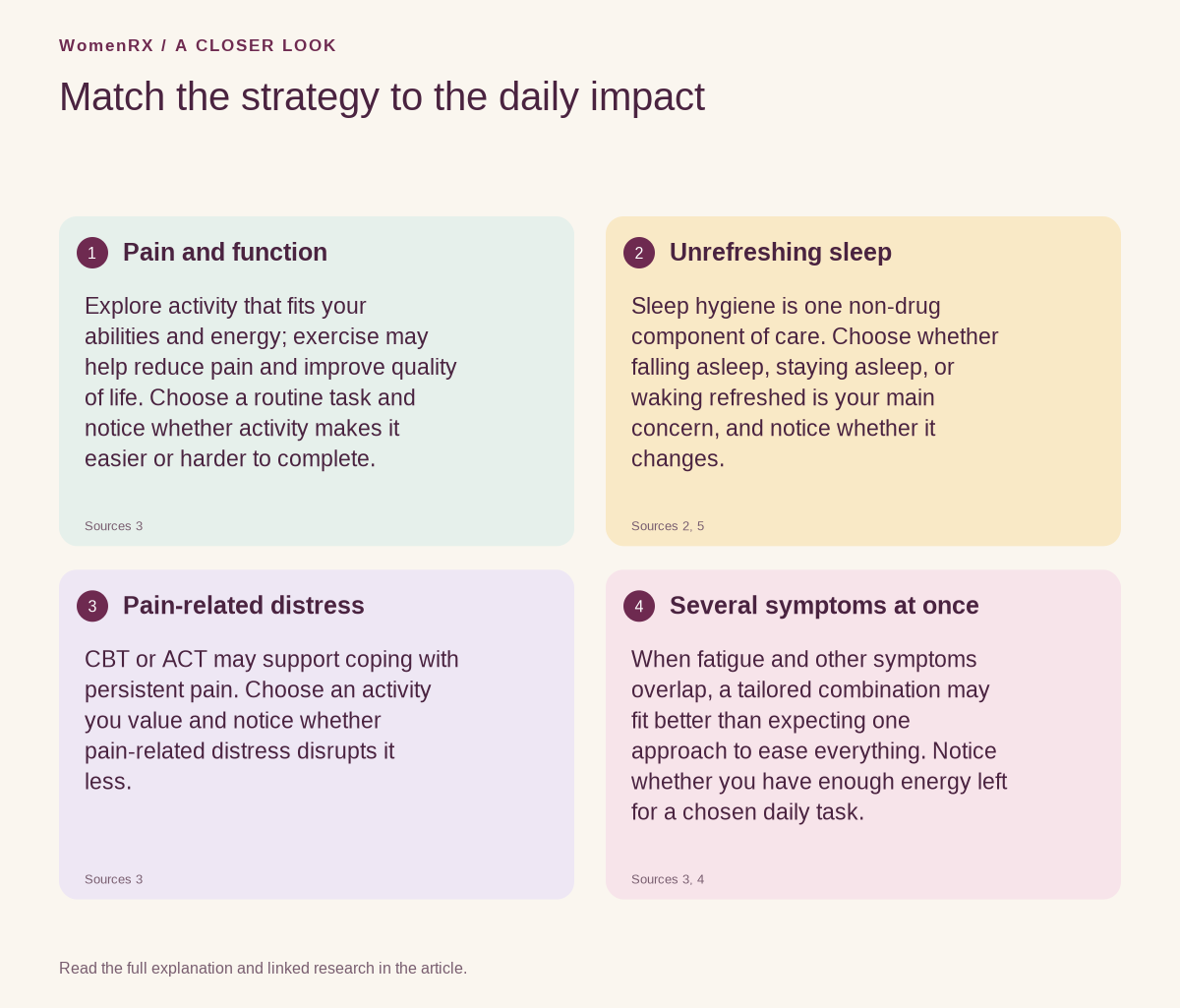
Match the strategy to the daily impact
Pain and function: Explore activity that fits your abilities and energy; exercise may help reduce pain and improve quality of life. Choose a routine task and notice whether activity makes it easier or harder to complete.3
Unrefreshing sleep: Sleep hygiene is one non-drug component of care. Choose whether falling asleep, staying asleep, or waking refreshed is your main concern, and notice whether it changes.25
Pain-related distress: CBT or ACT may support coping with persistent pain. Choose an activity you value and notice whether pain-related distress disrupts it less.3
Several symptoms at once: When fatigue and other symptoms overlap, a tailored combination may fit better than expecting one approach to ease everything. Notice whether you have enough energy left for a chosen daily task.34
Read the figure as text
Different approaches may support different parts of life with fibromyalgia. This comparison is a way to think through goals, not a ranking or a promise that a strategy will work for you.- Pain and function: Explore activity that fits your abilities and energy; exercise may help reduce pain and improve quality of life. Choose a routine task and notice whether activity makes it easier or harder to complete.3
- Unrefreshing sleep: Sleep hygiene is one non-drug component of care. Choose whether falling asleep, staying asleep, or waking refreshed is your main concern, and notice whether it changes.25
- Pain-related distress: CBT or ACT may support coping with persistent pain. Choose an activity you value and notice whether pain-related distress disrupts it less.3
- Several symptoms at once: When fatigue and other symptoms overlap, a tailored combination may fit better than expecting one approach to ease everything. Notice whether you have enough energy left for a chosen daily task.34
More questions, answered
Does trying non-drug care mean I should avoid medication?
No. Non-drug strategies can be part of care alongside medication; the treatment mix depends on your symptoms and preferences. The evidence doesn’t say that everyone should use medication or that everyone should avoid it. 3 4
Is exercise always the best choice?
Exercise is a recommended part of fibromyalgia care, but the type should fit your abilities, health needs, preferences, and lifestyle. It’s not a one-size-fits-all prescription, and other approaches may matter more for the symptoms that trouble you most. 3
Sources you can check
- Fibromyalgia - NHSAccessed 2026-09-25Return to first citation
- Fibromyalgia - Symptoms - NHSAccessed 2026-09-25Return to first citation
- Fibromyalgia - Treatment - NHSAccessed 2026-09-25Return to first citation
- Fibromyalgia Syndrome: Current Considerations in Symptom Management.Menzies V. · The American journal of nursing · 2016Return to first citation
- Fibromyalgia in Primary Care.Higgs JB. · Primary care · 2018Return to first citation
- Fibromyalgia: the prototypical central sensitivity syndrome.Boomershine CS. · Current rheumatology reviews · 2015Return to first citation
- Fibromyalgia: diagnosis and treatment options.Marcus DA. · Gender medicine · 2009Return to first citation