Can Endometriosis Be Cured or Managed Without Medication?
Lifestyle changes may support pain relief, but current evidence does not show that they remove endometriosis or cure it.
There’s no established cure for endometriosis, and feeling better doesn’t mean the lesions have gone away. A small randomized trial found that diet and exercise coaching helped some pain symptoms when added to hormonal treatment, but it didn’t test a drug-free replacement or prove disease reversal. Non-drug approaches may be part of a pain plan; treatment choices also depend on side effects and whether pregnancy is a current goal. 2 4
Cure, symptom relief, and disease are different things
Endometriosis is tissue similar to the lining of the uterus growing elsewhere in the body. It can cause pain and difficulty getting pregnant, though symptoms vary. There’s currently no treatment known to cure it. Treatment can help manage symptoms, and surgery can remove areas of endometriosis, but symptoms may return after surgery. 2
That distinction matters if pain improves with a food change, exercise, or another non-drug approach. Less pain is worthwhile, but it doesn’t show that lesions have disappeared. The lifestyle studies described here measured symptoms or quality of life, not whether endometriosis was removed or reversed. 3 4
What non-drug approaches may offer
A randomized trial tested structured coaching on a Mediterranean-style diet and aerobic exercise alongside hormonal treatment, not instead of it. In 140 adults aged 18-45 with symptomatic endometriosis despite hormonal treatment, the coaching group had greater average improvement over 12 months in non-menstrual pelvic pain and pain with bowel movements than the group receiving no additional lifestyle advice. Anxiety also improved; depression and quality-of-life scores did not change significantly. This supports a possible add-on for symptom management, not a stand-alone cure. 4
Diet evidence is less decisive. In a cross-sectional study of 254 women with endometriosis, greater adherence to a Mediterranean diet was associated with lower odds of pelvic pain, but the study could not establish that the diet caused the difference. The association with fatigue weakened after adjustment, and diet adherence wasn’t independently associated with endometriosis-specific quality-of-life domains. 3
Other pain supports, such as physical therapy, relaxation practices, meditation, or acupuncture, may help some people manage pain generally. But general pain guidance isn’t proof that a specific approach treats endometriosis itself. Research on non-drug treatments for chronic pelvic pain has been limited, and often does not clearly separate endometriosis from other causes of pelvic pain. 1 6
A practical way to use these approaches is to choose one that fits your life and the symptom you most want to ease, while keeping any prescribed treatment in place unless you and your prescriber decide to change it. For example, you might try a manageable movement routine for function or a diet adjustment that feels sustainable, then assess whether it helps your symptoms. That is symptom support, not a test of whether the disease is gone.
How to weigh non-drug and medical options
Medical care may include medication, surgery, or both. The right balance depends on pain, side effects, the effects on everyday life, and personal goals. A real-world patient-reported study of dienogest found that some participants reported symptom and quality-of-life improvements, while adverse effects were common and some stopped treatment. That study was observational, so it can illustrate a tradeoff but can’t predict what one person will experience. 7
If side effects are making treatment hard to continue, that’s a reason to revisit the plan, not a reason you have to choose between enduring them and going without support. Non-drug pain strategies may complement medical treatment, though endometriosis-specific evidence for many individual approaches remains limited. 1 6
If you’re planning pregnancy, say so early in the conversation about treatment. Decisions about surgery for fertility are complex: factors can include age, ovarian reserve, other fertility factors, and the type of endometriosis. For superficial endometriosis, the review says current guidelines recommend against routine surgery before assisted reproductive treatment. Decisions about deep endometriosis are more individualized and depend on factors such as fertility goals, ovarian reserve, age, and other infertility factors. 5
Your priorities may change over time. Endometriosis is commonly diagnosed from puberty through menopause, and symptoms usually stop after menopause, although they can persist. A plan that suits you now may need to change if pain, side effects, or fertility goals change. 2
A useful comparison for your next decision
Think about each option by the job you want it to do. Is the goal to reduce pain, address lesions, or support a pregnancy goal? Does the evidence show an effect on that outcome, or only suggest an association? That keeps symptom relief from being mistaken for reversal, and helps you compare options without treating “natural” and “medical” as competing camps.
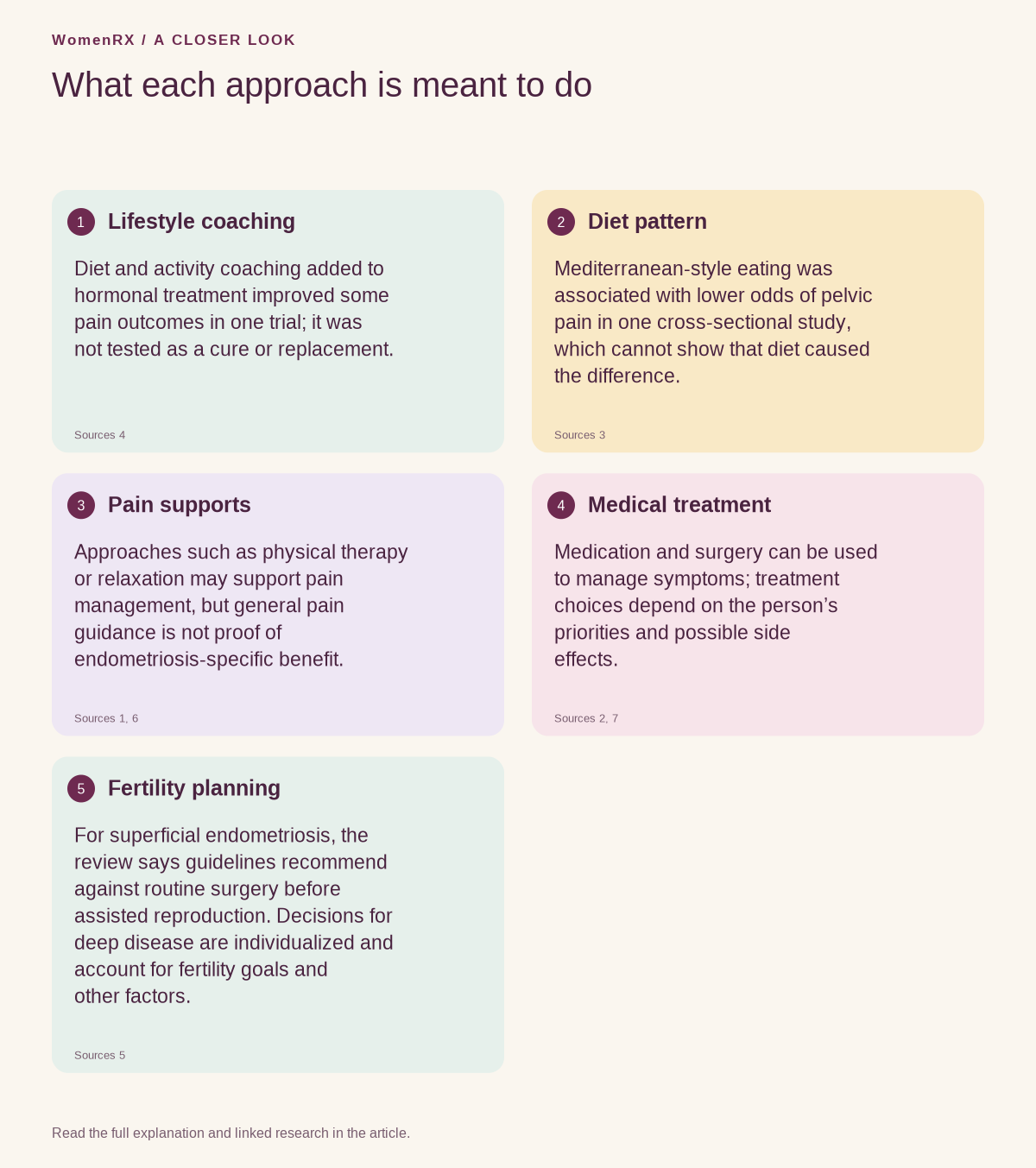
What each approach is meant to do
Lifestyle coaching: Diet and activity coaching added to hormonal treatment improved some pain outcomes in one trial; it was not tested as a cure or replacement.4
Diet pattern: Mediterranean-style eating was associated with lower odds of pelvic pain in one cross-sectional study, which cannot show that diet caused the difference.3
Pain supports: Approaches such as physical therapy or relaxation may support pain management, but general pain guidance is not proof of endometriosis-specific benefit.16
Medical treatment: Medication and surgery can be used to manage symptoms; treatment choices depend on the person’s priorities and possible side effects.27
Fertility planning: For superficial endometriosis, the review says guidelines recommend against routine surgery before assisted reproduction. Decisions for deep disease are individualized and account for fertility goals and other factors.5
Read the figure as text
Compare the intended outcome with what the evidence supports. Symptom improvement, lesion removal, and fertility support are distinct goals.- Lifestyle coaching: Diet and activity coaching added to hormonal treatment improved some pain outcomes in one trial; it was not tested as a cure or replacement.4
- Diet pattern: Mediterranean-style eating was associated with lower odds of pelvic pain in one cross-sectional study, which cannot show that diet caused the difference.3
- Pain supports: Approaches such as physical therapy or relaxation may support pain management, but general pain guidance is not proof of endometriosis-specific benefit.16
- Medical treatment: Medication and surgery can be used to manage symptoms; treatment choices depend on the person’s priorities and possible side effects.27
- Fertility planning: For superficial endometriosis, the review says guidelines recommend against routine surgery before assisted reproduction. Decisions for deep disease are individualized and account for fertility goals and other factors.5
More questions, answered
If my pain improves, does that mean the endometriosis is gone?
No. Pain improvement is a meaningful change in symptoms, but it doesn’t establish that endometriosis lesions have disappeared. The lifestyle trial measured pain and other patient-reported outcomes, not whether lesions were removed. 4
Can I use lifestyle changes instead of prescribed treatment?
The trial evidence here tested diet and exercise coaching as an addition to hormonal treatment, so it doesn’t establish that coaching can replace treatment. If you want to change a prescribed plan, discuss that change rather than stopping on your own. 4
Does surgery guarantee a cure?
No. Surgery can remove areas of endometriosis, but symptoms may return, and further surgery may be needed. When fertility is a goal, potential benefits need to be weighed against factors such as ovarian reserve. 2 5
Sources you can check
- Non-Drug Pain Management: MedlinePlusAccessed 2026-09-25Return to first citation
- Endometriosis - NHSAccessed 2026-09-25Return to first citation
- Mediterranean Diet Adherence and Endometriosis Symptoms: Implications for Nutritional Management.Alarcó-Rosales R, Martín-Manchado L, Sánchez-Sansegundo M, Hurtado-Sánchez JA, Moya-Yeste AM, Zaragoza-Martí A. · Journal of gynecology obstetrics and human reproduction · 2026Return to first citation
- Diet and physical activity coaching for well-being and pain reduction in patients with symptomatic endometriosis: a randomized-controlled clinical trial.Donati A, Giola F, Privitera G, Barbara G, Dridi D, Ottolini FL, Buggio L, Biciuffi R, Parazzini F, Chiaffarino F. · European journal of obstetrics, gynecology, and reproductive biology · 2026Return to first citation
- Endometriosis: surgical management for fertility enhancement.Aase DA, Khan Z. · Frontiers in endocrinology · 2026Return to first citation
- Noncyclic Chronic Pelvic Pain Therapies for Women: Comparative EffectivenessAndrews J, Yunker A, Reynolds WS, Likis FE, Sathe NA, Jerome RN. · 2012Return to first citation
- Real-world effectiveness and tolerability of dienogest in patients with endometriosis: a cross-sectional patient-reported-study.Prost P, Pierre M, Allègre L, Bottero C, Letouzey V, Huberlant S. · Journal of gynecology obstetrics and human reproduction · 2026Return to first citation