Can Interstitial Cystitis Improve Without Medication?
Non-drug approaches may offer supplemental relief from bladder pain symptoms, but relief is different from a cure.
Non-drug approaches may offer supplemental relief, but no treatment is definitively successful. Bladder training and dietary changes have been described as possible sources of supplemental relief, not cures. Stress management and pelvic floor physical therapy may also be considered as parts of multimodal care. Flares can return, and new or changing symptoms shouldn’t automatically be treated as another flare: infection and other causes need consideration. 2 3
Improvement isn’t the same as a cure
Interstitial cystitis/bladder pain syndrome (IC/BPS) is generally described as pelvic pain lasting more than six weeks with lower urinary tract symptoms, when infection or another identifiable cause hasn’t been found. Symptoms vary, and care may combine behavior changes, stress management, and non-drug treatment. Symptoms can flare again, so a better stretch doesn’t necessarily mean the condition is cured. 2
A useful distinction: a flare is a worsening of symptoms; improvement means symptoms are less burdensome; remission would mean symptoms have eased substantially or are absent for a period. Flares and recurrences often occur, and no treatment is definitively successful. Relief is worth pursuing without asking any one change to prove that IC/BPS is gone. 2
Match the trial to the symptom
Non-drug care can be part of a plan, but there isn’t one routine that fits everyone. Bladder training, biofeedback, and dietary changes have been described as possible sources of supplemental relief. That makes them options to evaluate, not a reason to assume every food or bladder habit needs changing. 3
Start with the problem you want to make less disruptive. If frequent trips to the bathroom are the issue, a discussion about bladder habits or bladder training is more relevant than cutting foods at random. Notice whether trips become less disruptive and whether pain changes; a change that makes one symptom harder to live with isn’t an obvious win. If you suspect a particular food is linked to flares, compare symptoms when you change that one food rather than removing a long list at once. Diet changes may offer supplemental relief, but they aren’t an established cure for IC/BPS. 2 3
Pelvic floor physical therapy is another non-drug option within multimodal IC/BPS care. If pelvic pain is prominent, ask whether an assessment of your pelvic-floor symptoms would help decide if it fits. This is a different question from whether a food seems to trigger a flare, and the two approaches needn’t be judged by the same outcome. Physical therapy isn’t a guaranteed stand-alone treatment. 2
For whichever change you try, note a simple starting point, such as how often urgency interrupts your day or how much pain interferes with an activity. Then review that same measure after a trial discussed with your care team. This is a way to make your own comparison, not a diagnostic test or a fixed treatment schedule. If a restriction brings no clear benefit, reconsider it rather than letting the routine grow more restrictive.
Stress management is also included in multimodal care. That doesn’t mean stress causes your symptoms or that the pain is “just stress.” It means coping and stress-management approaches may sit alongside other care for a chronic pain condition. 2
When the pattern no longer fits
IC/BPS is a diagnosis made in the absence of infection or another identifiable cause. If urinary symptoms are new, changing, or not responding as expected, reassessing the cause matters; a familiar diagnosis shouldn’t automatically explain every new symptom. 2
Pelvic pain and urinary symptoms can overlap, especially if you have periods. For example, period pain often starts just before or around a period and can spread from the abdomen to the back or thighs. Notice whether pain rises and falls with bleeding, whether it also occurs at other times, and whether urinary symptoms change with it. A cycle-linked pattern doesn’t diagnose the cause, but it gives your care team more to work with than calling every episode a bladder flare. If periods become heavier, more painful, or irregular, or you have pain during sex or bleeding between periods, those changes also deserve a fresh look at possible gynecologic causes. 1 2
You can pursue non-drug strategies without deciding that medication is never an option. The useful question is which combination gives you meaningful relief and fits your life, with the plan revisited when symptoms or the suspected cause changes. IC/BPS care is often multimodal, and oral medication or other options may also be considered. 2
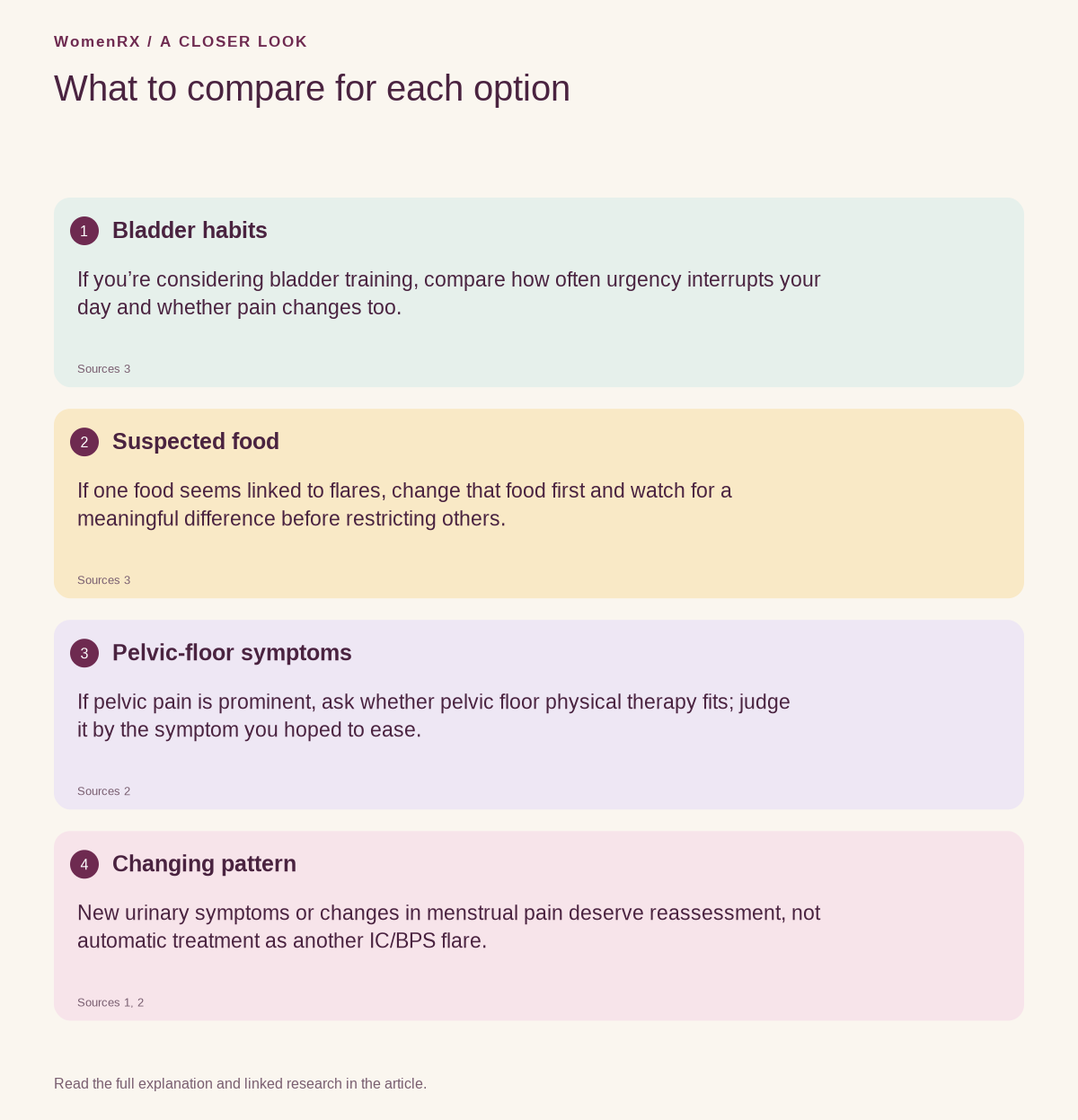
What to compare for each option
Bladder habits: If you’re considering bladder training, compare how often urgency interrupts your day and whether pain changes too.3
Suspected food: If one food seems linked to flares, change that food first and watch for a meaningful difference before restricting others.3
Pelvic-floor symptoms: If pelvic pain is prominent, ask whether pelvic floor physical therapy fits; judge it by the symptom you hoped to ease.2
Changing pattern: New urinary symptoms or changes in menstrual pain deserve reassessment, not automatic treatment as another IC/BPS flare.12
Read the figure as text
Choose one concern to review. These prompts help you judge whether a change is useful; they aren’t a diagnostic score or treatment schedule.- Bladder habits: If you’re considering bladder training, compare how often urgency interrupts your day and whether pain changes too.3
- Suspected food: If one food seems linked to flares, change that food first and watch for a meaningful difference before restricting others.3
- Pelvic-floor symptoms: If pelvic pain is prominent, ask whether pelvic floor physical therapy fits; judge it by the symptom you hoped to ease.2
- Changing pattern: New urinary symptoms or changes in menstrual pain deserve reassessment, not automatic treatment as another IC/BPS flare.12
More questions, answered
Does a symptom flare mean the condition is getting worse?
Not necessarily. Flares and recurrences can occur in IC/BPS, so a temporary worsening doesn’t by itself establish a lasting change. If symptoms are new or changing, reassess whether another cause needs to be considered. 2
Can diet changes cure interstitial cystitis?
Dietary changes may provide supplemental relief, but they aren’t an established cure for IC/BPS. There’s no reason to assume every possible trigger affects you; focus on whether a specific change makes a meaningful difference to your symptoms. 2 3
Sources you can check
- Period pain - NHSAccessed 2026-09-25Return to first citation
- Female Pelvic Conditions: Interstitial Cystitis/Bladder Pain Syndrome.Beltran E. · FP essentials · 2024Return to first citation
- Multimodal therapy for interstitial cystitis.Dell JR, Parsons CL. · The Journal of reproductive medicine · 2004Return to first citation