Can Hypothyroidism Improve Without Medication?
Some thyroid changes can be temporary, but a thyroid that cannot make enough hormone usually needs replacement treatment.
It depends on why your thyroid tests are abnormal. For adults 60 and older with a mild TSH elevation and normal free T4, monitoring may be more useful than routine levothyroxine. That evidence does not establish a treatment threshold for younger adults or for pregnancy and pregnancy planning. Persistent hormone deficiency is usually treated with levothyroxine. Thyroid function can also change after thyroid inflammation or removal of one thyroid lobe. Pregnancy changes how promptly a known thyroid condition needs attention. 684
Start with the test result, not the symptom
Feeling tired, cold, constipated, or unlike yourself can raise the question of hypothyroidism. Those symptoms can't establish the diagnosis on their own because they overlap with other conditions. Blood tests, particularly thyroid-stimulating hormone (TSH) and thyroxine (T4), help show whether your thyroid is making enough hormone. Your history helps explain why the result changed. 87
One distinction matters right away: subclinical hypothyroidism means TSH is elevated but free T4 remains normal. That isn't the same test pattern as clear thyroid hormone deficiency. The difference can change whether the next step is monitoring or hormone replacement. 68
When monitoring may answer the question
For adults 60 and older with TSH between 4.5 and 10 mIU/L and normal free T4, monitoring may be more useful than starting levothyroxine routinely. In a systematic review of that group, levothyroxine did not show a significant benefit over placebo or no treatment for quality of life or major cardiovascular events. Those findings support periodic reassessment for many people in that older, mild subclinical group. They do not establish a treatment threshold for younger adults, pregnancy, or pregnancy planning. 6
If you're already taking levothyroxine for a past diagnosis of mild subclinical hypothyroidism, a normal result while taking it doesn't prove you no longer need it. Nor does the original prescription prove you must take it forever. A small six-month trial explored supervised discontinuation in adults with subclinical hypothyroidism, but most participants were men, and it was designed primarily to test whether a larger trial was feasible. Its results aren't a reason to stop medication on your own. The useful question is what your tests showed before treatment and whether the original reason for treatment still applies. 58
When the cause may be temporary, and when it may not
After removal of one thyroid lobe: The remaining lobe can sometimes make enough hormone. In a systematic review and meta-analysis of studies after one-lobe surgery, some postoperative hypothyroidism was transient, while some people needed thyroid hormone. Follow-up testing matters because an early abnormal result does not, by itself, tell you which course you'll have. That finding does not apply in the same way if your entire thyroid was removed. 41
With thyroid inflammation: Thyroiditis can first release stored hormone into the bloodstream and later leave the thyroid underactive. NIDDK notes that this underactive phase can become permanent. Knowing that inflammation is involved makes reassessment meaningful, but it does not guarantee recovery or make hormone replacement unnecessary while levels are low. 8
With Hashimoto's disease or lasting loss of thyroid function: Hashimoto's is an autoimmune condition that can leave the gland unable to make enough hormone. Surgery is another possible cause of lasting hormone loss. When your thyroid cannot supply the hormone your body needs, levothyroxine replaces it; diet or supplements are not a substitute for that missing hormone. 718
A medicine affecting thyroid hormone production may also be relevant to the cause. Bring the name of any medicine you suspect into the discussion rather than changing it yourself. 8
What “natural” changes can and cannot do
It makes sense to ask whether food or supplements could help. But adding iodine is not a general fix for an underactive thyroid. If you have Hashimoto's or another autoimmune thyroid condition, large amounts of iodine from seaweed or iodine supplements may cause or worsen hypothyroidism. The more useful first move is to establish the cause and test pattern, not to try to force a normal result with a supplement. 8
If you do need levothyroxine, follow-up blood tests check whether the replacement is doing its job. MedlinePlus describes a test about six to eight weeks after starting treatment, with further testing after dose changes. Don't stop a prescribed thyroid medicine just because you feel better or see a normal result: that result may mean the treatment is working. 18
Pregnancy and the months after birth
Pregnancy is a reason to revisit a known thyroid condition promptly, not to assume that a plan made before pregnancy still fits. Untreated hypothyroidism during pregnancy can affect both the pregnant woman and baby; thyroid hormone medicine can be used during pregnancy, and women already taking it may need more testing and a dose change. If you're planning pregnancy and know you have hypothyroidism or an abnormal thyroid result, raise it before you conceive so your testing and treatment plan can be reviewed. 872
After birth, physical and emotional changes can make it hard to tell what a symptom means. If you're concerned about postpartum thyroiditis, symptoms alone cannot identify it: thyroid blood tests can show whether thyroid function is abnormal, and follow-up tests can show whether an underactive result persists. Thyroiditis in general can have an underactive phase that becomes permanent, but that does not predict whether postpartum thyroiditis will resolve. 378
The central question is not simply, “Can hypothyroidism reverse?” It's what changed your thyroid function, what your TSH and T4 show now, and whether repeat results point toward recovery or an ongoing need for replacement. 1468
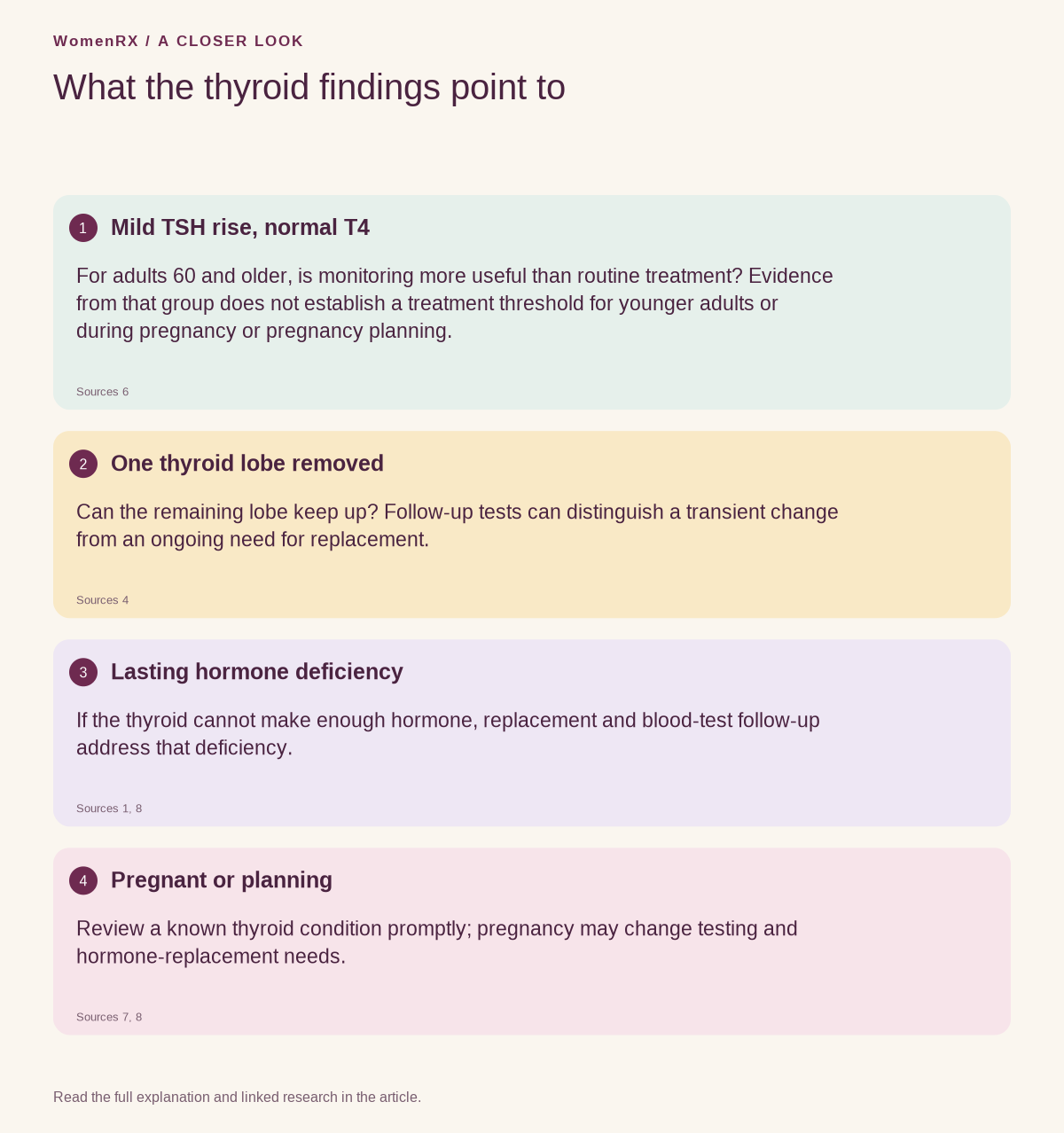
What the thyroid findings point to
Mild TSH rise, normal T4: For adults 60 and older, is monitoring more useful than routine treatment? Evidence from that group does not establish a treatment threshold for younger adults or during pregnancy or pregnancy planning.6
One thyroid lobe removed: Can the remaining lobe keep up? Follow-up tests can distinguish a transient change from an ongoing need for replacement.4
Lasting hormone deficiency: If the thyroid cannot make enough hormone, replacement and blood-test follow-up address that deficiency.18
Pregnant or planning: Review a known thyroid condition promptly; pregnancy may change testing and hormone-replacement needs.78
Read the figure as text
The test pattern and likely cause lead to different follow-up questions; pregnancy changes the context for any of these paths.- Mild TSH rise, normal T4: For adults 60 and older, is monitoring more useful than routine treatment? Evidence from that group does not establish a treatment threshold for younger adults or during pregnancy or pregnancy planning.6
- One thyroid lobe removed: Can the remaining lobe keep up? Follow-up tests can distinguish a transient change from an ongoing need for replacement.4
- Lasting hormone deficiency: If the thyroid cannot make enough hormone, replacement and blood-test follow-up address that deficiency.18
- Pregnant or planning: Review a known thyroid condition promptly; pregnancy may change testing and hormone-replacement needs.78
More questions, answered
Does a normal thyroid test while taking levothyroxine mean I'm cured?
Not necessarily. Levothyroxine replaces hormone your thyroid may not be making, so a normal result can mean the dose is working. Whether treatment is still needed depends on the original diagnosis and cause; don't stop it based on one normal result. 18
Sources you can check
- Hypothyroidism | Hashimoto's Disease | MedlinePlusAccessed 2026-09-25Return to first citation
- Levothyroxine: a medicine for an underactive thyroid (hypothyroidism) - NHSAccessed 2026-09-25Return to first citation
- Postpartum Care: MedlinePlusAccessed 2026-09-25Return to first citation
- Hypothyroidism after hemithyroidectomy: a systematic review and meta-analysis.Cooper D, Kaur R, Ayeni FE, Eslick GD, Edirimanne S. · Thyroid research · 2024Return to first citation
- Discontinuation of levothyroxine therapy in patients with subclinical hypothyroidism: a pilot randomized clinical trial.Maraka S, Owen RR, Singh Ospina NM, Knox M, Dodds T, Thostenson JD, Dishongh K, Raciborski RA, Albashaireh A, Shah A, Syed S, Naqvi S, Motahari H, Thumma S, Toloza F, Ambrogini E, ... · Endocrine · 2025Return to first citation
- Levothyroxine for subclinical hypothyroidism in older adults: no evidence of benefit on quality of life or cardiovascular outcomes: a systematic review.Tuesta-Nole JR, Serruto MES, Román LAP, De Los Ángeles Llamo Barboza M, Chujutalli MAV, Vega JEC. · BMC geriatrics · 2026Return to first citation
- Underactive thyroid (hypothyroidism) - NHSAccessed 2026-09-25Return to first citation
- Hypothyroidism (Underactive Thyroid) - NIDDKAccessed 2026-09-25Return to first citation