Subclinical Hypothyroidism: When Is Treatment Considered?
A mildly high TSH is a reason to look at the full thyroid picture, not an automatic reason to start medication.
Subclinical hypothyroidism means TSH is elevated while free T4, a thyroid hormone, remains in the normal range. A repeat test can help establish whether that pattern persists. For most adults, thyroid hormone treatment hasn’t shown meaningful symptom benefits, but the discussion changes if you’re trying to become pregnant: the main adult guideline doesn’t cover that situation. 45
First, read the two results together
TSH is a signal involved in regulating the thyroid. Free T4 measures thyroid hormone circulating in your blood. When TSH is above the lab’s reference range but free T4 is normal, the pattern is called subclinical hypothyroidism. It isn’t the same finding as an elevated TSH with low free T4. 24
If your TSH is only a little high, ask whether it makes sense to repeat TSH and free T4 before deciding what the result means for you. A study of healthy, nonpregnant Finnish adults specifically described a high TSH confirmed on repeat sampling. Its proposed reference range came from that population and testing method, so it shouldn’t be treated as a universal cutoff for a US lab result. 5
This distinction matters even more during pregnancy. In a study that followed untreated pregnant women who initially met the definition of subclinical hypothyroidism, 88.7% of 326 women with subsequent monthly tests had at least one normal thyroid test later in pregnancy. That doesn’t mean every result stayed normal, or that repeat testing is a substitute for a pregnancy-specific assessment. It shows why one abnormal result and a persistent pattern aren’t necessarily the same thing. 7
What treatment is likely to do outside pregnancy
The usual medication is levothyroxine, which replaces thyroid hormone. The question with a mildly elevated TSH isn’t simply whether medication can move a lab value. It’s whether taking it is likely to help you feel or function better. 14
A 2019 clinical practice guideline reviewed 21 randomized trials involving 2,192 adults with subclinical hypothyroidism. It found no clinically relevant improvement in quality of life or thyroid-related symptoms, including fatigue and depressive symptoms, with thyroid hormone treatment. The panel recommended against routinely treating adults in its scope and favored monitoring to see whether thyroid function progresses or resolves. Evidence about longer-term harms was more limited. 4
That finding can help put a symptom in context. For example, if you’re exhausted and your TSH is just above the lab range, the fatigue deserves attention, but levothyroxine isn’t reliably shown to fix it when free T4 is normal. A recent review likewise found that larger placebo-controlled trials in older adults with mild subclinical hypothyroidism did not show meaningful symptom or overall cardiometabolic improvement, although smaller studies in selected groups reported some promising findings. 46
Age, symptom severity and the degree of TSH elevation still belong in the conversation. The 2019 guideline notes that earlier guidelines often favored treatment above a TSH of 10 mIU/L or at lower levels for some younger or symptomatic adults. Its own recommendation is more cautious: it does not apply to TSH above 20 mIU/L and may not apply to people with severe symptoms or younger adults, such as those 30 or under. Those are boundaries of the recommendation, not automatic treatment instructions. 4
Treatment also brings an ongoing task. Levothyroxine dosing is individualized, and blood tests are used to assess whether the dose is right. That commitment is worth weighing against a benefit that, for many adults with mild subclinical hypothyroidism, hasn’t been demonstrated. 134
Pregnancy plans change which evidence applies
If you’re trying to conceive, say so when you discuss the result. The adult guideline’s recommendation against treatment explicitly does not apply to women trying to become pregnant. It can’t be used to settle your decision either way, and a TSH threshold discussed for nonpregnant adults shouldn’t simply be carried into pregnancy. 4
If you’re pregnant, thyroid testing and any treatment need to be considered in that setting. Pregnancy is accounted for in levothyroxine dosing and monitoring information, and thyroid results may change over the course of pregnancy. The study showing that results sometimes return to normal did not test whether leaving a particular pregnant woman untreated improves or worsens pregnancy outcomes; it examined later test results among participants who received placebo. 37
So the useful next question is different from “Is my number high enough for medication?” It’s “How should this TSH and free T4 result be assessed given where I am with pregnancy, and what follow-up would clarify the decision?” If you already take levothyroxine and become pregnant, let your prescribing clinician know, since pregnancy may call for additional thyroid blood tests and an individualized dose assessment. 13
Where antibodies fit
A thyroid antibody test can help identify an autoimmune thyroid disorder. It answers a different question from TSH and free T4: it may offer a clue about why thyroid results are abnormal, rather than measure the hormone level itself. This evidence does not establish a rule that an antibody result alone determines whether levothyroxine will help. 2
The practical way to frame a borderline result is to separate three decisions: Is the TSH and free T4 pattern confirmed? Is pregnancy or an attempt to conceive part of the picture? And what benefit is treatment reasonably expected to provide in your situation? Those answers make monitoring and treatment a more useful comparison than the lab flag alone. 457
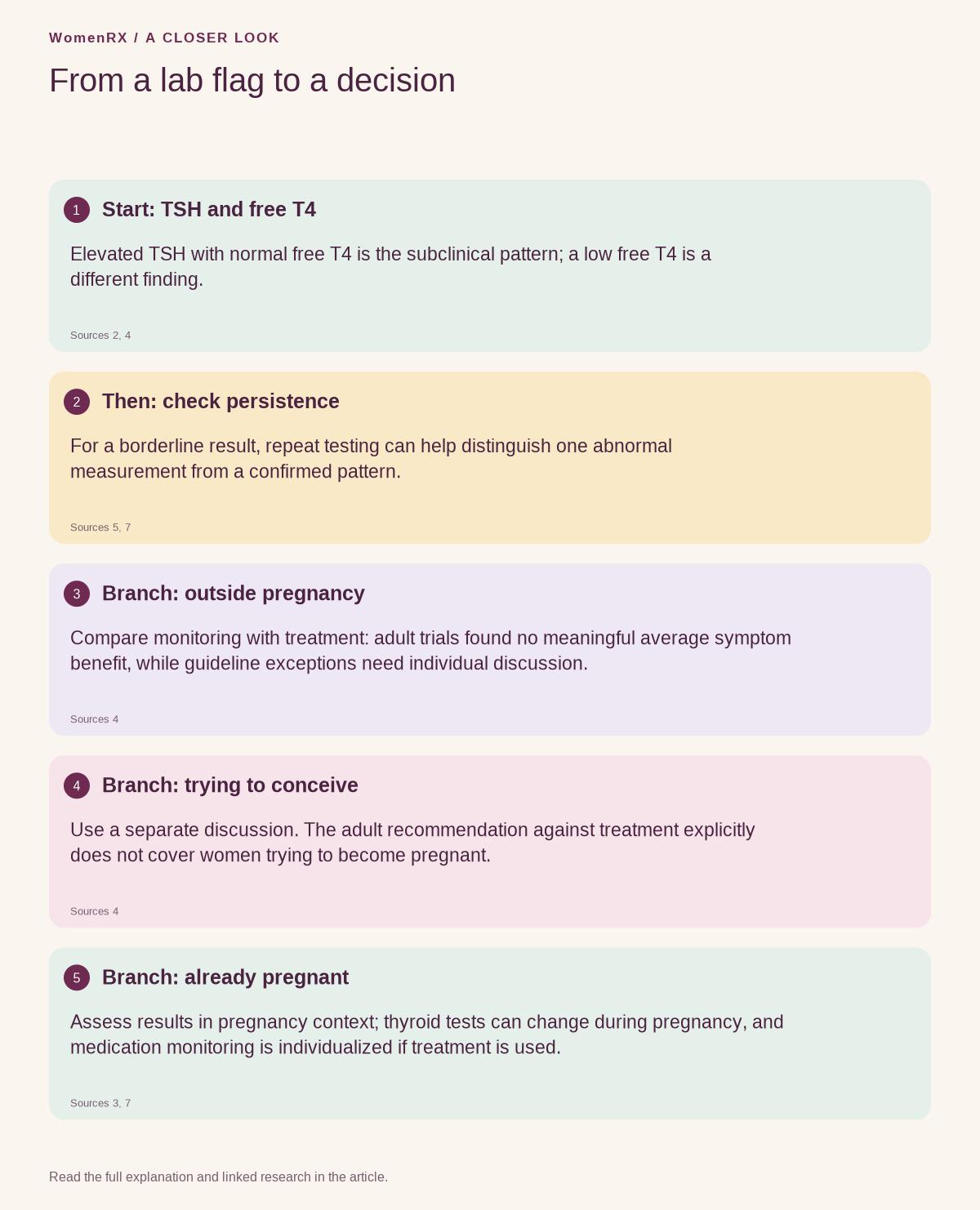
From a lab flag to a decision
Start: TSH and free T4: Elevated TSH with normal free T4 is the subclinical pattern; a low free T4 is a different finding.24
Then: check persistence: For a borderline result, repeat testing can help distinguish one abnormal measurement from a confirmed pattern.57
Branch: outside pregnancy: Compare monitoring with treatment: adult trials found no meaningful average symptom benefit, while guideline exceptions need individual discussion.4
Branch: trying to conceive: Use a separate discussion. The adult recommendation against treatment explicitly does not cover women trying to become pregnant.4
Branch: already pregnant: Assess results in pregnancy context; thyroid tests can change during pregnancy, and medication monitoring is individualized if treatment is used.37
Read the figure as text
The pathway separates confirming the result from choosing the discussion that fits your circumstances. It is not a diagnostic score.- Start: TSH and free T4: Elevated TSH with normal free T4 is the subclinical pattern; a low free T4 is a different finding.24
- Then: check persistence: For a borderline result, repeat testing can help distinguish one abnormal measurement from a confirmed pattern.57
- Branch: outside pregnancy: Compare monitoring with treatment: adult trials found no meaningful average symptom benefit, while guideline exceptions need individual discussion.4
- Branch: trying to conceive: Use a separate discussion. The adult recommendation against treatment explicitly does not cover women trying to become pregnant.4
- Branch: already pregnant: Assess results in pregnancy context; thyroid tests can change during pregnancy, and medication monitoring is individualized if treatment is used.37
More questions, answered
Does a positive thyroid antibody test mean I need levothyroxine?
An antibody test may help identify an autoimmune thyroid disorder. It doesn’t measure free T4, and the evidence cited here does not establish an antibody-based treatment rule. The result is one piece of context to discuss alongside your thyroid hormone tests and pregnancy plans. 24
Sources you can check
- Levothyroxine: a medicine for an underactive thyroid (hypothyroidism) - NHSAccessed 2026-09-25Return to first citation
- Thyroid Tests: MedlinePlusAccessed 2026-09-25Return to first citation
- LEVOTHYROXINE SODIUM TABLET [CARDINAL HEALTH 107, LLC] | US prescribing information and patient instructionsAccessed 2026-09-25Return to first citation
- Thyroid hormones treatment for subclinical hypothyroidism: a clinical practice guideline.Bekkering GE, Agoritsas T, Lytvyn L, Heen AF, Feller M, Moutzouri E, Abdulazeem H, Aertgeerts B, Beecher D, Brito JP, Farhoumand PD, Singh Ospina N, Rodondi N, van Driel M, Wallace... · BMJ (Clinical research ed.) · 2019Return to first citation
- Serum TSH reference interval in healthy Finnish adults using the Abbott Architect 2000i Analyzer.Schalin-Jäntti C, Tanner P, Välimäki MJ, Hämäläinen E. · Scandinavian journal of clinical and laboratory investigation · 2011Return to first citation
- Cardiometabolic Outcomes and Levothyroxine Treatment Effects in Subclinical Hypothyroidism: A Systematic Review.Hag Elagib MA, Alamin MA, Omer Amin Ahmed Y, Musa IE, Khaleifa MA, Elsamani EA, Najar H, Ahmed A. · Cureus · 2026Return to first citation
- Thyroid Function Throughout Pregnancy in Women With Subclinical Hypothyroidism or Hypothyroxinemia.Theilen LH, Mele L, Peaceman AM, Reddy UM, Varner MW, Thorp JM, Saade GR, Tita ATN, Rouse DJ, Sibai BM, Costantine MM, Caritis SN, Casey BM, for th... · Obstetrics and gynecology · 2026Return to first citation