Hypothyroidism and Fertility: What to Check
An underactive thyroid deserves attention when you’re trying to conceive, but a borderline test result doesn’t explain every fertility concern.
Yes. Overt thyroid dysfunction can affect reproductive function, and untreated hypothyroidism also matters during pregnancy. If you already take levothyroxine, ask whether your thyroid levels need checking before conception and how they’ll be monitored if you become pregnant. If you’re being evaluated for infertility, ask which thyroid tests fit your history rather than assuming thyroid disease is the cause. 536
Start with the thyroid question you actually have
There’s a difference between managing known hypothyroidism and looking for a possible cause of difficulty conceiving. Overt thyroid dysfunction can affect reproductive function. But fertility can involve factors in either partner, sometimes more than one at once, and testing may extend well beyond the thyroid. 54
If you already have hypothyroidism, the useful preconception question is whether your current treatment is keeping your thyroid levels where your clinician wants them. Levothyroxine treatment is assessed with blood tests, and pregnancy can change the amount needed. Don’t stop it because you’re trying to conceive or because a pregnancy test is positive. 13
If you don’t have a thyroid diagnosis, a thyroid test may still be worth discussing, particularly when your health history raises a concern. That isn’t the same as saying everyone undergoing infertility evaluation needs every thyroid test. A recent review of subclinical hypothyroidism in infertility favors selective testing over universal screening, and does not recommend routine thyroid-antibody testing for everyone with infertility. 6
Know what the tests can tell you
TSH is usually the first blood test used to assess thyroid function. T4 measures a thyroid hormone; thyroid-antibody tests can help identify an autoimmune thyroid disorder. Ask what each proposed test would clarify in your situation. A mildly unusual result, an established diagnosis of hypothyroidism, and a positive antibody test with otherwise normal thyroid function are not interchangeable findings. 25
One useful question is: “If this result is borderline, what would we check next, and would it change my care?” Treatment decisions at lower TSH thresholds before conception remain debated. Recent reviews question whether using a low threshold to start levothyroxine improves fertility outcomes; a borderline number alone shouldn’t be presented as either an explanation for infertility or a promise that treatment will lead to pregnancy. 56
Also mention the medicines and supplements you take when you discuss testing. Biotin can affect thyroid test results. If you take levothyroxine, calcium- or iron-containing products can interfere with its absorption, so your clinician or pharmacist may want to review how you take them. 13
What changes once you’re pregnant?
Pregnancy shifts the question from whether thyroid treatment might help conception to whether your thyroid condition is being adequately treated during pregnancy. For someone taking levothyroxine, thyroid levels may need closer monitoring and the prescribed amount may change. Untreated hypothyroidism in pregnancy carries risks; levothyroxine should not be discontinued simply because you’re pregnant. Let the clinician managing your thyroid medication know when you become pregnant so there’s a monitoring plan. 13
Evidence about subclinical hypothyroidism during pregnancy should not be mistaken for evidence that treating a borderline result helps someone conceive. A systematic review of 11 randomized trials involving 2,749 pregnant women with subclinical hypothyroidism found lower pregnancy-loss risk with levothyroxine in the studies reporting that outcome, but no significant difference in live birth in the studies reporting live birth. Those trials studied treatment after pregnancy had begun. 7
After delivery, thyroid treatment may need another review rather than simply continuing a pregnancy plan indefinitely. The US prescribing information for levothyroxine describes postpartum dose reassessment and TSH monitoring for people whose dose changed during pregnancy. 3
Keep the wider fertility picture in view
If pregnancy hasn’t happened, ask about a fertility evaluation as a whole, not just thyroid blood work. Infertility may be diagnosed after a year of frequent unprotected sex, or after six months if you’re 35 or older. Irregular periods, being over 40, previous pelvic inflammatory disease, or earlier fertility concerns are reasons to seek an evaluation sooner. Depending on the situation, an evaluation can include testing for both partners. 4
You can bring three questions to that discussion: Do my history or results point to thyroid testing? If a thyroid result is abnormal, what does it mean and what would we do next? If I become pregnant while taking levothyroxine, who will arrange follow-up blood tests? Those questions make room for thyroid care without letting one possible factor crowd out the rest. 2346
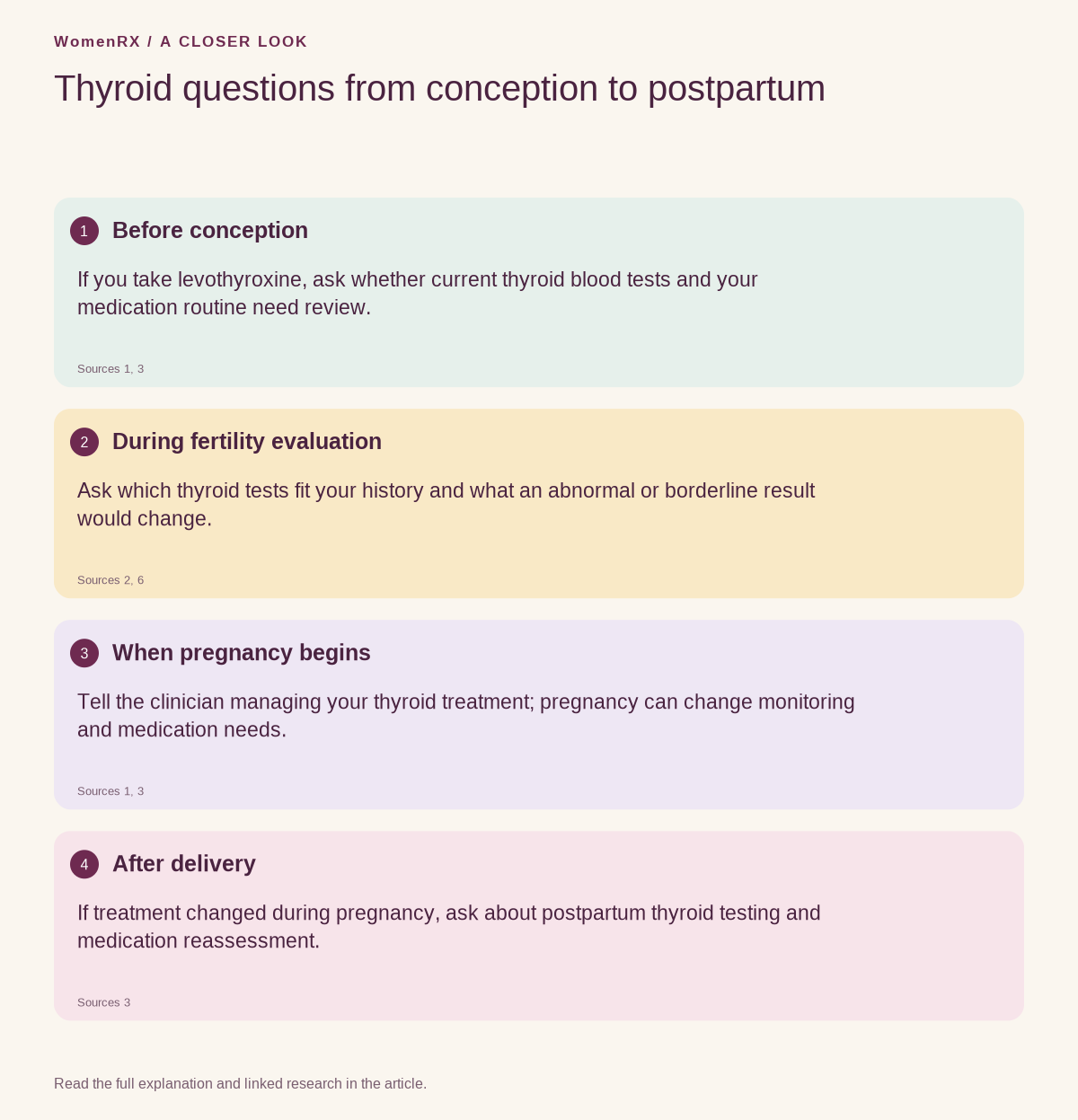
Thyroid questions from conception to postpartum
Before conception: If you take levothyroxine, ask whether current thyroid blood tests and your medication routine need review.13
During fertility evaluation: Ask which thyroid tests fit your history and what an abnormal or borderline result would change.26
When pregnancy begins: Tell the clinician managing your thyroid treatment; pregnancy can change monitoring and medication needs.13
After delivery: If treatment changed during pregnancy, ask about postpartum thyroid testing and medication reassessment.3
Read the figure as text
The question changes from whether testing is useful to how an established condition is monitored.- Before conception: If you take levothyroxine, ask whether current thyroid blood tests and your medication routine need review.13
- During fertility evaluation: Ask which thyroid tests fit your history and what an abnormal or borderline result would change.26
- When pregnancy begins: Tell the clinician managing your thyroid treatment; pregnancy can change monitoring and medication needs.13
- After delivery: If treatment changed during pregnancy, ask about postpartum thyroid testing and medication reassessment.3
More questions, answered
Should I ask for thyroid-antibody testing if I’m having trouble conceiving?
Ask what an antibody result would add to your evaluation. Antibody tests can help identify autoimmune thyroid disorders, but routine antibody screening for everyone with infertility is not recommended in a recent review. 26
Can I keep taking levothyroxine if I become pregnant?
Yes, when it’s needed to treat hypothyroidism. Don’t stop it because of a positive pregnancy test. Tell the clinician managing your prescription, since pregnancy can change your monitoring and treatment needs. 13
Sources you can check
- Levothyroxine: a medicine for an underactive thyroid (hypothyroidism) - NHSAccessed 2026-09-25Return to first citation
- Thyroid Tests: MedlinePlusAccessed 2026-09-25Return to first citation
- LEVOTHYROXINE SODIUM TABLET [CARDINAL HEALTH 107, LLC] | US prescribing information and patient instructionsAccessed 2026-09-25Return to first citation
- Infertility | Infertility Treatments | MedlinePlusAccessed 2026-09-25Return to first citation
- Thyroid disorders and female infertility.Unuane D, Velkeniers B, Poppe KG. · The Journal of clinical endocrinology and metabolism · 2026Return to first citation
- Update on the management of subclinical hypothyroidism in patients with infertility.Yeshua AS, Harris BS, Quaas AM. · Current opinion in obstetrics & gynecology · 2025Return to first citation
- Levothyroxine for subclinical hypothyroidism during pregnancy: an updated systematic review and meta-analysis of randomized controlled trials.Provinciatto H, Moreira MVB, Neves GR, De Freitas LR, Mitsui HC, Zhang JMF, Araujo Júnior E. · Archives of gynecology and obstetrics · 2024Return to first citation