Can You Get Pregnant With Hypothyroidism?
Pregnancy is possible with hypothyroidism, but your thyroid hormone results and treatment status matter more than the diagnosis alone.
Yes. Hypothyroidism does not make pregnancy impossible: an observational study identified women with an overt hypothyroid pattern after they were already pregnant. It cannot tell us whether they had that pattern when they conceived or how likely conception was. If you’re planning pregnancy, the useful next step is to understand your TSH and thyroid hormone results and whether treatment needs review. 629

A diagnosis isn’t the same as a fertility prediction
A study of 1,000 women attending hospitals in North India during the first trimester found seven with high thyroid-stimulating hormone (TSH) and low free T4, a pattern suggestive of overt hypothyroidism. They were pregnant, so the condition isn’t an absolute barrier to pregnancy. But testing after conception cannot show what their thyroid levels were when they conceived, or estimate the chance of conception for someone trying now. 6
There is a reason to take a confirmed thyroid problem seriously while trying to conceive. A review focused on women attempting pregnancy through natural or timed intercourse found strong evidence supporting treatment of overt thyroid dysfunction. It did not find sufficient evidence to recommend thyroid hormones as an across-the-board fertility treatment, and it did not recommend treating subclinical hypothyroidism solely to improve conception in that setting. 9
What does your test result actually mean?
TSH is usually the first blood test used to assess thyroid function. T4 measures a thyroid hormone, while thyroid antibody tests can help identify an autoimmune cause. They answer different questions. 2
- Overt hypothyroidism: High TSH together with low free T4 indicates too little circulating thyroid hormone. In the first-trimester study, this was the pattern described as suggestive of overt hypothyroidism. 6
- Subclinical hypothyroidism: TSH is elevated, but free T4 remains within the reference range. That is not the same finding as low free T4, and evidence about treating it to improve fertility is less settled. 49
- Thyroid autoimmunity: Antibodies point toward an autoimmune thyroid condition; they do not, by themselves, tell you that thyroid hormone is low. A woman can have thyroid antibodies while her thyroid hormone levels are within range. 27
For example, if you’ve been told that your “thyroid test was positive,” it’s worth finding out whether that means elevated TSH, low free T4, positive antibodies, or some combination. The answer changes what the result says about thyroid function and what question to ask next. 267
A mildly elevated TSH also needs context. In a study of 4,800 women in the first trimester in China, 27.8% met a definition of subclinical hypothyroidism using TSH above 2.5 mIU/L, compared with 4.0% using that laboratory’s first-trimester reference interval. Those figures do not establish a cutoff for you; they show how much the chosen pregnancy reference range can change a label. Ask which range applies to your result rather than assuming every value above a single number means the same thing. 5
Trying without fertility treatment versus using IVF
This distinction matters when you hear that levothyroxine “helps fertility.” A review of four studies involving 806 subfertile women examined treatment around IVF or intracytoplasmic sperm injection (ICSI) in women with subclinical hypothyroidism or thyroid autoimmunity. It reported potential benefits in some fertility-treatment outcomes. Those selected groups and procedures are different from trying to conceive through intercourse. 7
Reviews also reach different conclusions about how broadly to treat mild abnormalities. A 2023 narrative review described possible reasons to treat subclinical hypothyroidism to improve fertility, while a later review focused on natural or timed intercourse did not recommend that approach for conception. Neither makes a positive antibody test, with otherwise adequate thyroid function, interchangeable with overt hypothyroidism. 1097
If your periods have become irregular or heavy, mention that when discussing thyroid testing. Those can be symptoms of an underactive thyroid, but they don’t establish the cause on their own. 8
If you already take levothyroxine
Levothyroxine replaces thyroid hormone and can be taken during pregnancy when needed. Before pregnancy, ask whether your recent blood tests show that your current treatment is working as intended. If you become pregnant, let the clinician managing your thyroid know promptly: pregnancy can change the amount needed, and additional blood tests may be needed to check it. Don’t assume that a dose that suited you before pregnancy will automatically remain the right one. 138
The same conversation matters if hypothyroidism is first found during pregnancy. Untreated hypothyroidism is associated with increased risks of serious pregnancy complications, including pre-eclampsia, premature birth and miscarriage. That is a reason to address a confirmed diagnosis, not a reason to interpret a borderline TSH result as though it carried the same risks as overt disease. 86
A practical question to bring with your results is: “Do these tests show low thyroid hormone, a mild TSH change with normal free T4, or antibodies without low hormone, and does pregnancy or fertility treatment change the plan?” That gets closer to a useful decision than asking whether one TSH number is simply “good” or “bad.” 2679
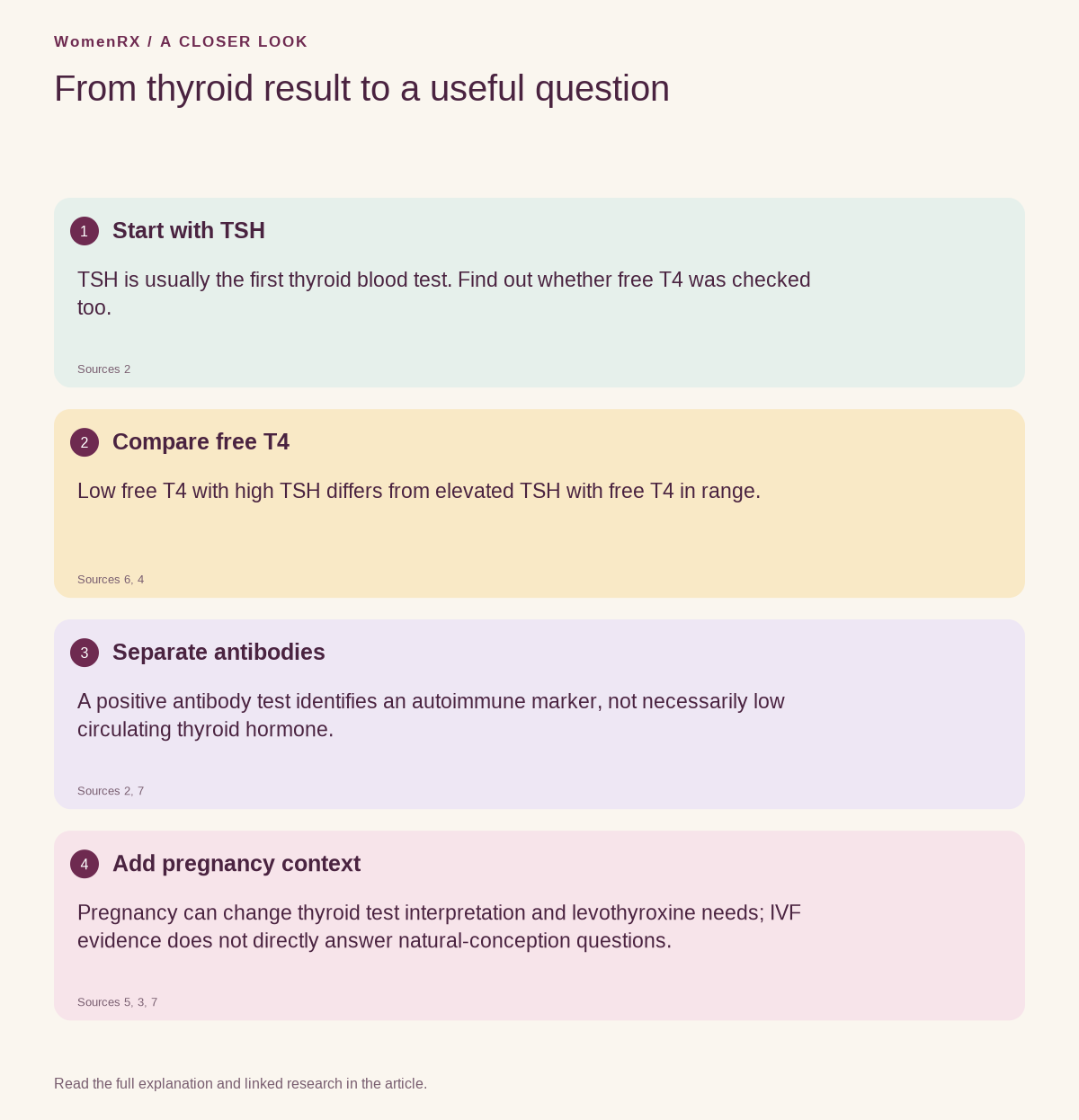
From thyroid result to a useful question
Start with TSH: TSH is usually the first thyroid blood test. Find out whether free T4 was checked too.2
Compare free T4: Low free T4 with high TSH differs from elevated TSH with free T4 in range.64
Separate antibodies: A positive antibody test identifies an autoimmune marker, not necessarily low circulating thyroid hormone.27
Add pregnancy context: Pregnancy can change thyroid test interpretation and levothyroxine needs; IVF evidence does not directly answer natural-conception questions.537
Read the figure as text
Follow the distinction that applies to your results, then consider whether you are planning pregnancy, already pregnant, or receiving fertility treatment.- Start with TSH: TSH is usually the first thyroid blood test. Find out whether free T4 was checked too.2
- Compare free T4: Low free T4 with high TSH differs from elevated TSH with free T4 in range.64
- Separate antibodies: A positive antibody test identifies an autoimmune marker, not necessarily low circulating thyroid hormone.27
- Add pregnancy context: Pregnancy can change thyroid test interpretation and levothyroxine needs; IVF evidence does not directly answer natural-conception questions.537
More questions, answered
If I have thyroid antibodies, do I need levothyroxine to get pregnant?
Not necessarily. Antibodies and low thyroid hormone are different findings. Evidence from selected IVF/ICSI populations should not be treated as proof that levothyroxine improves natural conception when thyroid hormone levels are otherwise adequate. Ask what your TSH and free T4 show alongside the antibody result. 279
Sources you can check
- Levothyroxine: a medicine for an underactive thyroid (hypothyroidism) - NHSAccessed 2026-09-25Return to first citation
- Thyroid Tests: MedlinePlusAccessed 2026-09-25Return to first citation
- LEVOTHYROXINE SODIUM TABLET [CARDINAL HEALTH 107, LLC] | US prescribing information and patient instructionsAccessed 2026-09-25Return to first citation
- Subclinical hypothyroidism and cardiovascular risk: recommendations for treatment.Weiss IA, Bloomgarden N, Frishman WH. · Cardiology in review · 2011Return to first citation
- Assessment of thyroid function during first-trimester pregnancy: what is the rational upper limit of serum TSH during the first trimester in Chinese pregnant women?Li C, Shan Z, Mao J, Wang W, Xie X, Zhou W, Li C, Xu B, Bi L, Meng T, Du J, Zhang S, Gao Z, Zhang X, Yang L, Fan C, Teng W. · The Journal of clinical endocrinology and metabolism · 2014Return to first citation
- High prevalence of subclinical hypothyroidism during first trimester of pregnancy in North India.Dhanwal DK, Prasad S, Agarwal AK, Dixit V, Banerjee AK. · Indian journal of endocrinology and metabolism · 2013Return to first citation
- Thyroxine Replacement for Subfertile Females With Subclinical Hypothyroidism and Autoimmune Thyroiditis: A Systematic Review.Myneni R, Chawla HV, Grewal AS, Vivekanandan G, Ndakotsu A, Abubacker AP, Iqbal A, Khan S. · Cureus · 2021Return to first citation
- Underactive thyroid (hypothyroidism) - NHSAccessed 2026-09-25Return to first citation
- Optimization of conception with intercourse for women with infertility.Boedeker D, Neumann B, Vest A, Hill MJ, Stanford JB, Johnstone EB. · Fertility and sterility · 2026Return to first citation
- Thyroid dysfunction and female infertility. A comprehensive review.Concepción-Zavaleta MJ, Coronado-Arroyo JC, Quiroz-Aldave JE, Concepción-Urteaga LA, Paz-Ibarra J. · Diabetes & metabolic syndrome · 2023Return to first citation