Can You Get Pregnant With Endometriosis?
Yes, pregnancy is possible with endometriosis, but the best path depends on your age, where the disease is, and your fertility history.
Yes. Endometriosis can make conception harder for some people, but a diagnosis doesn’t mean you can’t get pregnant. The next step depends on factors such as age, how long you’ve been trying, whether the ovaries or fallopian tubes are affected, and any prior surgery. Natural attempts, selected surgery, and fertility treatment are all possibilities; surgery isn’t a guaranteed route to pregnancy. 1 4 5
How endometriosis can affect conception
Endometriosis occurs when tissue similar to the lining of the uterus grows elsewhere. 5 It’s often found around the ovaries, fallopian tubes, or elsewhere in the pelvis. 1 In some people, inflammation, adhesions, or changes to pelvic anatomy may interfere with fertility. The impact isn’t the same for everyone, and the diagnosis alone can’t tell you whether you’ll conceive naturally. 3
That’s why the location and extent of disease matter, but they aren’t the whole story. Age, time trying to conceive, prior pregnancies, and the condition of the ovaries and fallopian tubes can also shape the options. 3 5
Three paths to discuss
Trying without fertility treatment
If you want to try naturally, endometriosis doesn’t automatically rule that out. A fertility assessment can help clarify whether that’s a reasonable first path for you, rather than relying on the diagnosis or symptoms alone. If you’ve been having difficulty getting pregnant, the NHS advises seeking fertility-specialist support. 1
Age and time trying are worth raising early because they’re part of fertility assessment and can affect which options make sense. One tool used after endometriosis surgery, the Endometriosis Fertility Index, includes age, duration of infertility, pregnancy history, and findings from surgery. It’s a way to inform prognosis after an operation, not a guarantee or a stand-alone answer for everyone. 3
Surgery, when the potential benefit fits the tradeoff
Surgery may be considered for symptoms or fertility-related reasons, but its role depends on the kind and location of endometriosis. A recent review says laparoscopy may improve the chance of unassisted pregnancy for some people with superficial disease, while routine surgery before assisted reproductive treatment isn’t recommended. 5
For deep endometriosis, the decision is more individual. Age, ovarian reserve, fertility goals, and other factors matter, and surgery can carry a risk of affecting ovarian reserve. Surgery before fertility treatment hasn’t been shown to be the right choice for everyone with more extensive disease. 4 5
If you’ve already had surgery, mention what was done and whether your ovaries or tubes were involved. A meta-analysis of seven retrospective cohort studies found higher odds of spontaneous pregnancy after a first operation than after repeat surgery; it also found higher odds of pregnancy per embryo transfer after a first operation. Because these were observational studies, they show an association, not proof that repeat surgery itself caused poorer outcomes. They do support discussing the likely fertility benefit and risks before another operation. 2
Fertility treatment
Fertility treatment, including assisted reproductive technology, may be another route. Surgery isn’t routinely recommended simply as a step before assisted reproduction, and the choice depends on your fertility findings and goals. Ask how the recommended approach accounts for disease location, ovarian reserve, prior treatment, and age. 5
Hormonal medicines used to manage endometriosis symptoms aren’t used while trying to get pregnant, according to the NHS. If you’re taking them, ask how your treatment plan should change when pregnancy becomes a goal. 1
Make the decision about your situation, not just the stage
A useful discussion is more specific than “Can endometriosis cause infertility?” You might ask:
- Are my ovaries, fallopian tubes, or pelvic anatomy affected in a way that changes my options?
- Would surgery be expected to help with my symptoms, fertility, or both?
- Could surgery affect my ovarian reserve, and how does that risk compare with going directly to fertility treatment?
- If I’ve had surgery before, what would another operation be expected to add?
- Given my age and time trying, what are the reasonable next steps and when should we reassess?
These questions help connect the decision to your disease location, fertility history, and priorities. There’s no single path that suits everyone with endometriosis, and surgery or fertility treatment can’t promise pregnancy. 4 5
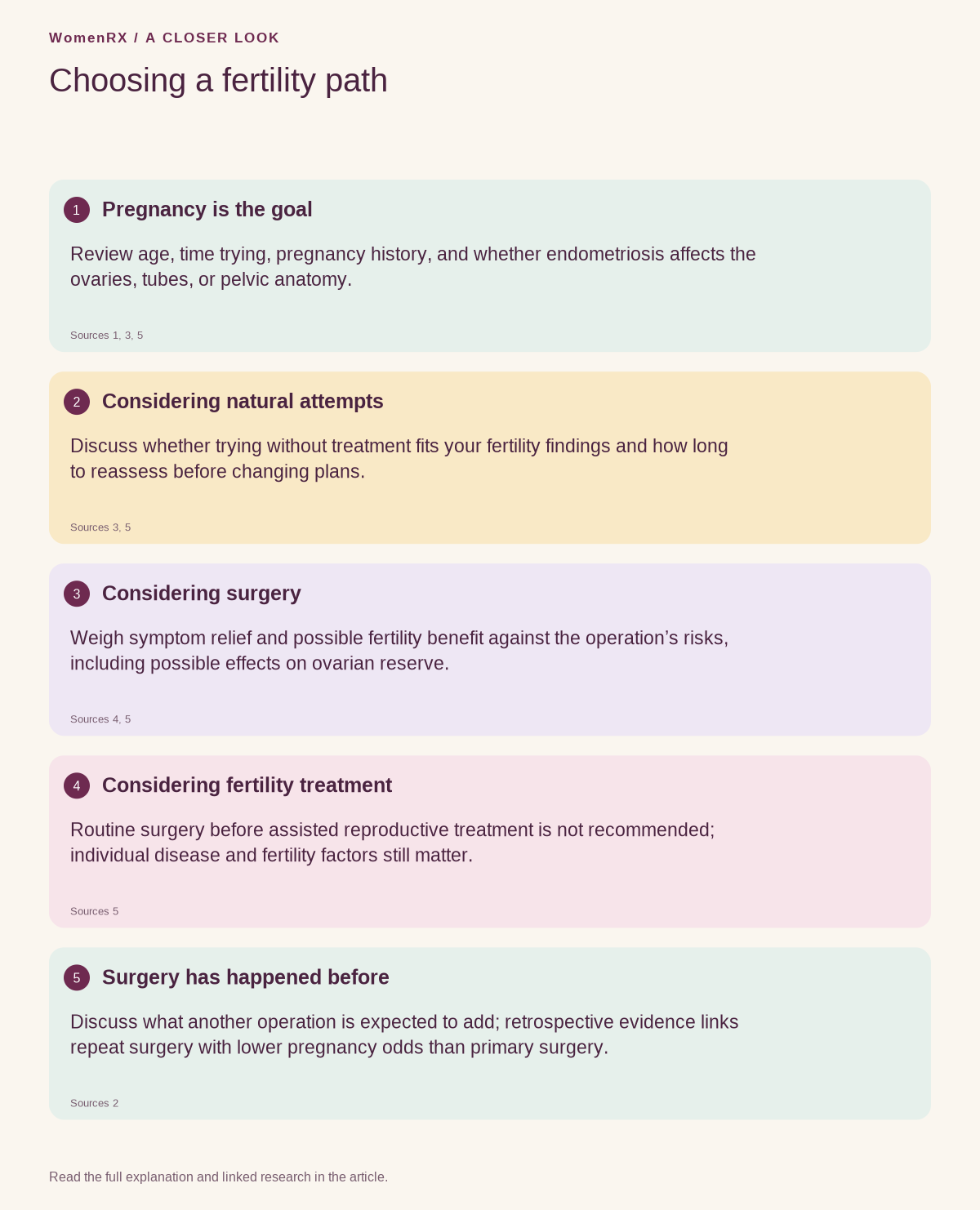
Choosing a fertility path
Pregnancy is the goal: Review age, time trying, pregnancy history, and whether endometriosis affects the ovaries, tubes, or pelvic anatomy.135
Considering natural attempts: Discuss whether trying without treatment fits your fertility findings and how long to reassess before changing plans.35
Considering surgery: Weigh symptom relief and possible fertility benefit against the operation’s risks, including possible effects on ovarian reserve.45
Considering fertility treatment: Routine surgery before assisted reproductive treatment is not recommended; individual disease and fertility factors still matter.5
Surgery has happened before: Discuss what another operation is expected to add; retrospective evidence links repeat surgery with lower pregnancy odds than primary surgery.2
Read the figure as text
A discussion flow linking pregnancy goals and personal fertility factors to possible next steps. It isn’t a diagnostic tool or a promise of an outcome.- Pregnancy is the goal: Review age, time trying, pregnancy history, and whether endometriosis affects the ovaries, tubes, or pelvic anatomy.135
- Considering natural attempts: Discuss whether trying without treatment fits your fertility findings and how long to reassess before changing plans.35
- Considering surgery: Weigh symptom relief and possible fertility benefit against the operation’s risks, including possible effects on ovarian reserve.45
- Considering fertility treatment: Routine surgery before assisted reproductive treatment is not recommended; individual disease and fertility factors still matter.5
- Surgery has happened before: Discuss what another operation is expected to add; retrospective evidence links repeat surgery with lower pregnancy odds than primary surgery.2
More questions, answered
Does having endometriosis mean I’m infertile?
No. Endometriosis can be associated with difficulty getting pregnant, but a diagnosis by itself doesn’t establish that you can’t conceive. The effect varies, so your fertility history and the location of disease matter. 1 5
Should I have surgery before IVF or other fertility treatment?
Not automatically. A recent review says routine surgery before assisted reproductive treatment isn’t recommended. For more extensive disease, the decision depends on factors such as age, ovarian reserve, fertility goals, and other infertility factors. 5
Sources you can check
- Endometriosis - NHSAccessed 2026-09-25Return to first citation
- Fertility after endometriosis surgery: a systematic review and meta-analysis comparison of primary versus multiple surgical interventions.Cao M, Koroneos Z, Tyson K, Mooney S, Holdsworth-Carson S. · European journal of obstetrics, gynecology, and reproductive biology · 2026Return to first citation
- Validation of Endometriosis Fertility Index for the Prediction of Non-Assisted Reproductive Technology (ART) Pregnancy in Women With Endometriosis-Associated Infertility: A Prospective Cohort Study.Mishra D, Shubham S, Malhotra N. · Cureus · 2026Return to first citation
- Endometriosis Longitudinal Fertility Study (ELFS): a prospective longitudinal cohort study of the effect of conservative and surgical management for moderate to severe endometriosis on future fertility - study protocol.Mooney S, Ross V, Dior UP, Reddington C, Hicks L, Cheng C, Amir M, Harlow K, Holdsworth-Carson S, Stern K, Healey M, Rogers P, END-IT Endometriosis Research Group. · BMJ open · 2026Return to first citation
- Endometriosis: surgical management for fertility enhancement.Aase DA, Khan Z. · Frontiers in endocrinology · 2026Return to first citation