Endometriosis and Weight: What the Evidence Shows
BMI studies find different patterns for different outcomes, but they don’t show that body size causes endometriosis or test weight loss as treatment.
BMI and endometriosis have been linked in some observational studies, but findings differ depending on whether researchers measure disease occurrence, pain, sexual function, or quality of life. These studies show patterns, not whether weight causes endometriosis or changes its course. These observational findings don’t test weight loss as treatment; one review suggests a possible link to explore, not a proven benefit. 35
One number, several different questions
When people ask whether weight is connected to endometriosis, they may mean: Does BMI affect the chance of having the disease? Does it change pain or other symptoms? Does changing weight improve treatment outcomes? Those are separate questions, and the research doesn’t give them the same answer.
BMI is calculated from height and weight. It can be useful for some population-level comparisons, but it doesn’t distinguish body fat from muscle or bone, and it can’t tell the whole story about an individual’s health. 1
Endometriosis has no single known cause. It can cause symptoms such as pain and fertility difficulties, and treatments can help manage symptoms. The guidance described here focuses on symptom management; it doesn’t identify weight change as a treatment. 2
Disease occurrence: an association isn’t a cause
A retrospective hospital study of 226 people being evaluated for possible endometriosis found a lower average BMI in the group whose diagnosis was confirmed. Because everyone in this study was already seeking care for symptoms, it cannot tell us whether BMI changes the chance of developing endometriosis in the general population. Nor can it show that body size caused the difference. 5
That distinction matters. Who gets referred, how the disease is diagnosed, and other differences between groups can affect an observed association. A study comparing BMI among people with and without a diagnosis does not test whether changing someone’s weight will prevent or treat the disease.
Symptoms: findings vary by outcome
For menstrual pain, a 2026 meta-analysis pooled six observational studies involving 2,274 women already diagnosed with endometriosis. Underweight participants had higher odds of dysmenorrhea than participants who were not underweight or those in the normal-weight group. The review found no significant association between dysmenorrhea and being overweight or having obesity. The authors also reported that some findings varied in sensitivity analyses. This is a pattern within people with endometriosis, not proof that low weight causes pain or that gaining weight will relieve it. 3
Other symptom measures tell a different, more complicated story. In a cross-sectional online survey of 1,586 women with endometriosis, BMI had a small association with sexual-function scores. The relationship was not a simple “higher BMI, worse function” pattern: both lower BMI and BMI above 30 were associated with lower scores. Because the survey captured one point in time, it cannot show that BMI caused the differences. 4
Quality-of-life research is similarly difficult to interpret. In a survey of 153 women with self-reported endometriosis, weight change since symptoms began was associated with poorer outcomes across several quality-of-life domains. But a survey cannot establish which came first: symptoms may affect eating or activity and weight, weight changes may affect how someone feels, or other factors may influence both. BMI associations also differed depending on the quality-of-life domain and how BMI was analyzed. 6
What these studies say about treatment
None of these studies tests weight loss as an endometriosis treatment. The authors of the review on menstrual pain speculate that managing weight and nutrition may be useful for dysmenorrhea, but they say prospective trials are needed to test whether diet can ease pain. That is a possibility to investigate, not evidence of a demonstrated treatment benefit. 3
A separate retrospective study of 314 patients having surgery for ovarian endometriosis found no significant BMI difference between groups with less versus more severe pelvic adhesions. Adhesion severity in a surgical cohort is not a measure of treatment benefit or response, and this single comparison doesn’t establish BMI as a predictor of adhesion severity. 7
The practical takeaway is not to dismiss symptoms or make weight a condition for care. If someone suggests weight loss as a way to treat endometriosis, it’s reasonable to ask what outcome they expect it to improve and what evidence supports that recommendation. Pain, bowel symptoms, sexual function, fertility concerns, and quality of life deserve attention in their own right, at any body size. 234
Read the claim by the outcome
When you encounter a claim about weight and endometriosis, check what was actually measured. A study about who had a diagnosis does not establish a cause. A study about pain does not show that weight change treats pain. And a BMI association with one aspect of quality of life cannot stand in for all symptoms or treatment outcomes.
These studies also don’t answer every question across reproductive life stages. The symptom meta-analysis concerns women with endometriosis, while the other surveys and clinical samples have their own recruitment and measurement limits. They do not establish a weight-based treatment rule for a particular life stage.
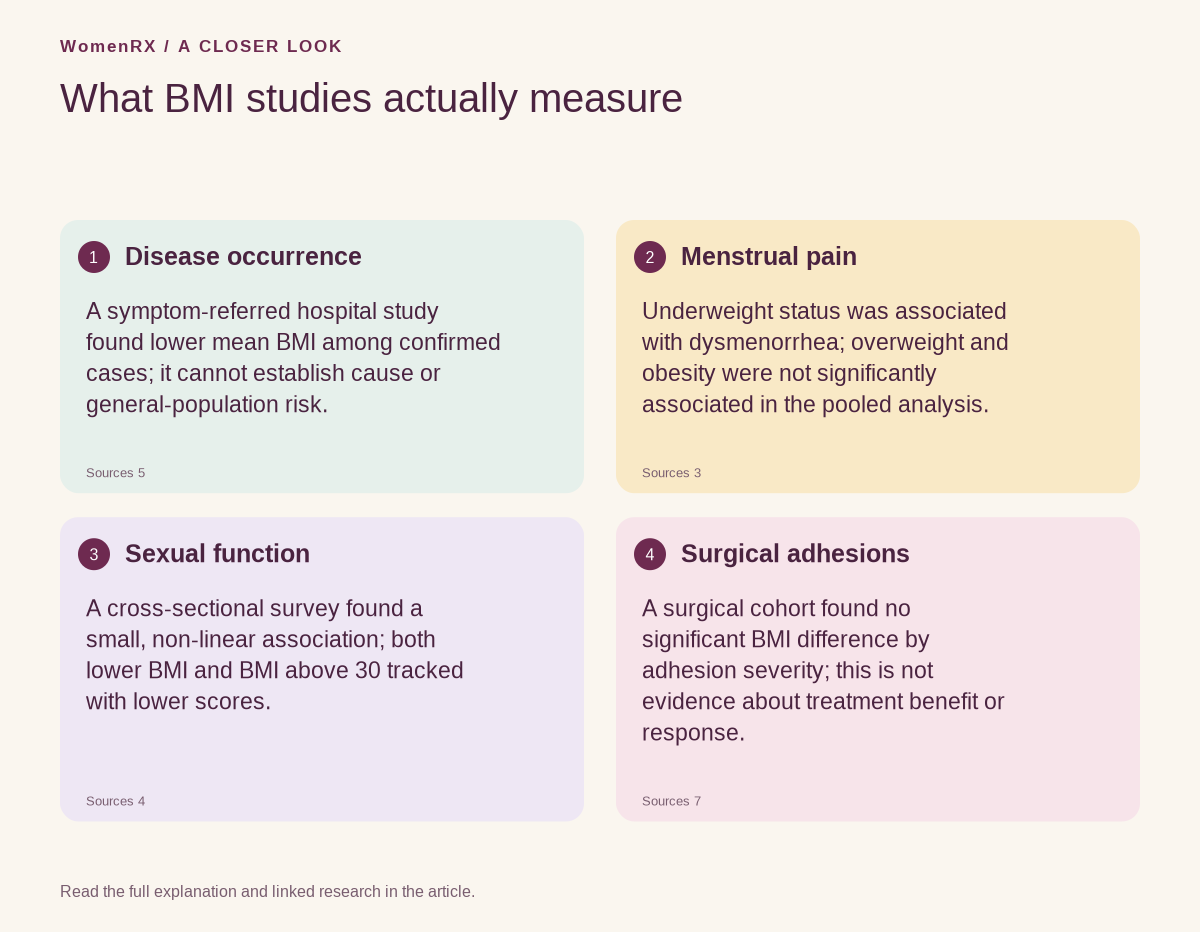
What BMI studies actually measure
Disease occurrence: A symptom-referred hospital study found lower mean BMI among confirmed cases; it cannot establish cause or general-population risk.5
Menstrual pain: Underweight status was associated with dysmenorrhea; overweight and obesity were not significantly associated in the pooled analysis.3
Sexual function: A cross-sectional survey found a small, non-linear association; both lower BMI and BMI above 30 tracked with lower scores.4
Surgical adhesions: A surgical cohort found no significant BMI difference by adhesion severity; this is not evidence about treatment benefit or response.7
Read the figure as text
These findings concern different outcomes. An association in one category does not establish that weight causes disease or that changing weight treats it.- Disease occurrence: A symptom-referred hospital study found lower mean BMI among confirmed cases; it cannot establish cause or general-population risk.5
- Menstrual pain: Underweight status was associated with dysmenorrhea; overweight and obesity were not significantly associated in the pooled analysis.3
- Sexual function: A cross-sectional survey found a small, non-linear association; both lower BMI and BMI above 30 tracked with lower scores.4
- Surgical adhesions: A surgical cohort found no significant BMI difference by adhesion severity; this is not evidence about treatment benefit or response.7
More questions, answered
Can BMI tell whether someone has endometriosis?
No. These studies report group-level associations, not a BMI test for diagnosis. BMI is a height-to-weight measure with limits, and it cannot distinguish muscle, bone, and fat. 15
Sources you can check
- Body Weight: MedlinePlusAccessed 2026-09-25Return to first citation
- Endometriosis - NHSAccessed 2026-09-25Return to first citation
- Association between Body Mass Index and Dysmenorrhea in Women with Endometriosis: A Systematic Review and Meta-Analysis.Apelian S, Taylor HS. · Gynecologic and obstetric investigation · 2026Return to first citation
- Association of body mass index on sexual function in women with endometriosis: A cross-sectional study.Vallée A, Ayoubi JM. · PloS one · 2026Return to first citation
- Associations between aggregate index of systemic inflammation and endometriosis risk utilizing logistic regression analysis.Chen J, Xu K, Xing Y, Liu S, Lu L. · Frontiers in medicine · 2026Return to first citation
- Associations of health and lifestyle factors with multidimensional quality of life among women with endometriosis: a cross-sectional study.Matek Sarić M, Ljubičić M, Sorić T, Sarić A, Marušić E, Abdi Mahmoud S, Čoklo M. · Frontiers in global women's health · 2026Return to first citation
- Risk factors for intraoperative adhesion in ovarian endometriosis patients: A retrospective study.Zhou L, Wang TF, Feng XS, Lai ZZ, Chen DZ, Chen PF, Jiang TT, Wang HL, Zheng ZQ. · Medicine · 2026Return to first citation