Body Weight and Fibroids: What the Evidence Shows
Some studies link higher body weight with having fibroids, but they don’t show that weight causes them or explains one person’s diagnosis.
Research on body weight and fibroid occurrence is mixed. One retrospective study found more fibroids among women categorized as overweight or obese, while a small case-control study found no significant association with BMI after adjustment. These findings describe groups, not an individual cause. They don’t establish whether changing weight shrinks fibroids or prevents them. 4 5
The short version: an association, not an explanation
Some research links higher body weight with the chance of having uterine fibroids. But the studies don’t agree, and an association in a group can’t tell you why a particular person has fibroids. It also doesn’t mean that changing your weight will prevent fibroids or make existing ones shrink.
Fibroids are common, noncancerous growths in or around the uterus. Their causes aren’t fully known. Age, family history and other factors can matter, and many people have fibroids without symptoms. 1
What the studies can, and can’t, tell us
A 2026 retrospective study compared fibroid occurrence across BMI categories among 1,170 women having routine health examinations. It reported higher occurrence in the groups categorized as overweight or obese than in the normal-weight group. The study also used external data for validation, but its authors described the findings as preliminary. Because it was observational, it can show a relationship, not establish that body weight caused fibroids. 4
A smaller matched case-control study in Eastern Sudan reached a different result: among 107 women with fibroids and 107 without, BMI wasn’t significantly associated with fibroids after adjustment. Its size and setting limit how widely the result can be applied, but it illustrates why a single study shouldn’t be treated as a settled answer. 5
Taken together, the evidence supports a possible population-level association, not a dependable way to predict who will develop fibroids. BMI is a height-and-weight measure, not a direct measure of body fat or a complete picture of health. 2
A risk association isn’t the same as fibroid growth or symptoms
The studies above compare fibroid occurrence or diagnosis across groups. They don’t establish that body weight determines how quickly a diagnosed fibroid will grow, where it will sit in the uterus, or how much it will bother you. Their findings also don’t establish whether losing weight shrinks fibroids or improves fibroid symptoms. 4 5
Symptoms can vary even among people who have fibroids. When symptoms occur, their pattern can depend on the fibroids’ size, number and location. Some people have no symptoms; others may have heavy or painful periods. 1 3
So a fibroid diagnosis isn’t a verdict about your habits or a clue that you need to lose weight to treat it. Your weight alone can’t tell you whether you have fibroids, how large they are, or whether they need treatment.
What this means for your diagnosis
If fibroids are suspected, a pelvic exam or imaging can help identify them. Ultrasound can show their number, size and location, which are more directly useful to understanding what’s going on than a BMI category. 1 3
If you already have a diagnosis, it’s reasonable to ask how the fibroids’ location and size relate to your symptoms and what options fit your situation. Treatment decisions depend on factors including symptoms, and treatment isn’t always needed when fibroids aren’t causing problems. 1 3
You can care for your overall health without treating weight change as a fibroid therapy. These studies don’t justify blaming weight for an individual diagnosis or promising that weight loss will prevent or shrink fibroids.
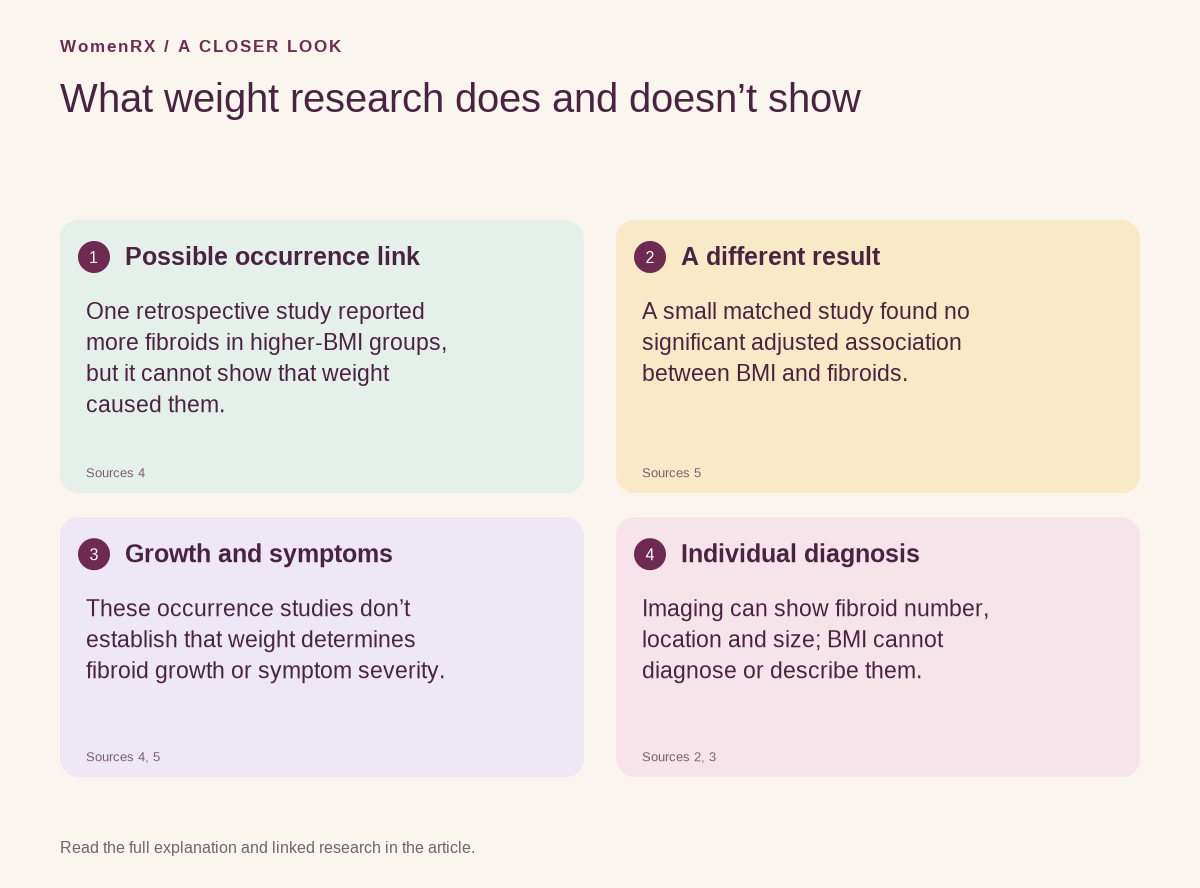
What weight research does and doesn’t show
Possible occurrence link: One retrospective study reported more fibroids in higher-BMI groups, but it cannot show that weight caused them.4
A different result: A small matched study found no significant adjusted association between BMI and fibroids.5
Growth and symptoms: These occurrence studies don’t establish that weight determines fibroid growth or symptom severity.45
Individual diagnosis: Imaging can show fibroid number, location and size; BMI cannot diagnose or describe them.23
Read the figure as text
The evidence separates group-level findings about fibroid occurrence from questions about an individual’s fibroids and symptoms.- Possible occurrence link: One retrospective study reported more fibroids in higher-BMI groups, but it cannot show that weight caused them.4
- A different result: A small matched study found no significant adjusted association between BMI and fibroids.5
- Growth and symptoms: These occurrence studies don’t establish that weight determines fibroid growth or symptom severity.45
- Individual diagnosis: Imaging can show fibroid number, location and size; BMI cannot diagnose or describe them.23
More questions, answered
Can losing weight shrink uterine fibroids?
The BMI studies cited above compare fibroid occurrence or diagnosis across groups. They don’t test whether losing weight changes the size of existing fibroids, so their findings can’t answer that question. 4 5
Can BMI tell me whether I have fibroids?
No. BMI can’t diagnose fibroids or show their size, number or location. A pelvic exam or imaging, often ultrasound, can help identify them. 1 3
Sources you can check
- Uterine Fibroids | Fibroids | MedlinePlusAccessed 2026-09-25Return to first citation
- Body Weight: MedlinePlusAccessed 2026-09-25Return to first citation
- Fibroids - NHSAccessed 2026-09-25Return to first citation
- Elevated Body Mass Index Associated With Uterine Fibroids: A Retrospective Cohort Study With Bioinformatic Validation.Lin J, Zhou L, Zhao M. · The journal of obstetrics and gynaecology research · 2026Return to first citation
- Association between uterine fibroids and hypertension among women of reproductive age in Eastern Sudan: a matched case-control study.Abdallah AA, Hassan OA, AlHabardi N, Adam I. · Scientific reports · 2026Return to first citation