Body Weight, Osteoporosis, and Fracture Risk
Weight can offer one clue about bone health, but it can’t tell you on its own whether you have osteoporosis or how likely you are to break a bone.
A low body mass index (BMI) is one factor associated with osteoporosis risk, but body weight is not a diagnosis or a reliable stand-alone forecast of fracture. BMI also can’t distinguish fat, muscle, and bone. Age, a previous fracture, bone density, and, for women, the bone loss that can follow menopause all matter when risk is assessed. 2 3 4
Weight is one clue, not a verdict
A lower BMI is recognized as a risk factor for osteoporosis. That makes weight relevant, but it doesn’t mean your weight reveals how strong your bones are. Osteoporosis involves reduced bone mass or changes in bone structure, and it often has no symptoms until a fracture occurs. 3 4
BMI compares weight with height. It doesn’t separate fat, muscle, bone, or water, so two people with the same BMI can have different body composition. It can also be less informative in some older adults, particularly when muscle has been lost. 2
The practical takeaway is that a number on the scale can’t confirm or rule out osteoporosis. Nor should you assume that a higher weight protects you from fractures, or that weight alone makes your risk high. Risk depends on more than body size.
What else changes the picture?
Age and menopause matter. Bone loss is part of aging, and women can lose bone more rapidly in the first few years after menopause. Menopause at an unusually young age or removal of the ovaries can also raise osteoporosis risk. These are reasons age and menopausal history may matter even when someone’s weight seems unremarkable. 3 4
A fracture history matters. In an osteoporosis assessment, a clinician may ask whether you have broken a bone before, review your medical history, and consider your risk of a future fracture. A bone density scan may also be part of the evaluation. 3
Bone density adds information BMI cannot. A fracture-risk estimate and a bone density scan answer different questions from the scale. A scan measures bone density; an overall risk assessment considers that result alongside personal factors such as age and fracture history. 3 4
A more useful way to interpret your weight
If you’re thinking about bone health, treat BMI as context rather than a scorecard. For example, a low BMI may be one reason to look more closely at other risk factors, but it doesn’t establish that you have osteoporosis. Likewise, a BMI that doesn’t seem concerning doesn’t rule out bone loss, especially if age, menopause, or a previous fracture raises questions.
A practical starting point is to consider the whole picture: your age, whether you’ve had a fracture, your menopausal history, and whether you’ve had a bone density scan or fracture-risk assessment. If you’re discussing this with a clinician, you can ask: “How do my weight and other risk factors fit together?” and “Would a bone density scan or formal fracture-risk assessment be useful for me?” Those questions focus the conversation on your actual risk, not a single number.
Weight is only one part of bone health. Regular physical activity and a diet with enough calcium and vitamin D are among the measures MedlinePlus lists for supporting bone strength; osteoporosis care may also involve fall prevention or medicine, depending on the person’s risk. 1 3
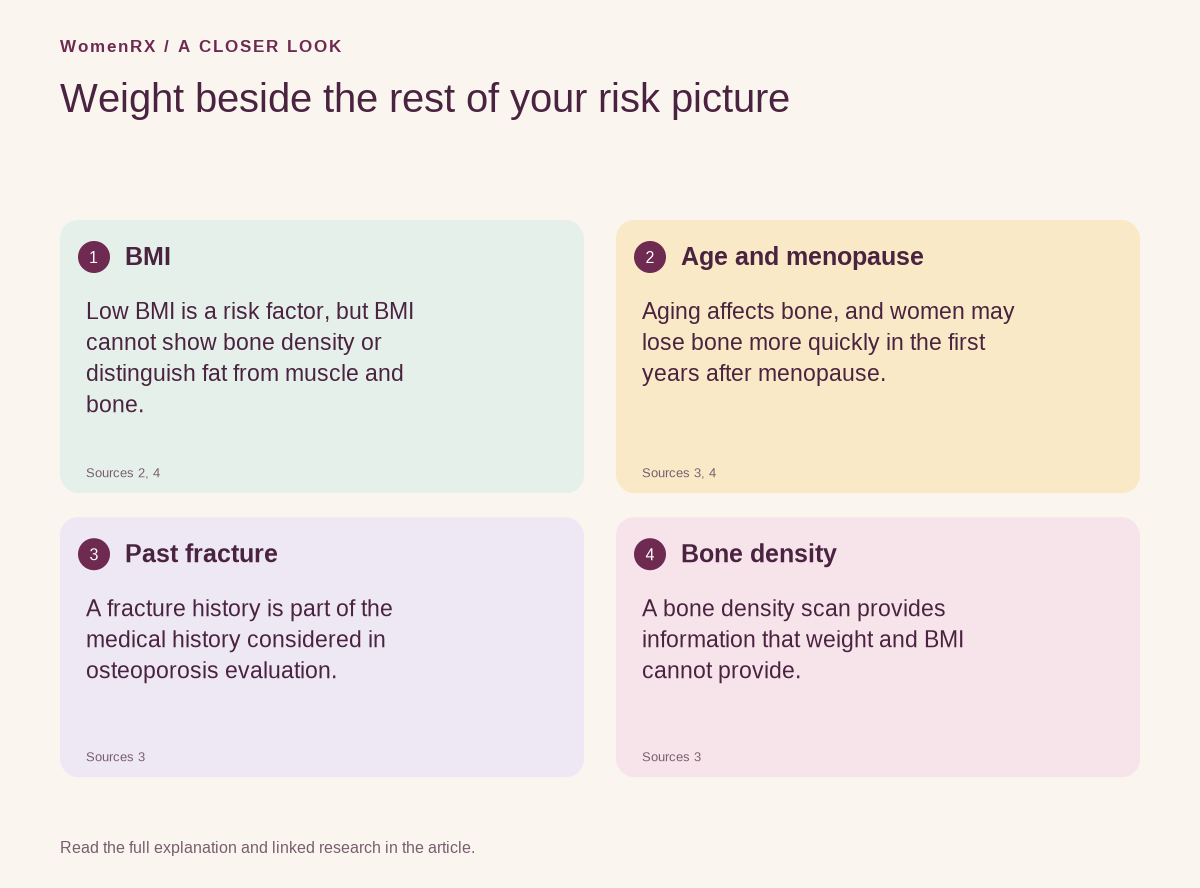
Weight beside the rest of your risk picture
BMI: Low BMI is a risk factor, but BMI cannot show bone density or distinguish fat from muscle and bone.24
Age and menopause: Aging affects bone, and women may lose bone more quickly in the first years after menopause.34
Past fracture: A fracture history is part of the medical history considered in osteoporosis evaluation.3
Bone density: A bone density scan provides information that weight and BMI cannot provide.3
Read the figure as text
BMI is one clue, while other personal and clinical details help explain bone and fracture risk.- BMI: Low BMI is a risk factor, but BMI cannot show bone density or distinguish fat from muscle and bone.24
- Age and menopause: Aging affects bone, and women may lose bone more quickly in the first years after menopause.34
- Past fracture: A fracture history is part of the medical history considered in osteoporosis evaluation.3
- Bone density: A bone density scan provides information that weight and BMI cannot provide.3
More questions, answered
Can a normal BMI rule out osteoporosis?
No. BMI doesn’t measure bone density, and osteoporosis may have no symptoms until a fracture. A bone density scan and an overall risk assessment provide different information from BMI. 2 3
Why does menopause come up in a bone-risk discussion?
Women can lose bone more rapidly in the first few years after menopause. Menopause at an unusually young age or removal of the ovaries can also increase osteoporosis risk. 4
Sources you can check
- Fracture | MedlinePlusAccessed 2026-09-25Return to first citation
- Body Weight: MedlinePlusAccessed 2026-09-25Return to first citation
- Osteoporosis | MedlinePlusAccessed 2026-09-25Return to first citation
- Osteoporosis - NHSAccessed 2026-09-25Return to first citation