Endometriosis and Fertility: Weighing Your Options
Your age, time trying, symptoms, and fertility findings can help clarify which options are worth discussing first.
Endometriosis doesn’t point to one fertility route for everyone. Age and time trying affect the urgency of an assessment; symptoms and disease location can make surgery relevant; and findings involving you or a partner may change the fertility plan. Trying without treatment, surgery, and assisted reproduction are all options in some situations, but bowel-endometriosis studies can’t rank them for everyone. 2 3 4 5
Start with your goal, not just the diagnosis
Endometriosis can affect areas around the uterus, including the ovaries and fallopian tubes, and can make it harder to get pregnant. But the diagnosis alone doesn’t show which fertility option fits you. Your pain, where the disease is, your pregnancy timeline, and findings from an evaluation all matter. Fertility factors can also involve a partner, so an assessment may need to consider both of you. 2 3
It helps to separate two goals: treating symptoms and trying to conceive. Hormone treatments can ease endometriosis pain, but they aren’t used while you’re trying to get pregnant. If pregnancy is your current priority, ask how a proposed pain treatment fits with that goal. 2
Timing is part of the decision
Age changes how long it may make sense to try before discussing fertility. MedlinePlus defines infertility as not becoming pregnant after a year of frequent, unprotected sex, or after six months if you’re 35 or older. Those are definitions, not instructions to wait before asking for help. MedlinePlus separately advises people over 40 or with past fertility concerns to seek advice when ready to try. 3
Guidance on when to seek an assessment isn’t identical to those definitions. The NHS advises asking for help after a year of trying, or sooner at age 36 or older or when there’s another reason for concern. That’s UK guidance rather than a US scheduling rule, but it reinforces a useful distinction: an existing concern can be a reason to start the conversation earlier. 1
An evaluation can help clarify whether endometriosis is the main issue or one part of a bigger picture. Testing differs for women and men and may include blood tests, imaging, and semen testing. You can ask what has been checked, what remains uncertain, and whether the results change the order of your options. 3
If you’ve had surgery before, bring the details if you have them. Ask what was removed and whether another operation is being considered for symptoms, anatomy, fertility, or more than one reason. If ovarian reserve is part of the discussion, ask whether assessing it would change the decision or timing. The bowel-endometriosis research discussed below doesn’t establish how a particular ovarian reserve result or prior ovarian surgery should change the order of treatment. 5
Three paths, with different trade-offs
Trying without surgery or fertility treatment may be an option to discuss if an evaluation hasn’t found another fertility factor and the time you’re comfortable trying fits your age and goals. It means avoiding an intervention for now, not ignoring a finding that may need its own plan. For example, if testing identifies damaged fallopian tubes or a partner’s fertility factor, ask how that finding changes the case for continuing to try without treatment. A pregnancy rate from a group study can’t predict what will happen for one person. 3
Surgery may be considered when disease or symptoms make it relevant, including when endometriosis affects the ability to have children. If significant pain or disease affecting another organ is part of the picture, an operation may be discussed for reasons beyond fertility. But surgery isn’t a guaranteed fertility boost. It can cause scarring or adhesions, and symptoms may return or further surgery may be needed. Ask what the operation is intended to improve, what could change for your fertility, and what the alternative would be. 2
Assisted reproduction may be considered before or after surgery. If an evaluation finds another fertility factor, or age and time trying make a longer period of trying less appealing, ask whether a fertility treatment plan should come before an operation intended mainly to address endometriosis. If symptoms are also driving the surgery discussion, ask how each route would address those symptoms as well as your pregnancy goal. Treatment for infertility depends on its causes, age, and time trying; the bowel-endometriosis evidence doesn’t establish a single best sequence. 3 5
One 2026 systematic review and meta-analysis looked specifically at bowel endometriosis. Across included studies, pooled cumulative pregnancy rates were 36% for spontaneous pregnancy without surgery, 40% for first-line medically assisted reproduction, 29% for spontaneous pregnancy after a primary surgical approach, and 56% overall after surgery. The review also reported 56% for assisted reproduction after surgery. These figures are not a head-to-head comparison: the patient groups and treatment sequences differed, and the review found high heterogeneity. They don’t show that one route causes better results for you. 4 5
That evidence applies to bowel endometriosis, not every form of the disease. A review of bowel endometriosis studies notes that coexisting conditions, differences in surgery, and inconsistent outcome reporting make results difficult to compare. So a percentage from this research shouldn’t be used as a personal forecast or a general ranking of surgery versus assisted reproduction. 5
Questions that can make the choice clearer
You might ask:
- What is the main reason you’re recommending this option: symptoms, anatomy, fertility, or a combination?
- What did the evaluation find about my fertility and my partner’s, if relevant? Does another finding need its own treatment plan? 3
- How does my age and time trying affect the timing of the next step? 3
- If surgery is proposed, what is the goal, and how might it affect the plan to conceive? 2
- If I choose assisted reproduction first, what would make us reconsider surgery?
- Would information about ovarian reserve change the sequence or timing in my case?
The most useful plan is one that connects the specific findings and your pregnancy goals to a next step, while being honest about what the evidence can’t predict.
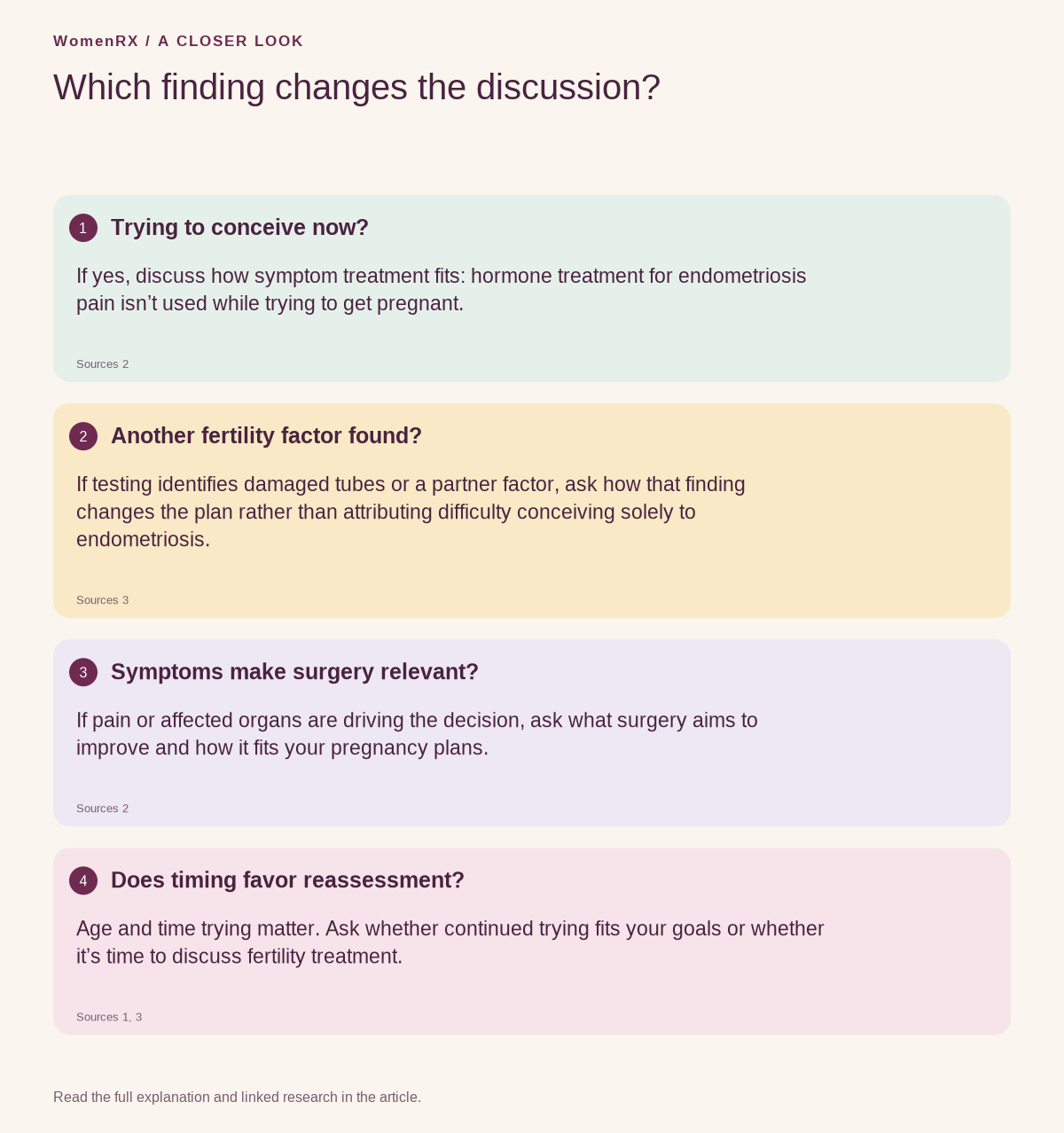
Which finding changes the discussion?
Trying to conceive now?: If yes, discuss how symptom treatment fits: hormone treatment for endometriosis pain isn’t used while trying to get pregnant.2
Another fertility factor found?: If testing identifies damaged tubes or a partner factor, ask how that finding changes the plan rather than attributing difficulty conceiving solely to endometriosis.3
Symptoms make surgery relevant?: If pain or affected organs are driving the decision, ask what surgery aims to improve and how it fits your pregnancy plans.2
Does timing favor reassessment?: Age and time trying matter. Ask whether continued trying fits your goals or whether it’s time to discuss fertility treatment.13
Read the figure as text
These are different branches of a conversation, not steps everyone must follow in order.- Trying to conceive now?: If yes, discuss how symptom treatment fits: hormone treatment for endometriosis pain isn’t used while trying to get pregnant.2
- Another fertility factor found?: If testing identifies damaged tubes or a partner factor, ask how that finding changes the plan rather than attributing difficulty conceiving solely to endometriosis.3
- Symptoms make surgery relevant?: If pain or affected organs are driving the decision, ask what surgery aims to improve and how it fits your pregnancy plans.2
- Does timing favor reassessment?: Age and time trying matter. Ask whether continued trying fits your goals or whether it’s time to discuss fertility treatment.13
More questions, answered
Should I wait a year before asking about fertility?
Not necessarily. MedlinePlus’s one-year threshold, or six months at age 35 or older, defines infertility; it isn’t an instruction to wait before asking. MedlinePlus advises seeking guidance when ready to try if you’re over 40 or have past fertility concerns. UK guidance also advises asking sooner than a year if you’re 36 or older or have another reason for concern. 3 1
Does endometriosis surgery guarantee better fertility?
No. Surgery is one option, but the available bowel endometriosis studies don’t establish that it improves pregnancy chances for every patient or that it is better than assisted reproduction. The evidence is difficult to compare across different patient groups and approaches. 4 5
Sources you can check
- Diagnosis of infertility - NHSAccessed 2026-09-25Return to first citation
- Endometriosis - NHSAccessed 2026-09-25Return to first citation
- Infertility | Infertility Treatments | MedlinePlusAccessed 2026-09-25Return to first citation
- Cumulative Pregnancy Rates Among Patients With Bowel Endometriosis According to Therapeutic Approach. A Systematic Review and Meta-Analysis.Larraín D, Heredia F, Maisto MLÁ, Claure F, Caradeux J. · Journal of minimally invasive gynecology · 2026Return to first citation
- Infertility management in patients with bowel endometriosis: the current landscape and the promise of randomised trialsLarraín D, Caradeux J, Maisto MD, Claure F, Villegas-Echeverry JD, Heredia F, Kondo W. · Facts, views & vision in ObGyn · 2025Return to first citation