Endometriosis and Fertility: Questions That Shape Your Options
Your age, symptoms, fertility assessment, and timeline can help clarify whether to keep trying, consider surgery, or move toward assisted reproduction.
Endometriosis doesn’t tell you on its own whether you’ll conceive or which treatment is right for you. A useful fertility discussion connects your age and time trying with your symptoms, ovarian findings, other fertility factors, and how soon you hope to become pregnant. Prior treatment and its results can help identify what still needs attention, but surgery before IVF hasn’t reliably improved live-birth outcomes. 3 4 5
Start with the outcome you want most
Before comparing treatments, be clear about your near-term goal. Are you hoping to try for pregnancy now, relieve pain that’s disrupting daily life, or understand your options before deciding? Those aims can point toward different paths. Treatment for infertility depends partly on its cause, how long you’ve been trying, and your age; endometriosis care also includes symptom treatment and, in some situations, surgery. 2 3
Endometriosis can be associated with difficulty getting pregnant, but the diagnosis alone can’t predict an individual outcome. Fertility concerns may involve more than one factor, including ovulation, the fallopian tubes, the uterus, or a partner’s fertility. A broader assessment can help keep the decision from resting on the endometriosis diagnosis alone. 2 3
Ask how age and timing change the plan
Age matters to fertility treatment decisions, and MedlinePlus notes that egg production can be affected by aging. It defines infertility after a year of trying, or after six months if you’re 35 or older. Those are diagnosis timeframes, not a way to choose between treatment options. 3
Consider asking: “Given my age and how long I’ve been trying, what would we gain or risk by waiting?” If you have a specific window in mind for pregnancy, say so. A plan that might suit someone with more time to try may not suit someone whose priority is moving toward treatment sooner. The available comparisons of surgery and assisted reproduction don’t establish one best sequence for everyone. 3 4 5
Clarify what the fertility assessment shows
Ask which findings are known and which still need evaluation. Depending on your situation, infertility testing may include blood tests or imaging, and may also assess a partner’s semen. The aim is to consider potential contributors across both partners, not only the endometriosis. 3
If ovarian reserve comes up, ask what the result can and can’t tell you about your options. This is especially relevant if surgery involving an ovarian endometrioma is being considered: a 2026 review found that, in its ovarian-endometrioma subgroup, surgery before IVF/ICSI was associated with lower AMH and fewer retrieved eggs. These group-level findings don’t predict an individual result, and the review rated the overall evidence very low in certainty. 4
Separate symptom relief from fertility treatment
Surgery may be discussed when endometriosis affects the ability to have children or symptoms are a major concern. But symptom relief and improving the chance of a live birth are different goals. In a 2024 review of 19 studies comparing surgery before IVF/ICSI with IVF/ICSI without prior surgery, live-birth rates per cycle did not differ significantly overall. After studies at high risk of bias were excluded, the surgery-first group had a lower live-birth rate per cycle. 2 5
Hormonal treatment for symptoms also needs a different conversation when you’re trying to conceive. NHS guidance says hormones aren’t given while someone is trying to get pregnant. If you’re weighing pregnancy attempts against pain control, ask what the symptom plan would be during that time. 2
A separate 2026 review of 22 studies involving 3,590 participants with ovarian endometriomas or deep infiltrating endometriosis also found no significant live-birth improvement from surgery followed by IVF/ICSI compared with IVF/ICSI alone. Its authors cautioned that the evidence was very low certainty and studies had limitations. Taken together, these reviews don’t support assuming surgery before IVF will improve fertility, but they also don’t settle every situation. 4
If surgery is on the table, useful questions include: “What specific problem is the operation meant to address?” “Is the aim pain relief, treating a finding, or improving fertility?” and “How might it affect my ovarian reserve or the timing of fertility treatment?” Surgery has general risks, including infection, bleeding, reactions to anesthesia, or accidental injury. 1 4
Use earlier treatment as information, not a verdict
If you’ve had surgery, note what it was intended to address and what changed afterward, such as whether symptoms improved. Those details can help frame whether the next discussion is mainly about symptom management, fertility, or both. They don’t prove that surgery improved fertility: reviews comparing surgery before IVF/ICSI with IVF/ICSI without prior surgery have not found a reliable live-birth advantage. In the ovarian-endometrioma subgroup of one review, surgery was associated with lower AMH and fewer retrieved eggs, so ovarian findings may matter when discussing the next step. 4 5
If you’ve used hormonal treatment for symptoms, how well it controlled pain is relevant to a symptom plan, but it doesn’t by itself establish your ability to conceive. If you’ve already had fertility treatment, discuss what the results showed and what remains unexplained; the studies comparing surgery-first with IVF/ICSI don’t tell you what to do after a particular treatment result. Fertility treatment decisions also depend on factors such as age, time trying, and the cause of infertility. 2 3 4 5
Compare paths without treating them as a ranking
Depending on your findings and priorities, the discussion may include trying to conceive without fertility treatment, surgery, or assisted reproduction such as IVF. In people with bowel endometriosis, one review reported pregnancies after both non-surgical and surgery-first approaches, but results varied across studies and the authors emphasized tailoring decisions to individual goals and symptoms. Those findings apply to bowel endometriosis and shouldn’t be treated as a forecast for every type of endometriosis. 6
You can leave the conversation with a plan rather than a universal answer: what you’re trying first, what would prompt a change, and how that timing fits your goals. If pain is central, ask how the proposed fertility path addresses it as well as pregnancy. If becoming pregnant soon is central, ask how each option affects the time before trying or treatment can begin. The trade-off is personal, and the evidence does not make one route best for every person. 2 4 6
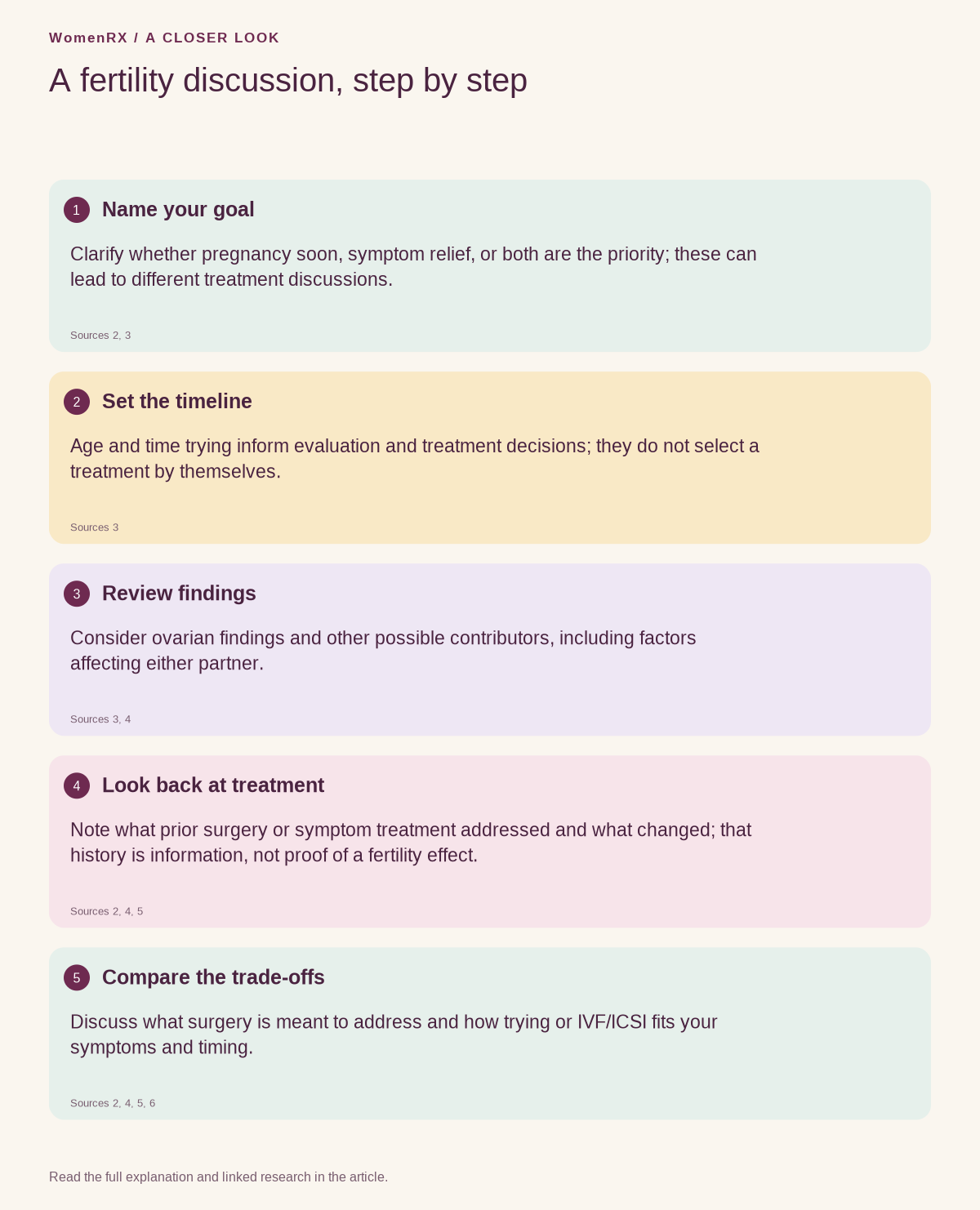
A fertility discussion, step by step
Name your goal: Clarify whether pregnancy soon, symptom relief, or both are the priority; these can lead to different treatment discussions.23
Set the timeline: Age and time trying inform evaluation and treatment decisions; they do not select a treatment by themselves.3
Review findings: Consider ovarian findings and other possible contributors, including factors affecting either partner.34
Look back at treatment: Note what prior surgery or symptom treatment addressed and what changed; that history is information, not proof of a fertility effect.245
Compare the trade-offs: Discuss what surgery is meant to address and how trying or IVF/ICSI fits your symptoms and timing.2456
Read the figure as text
Use these questions to connect your goals and assessment findings with the trade-offs between trying, surgery, and assisted reproduction.- Name your goal: Clarify whether pregnancy soon, symptom relief, or both are the priority; these can lead to different treatment discussions.23
- Set the timeline: Age and time trying inform evaluation and treatment decisions; they do not select a treatment by themselves.3
- Review findings: Consider ovarian findings and other possible contributors, including factors affecting either partner.34
- Look back at treatment: Note what prior surgery or symptom treatment addressed and what changed; that history is information, not proof of a fertility effect.245
- Compare the trade-offs: Discuss what surgery is meant to address and how trying or IVF/ICSI fits your symptoms and timing.2456
More questions, answered
Does endometriosis mean I’ll need IVF?
No. Endometriosis can be associated with difficulty getting pregnant, but treatment depends on the cause, how long you’ve been trying, age, and other fertility factors. The available comparisons don’t establish one treatment path for everyone. 2 3 4
Should I have surgery before IVF?
Not automatically. Reviews have not found a clear live-birth benefit from routine surgery before IVF/ICSI, and one review found lower AMH and fewer retrieved eggs after surgery in its ovarian-endometrioma subgroup. Ask what specific symptom or finding surgery would address and how that fits your fertility timeline. 4 5
Does symptom improvement after treatment mean my fertility improved?
Not necessarily. Symptom relief and fertility outcomes are different measures. How symptoms responded can inform a pain-management discussion, but a response to hormonal symptom treatment doesn’t establish whether you’ll conceive. 2 4 5
Sources you can check
- Surgery: MedlinePlusAccessed 2026-09-25Return to first citation
- Endometriosis - NHSAccessed 2026-09-25Return to first citation
- Infertility | Infertility Treatments | MedlinePlusAccessed 2026-09-25Return to first citation
- IVF/ICSI or surgery as first approach for the treatment of infertility associated with ovarian and deep infiltrating endometriosis? A systematic review and meta-analysis.Riemma G, García-Velasco JA, Abrão MS, Leone Roberti Maggiore U, Vignali M, Solima E, Ceccaroni M, Chiantera V, Moawad GN, Laganà AS, Agrifoglio V, De Franciscis P, Donna MCD, D'Am... · Reproductive biomedicine online · 2026Return to first citation
- Impact of Endometriosis Surgery on In Vitro Fertilization/Intracytoplasmic Sperm Injection Outcomes: a Systematic Review and Meta-analysis.Bourdon M, Peigné M, Maignien C, de Villardi de Montlaur D, Solignac C, Darné B, Languille S, Bendifallah S, Santulli P. · Reproductive sciences (Thousand Oaks, Calif.) · 2024Return to first citation
- Cumulative Pregnancy Rates Among Patients With Bowel Endometriosis According to Therapeutic Approach. A Systematic Review and Meta-Analysis.Larraín D, Heredia F, Maisto MLÁ, Claure F, Caradeux J. · Journal of minimally invasive gynecology · 2026Return to first citation