Endometriosis: How Diagnosis and Treatment Choices Fit Together
Symptoms can guide an endometriosis evaluation, but a normal scan does not rule it out, and surgery isn’t always the first step.
Evaluation usually starts with your symptoms and may include an examination and ultrasound. MRI can help assess some forms of endometriosis, but routine imaging can miss small, superficial lesions. Treatment may involve pain relief or hormonal medicines, with surgery considered in some situations. The right next step depends on how symptoms affect your life and whether you’re trying to become pregnant. 1 2 3
Start with the pattern, not a single test
Endometriosis can cause pain that affects daily life, and symptoms can overlap with other conditions, including adenomyosis. There isn’t one presentation that everyone has to match. If period pain or other symptoms are affecting school, work, relationships, or everyday activities, that’s a reasonable reason to ask about an evaluation, including for an adolescent whose periods have started. 1
An appointment may include questions about your symptoms and family history, followed by an abdominal or pelvic examination. An internal examination may be offered, but the NHS describes it as something a clinician may ask to do, not an automatic requirement. You can ask what the examination is intended to clarify before deciding. 1
A response to hormonal treatment can inform the discussion, but it doesn’t prove that you have endometriosis. Hormones may also ease symptoms from other conditions, so improvement alone isn’t a specific diagnostic test. 3
What ultrasound and MRI can, and can’t, show
Ultrasound may be done over the abdomen or internally. Imaging can help find or assess some forms of endometriosis. Reviews describe MRI as useful alongside ultrasound, particularly when looking for endometriomas or deeper disease and when planning treatment. Which scan is useful depends on the question being asked. 1 2
A normal scan doesn’t rule out endometriosis. Small, superficial lesions can be difficult to see with conventional imaging. That limitation matters: a reassuring result may narrow what imaging has found, but it doesn’t by itself explain away persistent symptoms. 3
When surgery enters the conversation
Surgery is one possible step, not a requirement for everyone. It may be discussed when other treatments haven’t helped, when there is extensive disease, or when endometriosis may be affecting fertility. Laparoscopy can allow a surgeon to see lesions directly, but whether surgery is useful depends on your symptoms, imaging, goals, and the question you need answered. 1 3
Before deciding, ask what the proposed procedure is meant to achieve: diagnosis, treatment of visible disease, or both. If you’re hoping to become pregnant, make that goal part of the conversation before choosing a plan. Ask what surgery is expected to do for your specific situation, and whether its likely benefits fit your fertility goals. 1
Match treatment to your current priorities
Painkillers and hormonal medicines offer different approaches to symptom relief. The NHS lists painkillers such as paracetamol or ibuprofen; hormonal medicines, including the combined contraceptive pill, change hormone levels and can ease pain. If either approach helps you function better day to day, that matters, even though relief alone doesn’t establish a diagnosis. The side effects to weigh depend on the particular medicine being considered, so ask what to expect from that option rather than assuming all treatments have the same downsides. 1 3
Trying for pregnancy changes the choice: the NHS says hormonal treatment won’t be given when you’re trying to get pregnant. That makes it useful to say clearly whether pregnancy is a current goal, a future goal, or not a goal. If endometriosis is suspected, or symptoms remain disruptive despite treatment, a referral to a gynecologist may help you consider further evaluation and options, including whether surgery is appropriate. 1
A practical way to frame the decision is: What symptom are we trying to improve? What might this option change in daily life? Which side effects would make it a poor fit for me? Does it fit my pregnancy plans? What would make us reconsider the plan? Those questions keep the discussion focused on your priorities without assuming one treatment suits everyone.
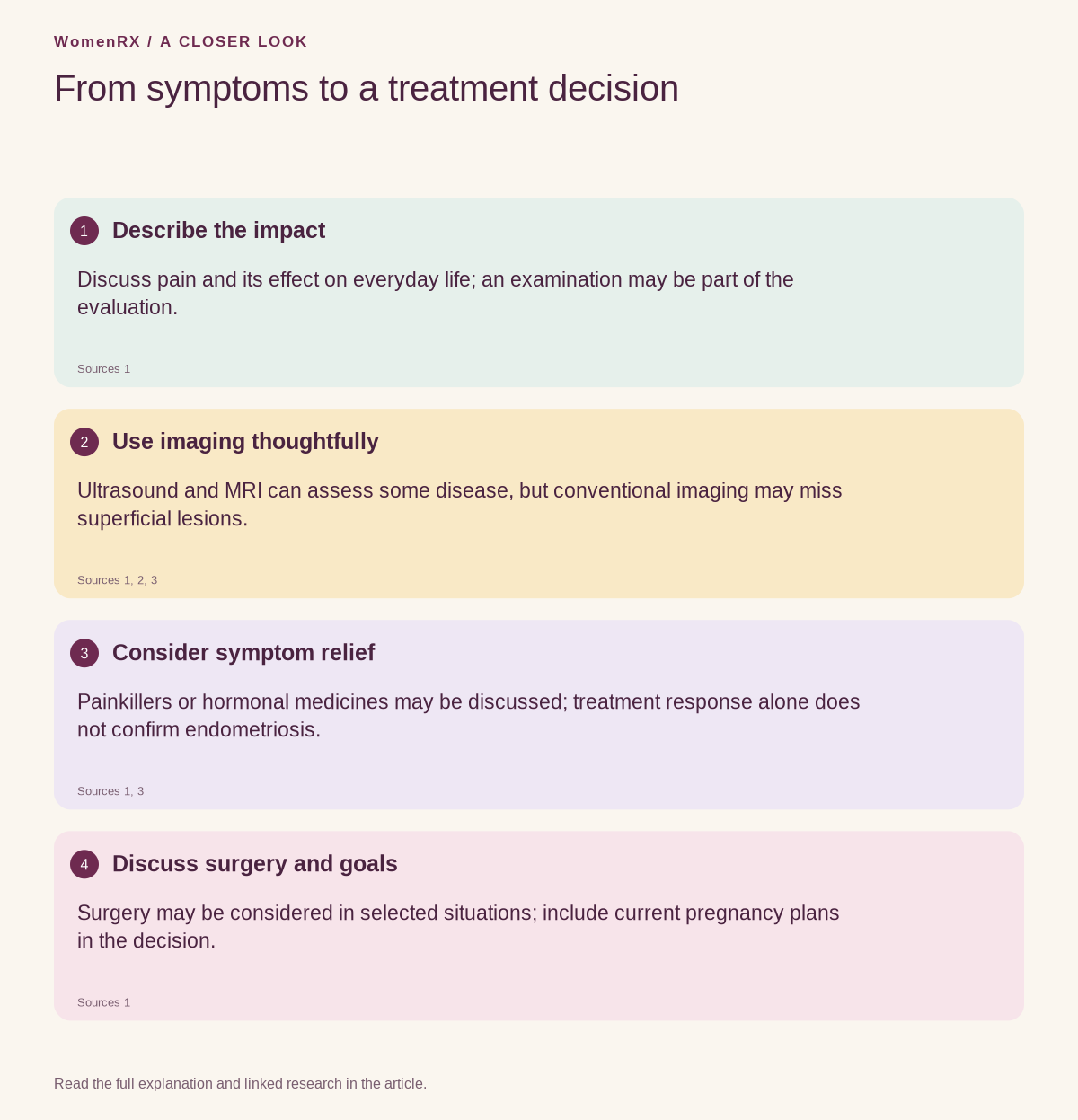
From symptoms to a treatment decision
Describe the impact: Discuss pain and its effect on everyday life; an examination may be part of the evaluation.1
Use imaging thoughtfully: Ultrasound and MRI can assess some disease, but conventional imaging may miss superficial lesions.123
Consider symptom relief: Painkillers or hormonal medicines may be discussed; treatment response alone does not confirm endometriosis.13
Discuss surgery and goals: Surgery may be considered in selected situations; include current pregnancy plans in the decision.1
Read the figure as text
This pathway shows how assessment, imaging, and treatment discussions can contribute without making surgery or a positive scan a requirement for every person.- Describe the impact: Discuss pain and its effect on everyday life; an examination may be part of the evaluation.1
- Use imaging thoughtfully: Ultrasound and MRI can assess some disease, but conventional imaging may miss superficial lesions.123
- Consider symptom relief: Painkillers or hormonal medicines may be discussed; treatment response alone does not confirm endometriosis.13
- Discuss surgery and goals: Surgery may be considered in selected situations; include current pregnancy plans in the decision.1
More questions, answered
Does a normal ultrasound mean I don’t have endometriosis?
No. Small or superficial lesions can be hard to see with conventional imaging, so a normal scan does not rule out endometriosis. 3
Do I need surgery to find out whether I have endometriosis?
Not necessarily. Surgery may be considered when other treatment has not helped, disease appears extensive, or fertility is a concern. Whether it is worthwhile depends on the individual situation. 1 3
Sources you can check
- Endometriosis - NHSAccessed 2026-09-25Return to first citation
- Navigating complexity: review and updates of endometriosis and adenomyosis imaging.Dev H, Falkner NM, Lee E. · The British journal of radiology · 2026Return to first citation
- Superficial Peritoneal Endometriosis Beyond Surgical Diagnosis: A Narrative Review of Emerging Functional and Molecular Perspectives.Palumbo M, D'Angelo G, Colacurci D, Baldini GM, La Verde M, Watrowski R, Carone V, Bifulco G, Giampaolino P, Della Corte L. · Medicina (Kaunas, Lithuania) · 2026Return to first citation