Endometriosis and Hormones: What the Link Really Means
Endometriosis responds to ovarian hormones, but that doesn’t mean it causes a whole-body hormone imbalance.
Estrogen can support endometriosis activity, and symptoms can flare around menstruation. Hormone treatments aim to reduce pain or disease activity by changing ovarian hormone signals; they don’t cure endometriosis or work for everyone. Some lesions may respond less to progesterone than expected. After menopause, symptoms usually ease, but they can persist, and evidence about menopausal hormone therapy in women with endometriosis remains limited. Low-quality evidence suggests estrogen-only therapy may carry a higher endometriosis recurrence risk than combined estrogen-progestogen therapy. 1 2 3
Hormone-responsive doesn’t mean hormone imbalance
Endometriosis involves tissue similar to the lining of the uterus growing elsewhere. It’s often described as estrogen-responsive: estrogen can support lesion activity. That’s different from saying endometriosis causes your body’s hormones to become generally “out of balance.” These findings describe how lesions respond to hormone signals; that responsiveness, by itself, doesn’t establish a generalized hormone imbalance throughout the body. 3 6
The distinction matters because a blood hormone test and the hormone activity within a lesion aren’t the same thing. A 2026 retrospective study of women having frozen embryo transfers found that serum progesterone levels in the endometriosis group were comparable to those in unaffected controls. That specific fertility-treatment finding doesn’t explain hormone signaling in every lesion or every person, but it shows why a simple claim of low progesterone throughout the body would go too far. 5
Why symptoms can follow your cycle
During a period, endometriosis patches can break down and bleed, but that blood cannot leave the body in the way menstrual blood does. This helps explain why severe pain may show up around menstruation. It isn’t the whole story: pelvic pain can happen at other times, too. 1
Ovarian hormones are another part of the picture. Peritoneal-fluid estrogen and progesterone concentrations vary across cycle phases and are higher than blood concentrations after ovulation. Those measurements help describe the hormone environment around pelvic lesions; they cannot, on their own, tell you why a particular day is painful. 7
Lesions may also respond differently from the uterine lining. A proposed feature of endometriosis is “progesterone resistance,” meaning some lesion tissue may not respond to progesterone as expected. This is a tissue-level response, not proof that progesterone is low in your bloodstream. The mechanisms are still being studied. 2 7
That difference may help explain why similar treatments don’t bring the same relief to everyone. In a cross-sectional study of 86 women treated after endometriosis surgery, pain response varied across patients and lesion characteristics. The study is too small to establish a reliable test for choosing treatment, but it illustrates that hormone responsiveness isn’t identical for everyone. 2
What hormone treatments are trying to do
These treatments take different routes to changing the hormone environment. Oral contraceptives are a contraceptive option that suppresses ovulation; progestins offer a progestogen-based approach without the estrogen component of a combined contraceptive. Both are used to manage endometriosis-related pain, but neither is a test of whether your own progesterone is “low.” 4 7
GnRH medicines act further upstream, on signals between the pituitary gland and the ovaries. GnRH antagonists block pituitary GnRH receptors, reducing signals that prompt ovarian estrogen production. GnRH agonists also reduce ovarian hormone secretion, though they work differently from antagonists. 4 6
A helpful way to compare them is by their purpose: hormonal treatment changes the conditions that can support symptoms; it doesn’t remove every lesion or guarantee lasting relief. Some people have little or no improvement, and symptoms can return after treatment stops. 1 4
After menopause: usually quieter, not always gone
Endometriosis symptoms usually stop after menopause, but they can continue. So menopause often changes the hormone environment without serving as a guaranteed off switch for symptoms. 1
Menopausal hormone therapy is a separate question from treatment during cycling years. Evidence on endometriosis recurrence with menopausal hormone therapy remains limited. Low-quality evidence discussed in the cited paper suggests estrogen-only therapy may carry a higher recurrence risk than combined estrogen-progestogen therapy. In a South Korean matched observational cohort of postmenopausal women with current or past endometriosis, estrogen-only hormone therapy was associated with higher ovarian cancer risk. That finding concerns ovarian cancer, not whether an individual woman’s endometriosis will return, and it does not establish cause and effect. 3
The practical takeaway is to separate three questions: whether your symptoms track your cycle, whether a treatment is changing hormone signals to manage symptoms, and whether symptoms continue after menopause. They’re related, but they aren’t interchangeable evidence of a general hormone imbalance.
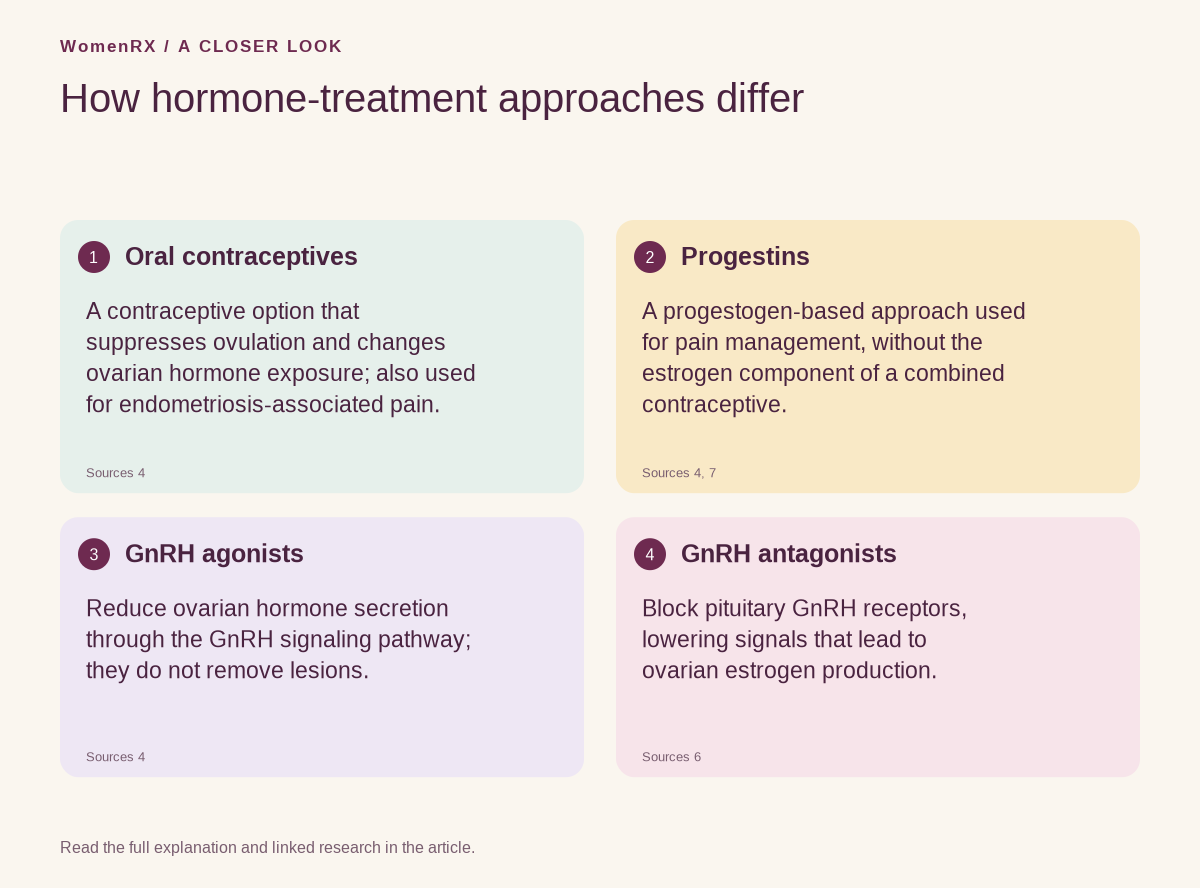
How hormone-treatment approaches differ
Oral contraceptives: A contraceptive option that suppresses ovulation and changes ovarian hormone exposure; also used for endometriosis-associated pain.4
Progestins: A progestogen-based approach used for pain management, without the estrogen component of a combined contraceptive.47
GnRH agonists: Reduce ovarian hormone secretion through the GnRH signaling pathway; they do not remove lesions.4
GnRH antagonists: Block pituitary GnRH receptors, lowering signals that lead to ovarian estrogen production.6
Read the figure as text
The options act on hormone signaling in different ways; this comparison shows their aims, not a ranking.- Oral contraceptives: A contraceptive option that suppresses ovulation and changes ovarian hormone exposure; also used for endometriosis-associated pain.4
- Progestins: A progestogen-based approach used for pain management, without the estrogen component of a combined contraceptive.47
- GnRH agonists: Reduce ovarian hormone secretion through the GnRH signaling pathway; they do not remove lesions.4
- GnRH antagonists: Block pituitary GnRH receptors, lowering signals that lead to ovarian estrogen production.6
More questions, answered
Does endometriosis mean my progesterone is low?
Not necessarily. “Progesterone resistance” describes a possible reduced response in some endometriosis tissue; it doesn’t establish low progesterone in the blood. In a retrospective study of women undergoing frozen embryo transfer, serum progesterone levels in the endometriosis group were comparable to those in unaffected controls. 5 7
Do hormone treatments cure endometriosis?
They’re used to manage symptoms or disease activity, not as a guaranteed cure. Treatments don’t work equally well for everyone, and symptoms may return after treatment stops. 1 4
Sources you can check
- Endometriosis - NHSAccessed 2026-09-25Return to first citation
- The role of progesterone and estrogen receptors in treatment choice after endometriosis surgery: A cross-sectional study.Poordast T, Alborzi S, Kiani Z, Omidifar N, Askary E, Chamanara K, Shokripour M, Keshtvarz Hesam Abadi A. · International journal of reproductive biomedicine · 2024Return to first citation
- Impact of Hormone Replacement Therapy on Risk of Ovarian Cancer in Postmenopausal Women with De Novo Endometriosis or a History of Endometriosis.Lee HJ, Lee B, Choi H, Kim T, Kim Y, Kim YB. · Cancers · 2023Return to first citation
- Understanding Peritoneal Fluid Estrogen and Progesterone Concentrations Permits Individualization of Medical Treatment of Endometriosis-Associated Pain with Lower Doses, Especially in Adolescents Not Requiring Contraception.Koninckx PR, Ussia A, Adamyan L, Wattiez A, Vigano P. · Journal of clinical medicine · 2025Return to first citation
- Serum progesterone concentrations at frozen embryo transfer in women with adenomyosis and endometriosis: a retrospective cohort study.Angelini E, Grecchi G, Vanni VS, Pagliardini L, Ferrari SM, Candiani M, Papaleo E. · Reproductive biology and endocrinology : RB&E · 2026Return to first citation
- Profile of Linzagolix in the Management of Endometriosis, Including Design, Development and Potential Place in Therapy: A Narrative Review.Donnez J, Cacciottola L, Squifflet JL, Dolmans MM. · Drug design, development and therapy · 2023Return to first citation
- Peritoneal fluid progesterone and progesterone resistance in superficial endometriosis lesions.Koninckx PR, Ussia A, Adamyan L, Gomel V, Martin DC. · Human reproduction (Oxford, England) · 2022Return to first citation