Adenomyosis and Hormones: What the Link Means
Adenomyosis appears to involve hormone signaling inside uterine tissue, but that is not the same as proving a whole-body hormone imbalance.
Adenomyosis is linked to estrogen and progesterone signaling in the uterus: research describes local estrogen activity and a reduced response to progesterone in adenomyotic tissue. The NHS says hormone-based treatments can ease period symptoms. 1 The tissue findings do not show that everyone with adenomyosis has abnormal hormone levels throughout the body. 2 3
A uterine hormone response isn’t a whole-body diagnosis
Adenomyosis happens when tissue from the uterine lining grows into the muscle wall. It can be associated with painful or heavy periods, pelvic pain, bloating, or pain during sex, though some people have no symptoms. 1
Hormones are part of the picture, but the distinction is where they act. Research has found changes in estrogen and progesterone signaling in adenomyotic tissue. That points to a local process in the uterus. It does not establish that a person with adenomyosis has unusually high estrogen, low progesterone, or another hormone imbalance throughout the body. 2 3
What researchers mean by local signaling
A review of adenomyosis and endometriosis describes increased local estrogen production through the enzyme aromatase, altered estrogen action involving the estrogen receptor beta, and reduced progesterone receptor expression. It characterizes this as progesterone resistance: tissue may respond differently to progesterone, rather than the finding simply meaning there is too little progesterone in the bloodstream. 3
A laboratory study gives one example of how researchers examine this. It found estrogen and progesterone receptors in adenomyotic tissue; when researchers exposed adenomyotic cells to estradiol, cell proliferation increased. The study examined tissue and cells, not the hormone levels or symptoms of every person with adenomyosis. So it helps explain a possible local mechanism, but it cannot establish an individual’s whole-body hormone profile. 2
This is why “hormone-responsive” and “hormone imbalance” aren’t interchangeable. A tissue’s altered response to hormones does not, by itself, tell you whether hormone levels in the blood are abnormal. These studies don’t establish a hormone test that diagnoses adenomyosis or identifies a single hormone pattern for everyone with it. 2 3
Why hormone-based treatments may still help
Some treatments for adenomyosis act on the menstrual cycle or uterine lining. The NHS lists an intrauterine system (IUS, or hormonal coil, including Mirena), which thins the womb lining and can make periods lighter and less painful, as well as other hormonal contraceptives. It also lists nonhormonal options such as NSAIDs and tranexamic acid. 1
A treatment that eases bleeding or pain does not, by itself, prove that a whole-body hormone imbalance caused those symptoms. It may work by changing the uterine lining or menstrual bleeding. Which options make sense depends on the symptoms and the person’s circumstances. 1
These tissue findings do not establish a hormone pattern after menopause. 2 3
The useful takeaway is that adenomyosis can involve altered hormone signaling in uterine tissue, while a systemic hormone imbalance is a separate claim. If you’re discussing treatment, it can help to ask what a proposed option is intended to improve, such as pain or heavy bleeding, rather than assuming it is meant to correct a specific blood hormone level.
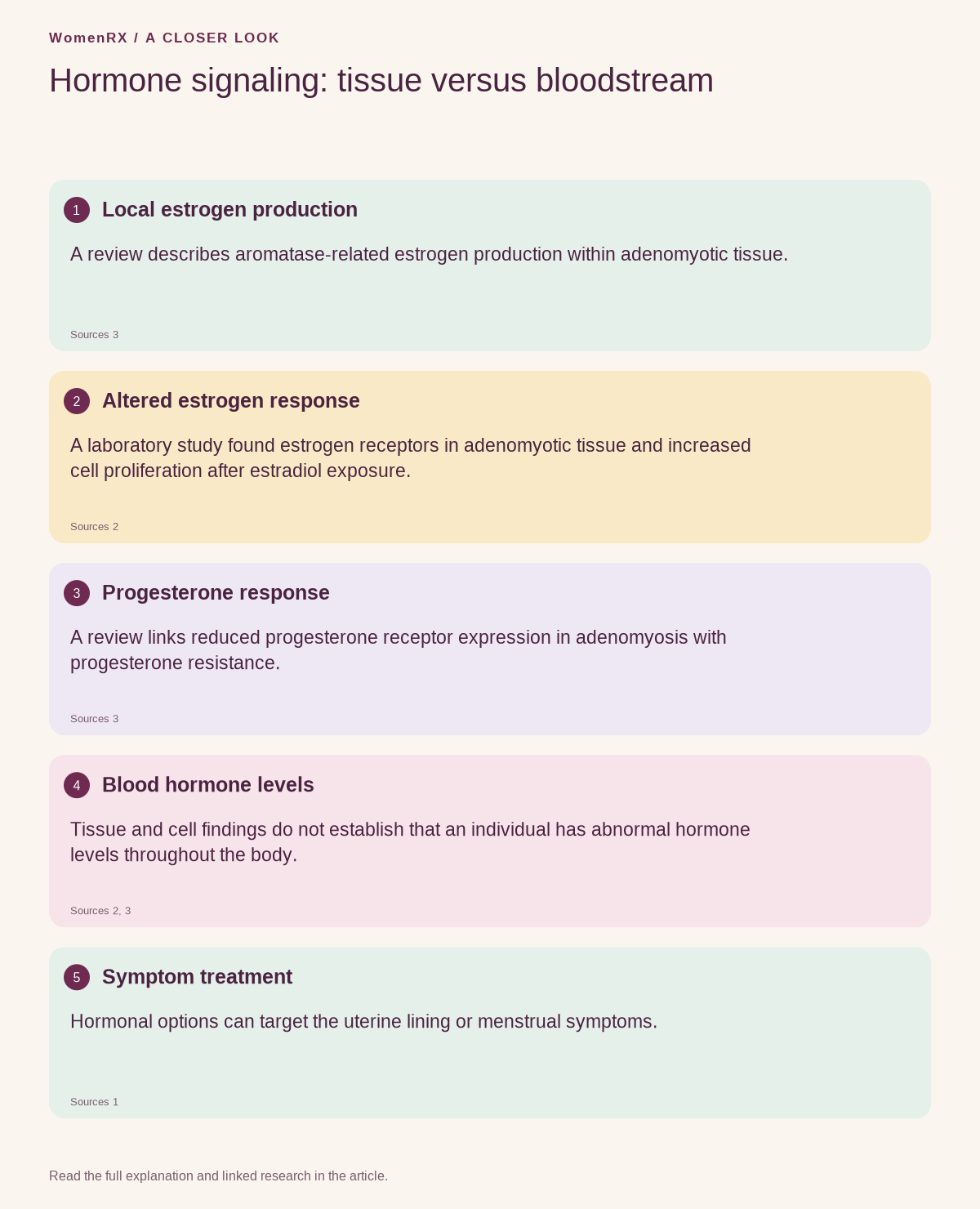
Hormone signaling: tissue versus bloodstream
Local estrogen production: A review describes aromatase-related estrogen production within adenomyotic tissue.3
Altered estrogen response: A laboratory study found estrogen receptors in adenomyotic tissue and increased cell proliferation after estradiol exposure.2
Progesterone response: A review links reduced progesterone receptor expression in adenomyosis with progesterone resistance.3
Blood hormone levels: Tissue and cell findings do not establish that an individual has abnormal hormone levels throughout the body.23
Symptom treatment: Hormonal options can target the uterine lining or menstrual symptoms.1
Read the figure as text
The distinction is between hormone activity described in uterine tissue and a whole-body hormone imbalance, which these tissue findings do not establish.- Local estrogen production: A review describes aromatase-related estrogen production within adenomyotic tissue.3
- Altered estrogen response: A laboratory study found estrogen receptors in adenomyotic tissue and increased cell proliferation after estradiol exposure.2
- Progesterone response: A review links reduced progesterone receptor expression in adenomyosis with progesterone resistance.3
- Blood hormone levels: Tissue and cell findings do not establish that an individual has abnormal hormone levels throughout the body.23
- Symptom treatment: Hormonal options can target the uterine lining or menstrual symptoms.1
More questions, answered
Does adenomyosis mean I have too much estrogen?
Not necessarily. Research describes local estrogen production and signaling in adenomyotic tissue, but that does not establish that estrogen is high throughout your body. 2 3
Why might a hormonal treatment help if my blood hormones aren’t known to be abnormal?
Some options can act on the uterine lining or menstrual bleeding. For example, an IUS (hormonal coil, including Mirena) thins the lining and can make periods lighter and less painful. Symptom improvement does not prove a whole-body hormone imbalance. 1
Sources you can check
- Adenomyosis - NHSAccessed 2026-09-25Return to first citation
- Functional Implications of Estrogen and Progesterone Receptors Expression in Adenomyosis, Potential Targets for Endocrinological Therapy.Sztachelska M, Ponikwicka-Tyszko D, Martínez-Rodrigo L, Bernaczyk P, Palak E, Półchłopek W, Bielawski T, Wołczyński S. · Journal of clinical medicine · 2022Return to first citation
- Endometriosis and adenomyosis: shared pathophysiology.Bulun SE, Yildiz S, Adli M, Chakravarti D, Parker JB, Milad M, Yang L, Chaudhari A, Tsai S, Wei JJ, Yin P. · Fertility and sterility · 2023Return to first citation