Fibroids and Hormones: How Estrogen and Progesterone Fit In
Estrogen and progesterone can support fibroid growth, but that doesn’t mean fibroids are caused by a whole-body hormone imbalance or that hormone levels predict what yours will do.
Fibroid tissue responds to estrogen and progesterone, and research points to the two hormones working together: estrogen can help fibroid cells respond to progesterone. That helps explain why fibroids are more common before menopause and may shrink as hormone levels fall afterward. It doesn’t mean one hormone level causes a fibroid or predicts its growth; fibroids vary, and pregnancy needs its own context. 1 3
What hormones do inside a fibroid
Fibroids are growths of muscle and other tissue in or around the uterus. Their exact cause isn’t known, but estrogen and progesterone appear to help them grow. 1
The relationship isn’t simply “estrogen causes fibroids.” A review of fibroid biology describes estrogen as helping fibroid cells produce progesterone receptors, which can make those cells responsive to progesterone. Progesterone signaling is also linked to cell growth and survival. In other words, the hormones can act as part of a tissue-level process rather than as separate on-off switches. 3 4
That distinction matters: having fibroids doesn’t, by itself, show that your body has a general hormone imbalance. And the hormone story isn’t a simple rule that a higher result on a blood test means a fibroid will grow. The research describes how fibroid tissue responds to hormones; it doesn’t give a personal forecast from an individual hormone level. 1 3
Reproductive years: hormone-responsive, not predictable
Fibroids mainly affect people who haven’t gone through menopause. They can differ in number and size, and many cause no symptoms. When symptoms do occur, they can include heavy or painful periods or bleeding between periods. The effect depends in part on the fibroids’ size, number, and location, not just on hormone signaling. 1 2
So, knowing that estrogen and progesterone can support fibroid growth helps explain the broader biology, but it doesn’t tell you how quickly a particular fibroid will change or whether it will cause symptoms. The underlying cause remains uncertain, and hormonal responsiveness is only part of the picture. 1 3
Pregnancy is its own context
Some people with fibroids get pregnant without problems, while some fibroids may be associated with difficulty getting pregnant, pregnancy loss, or problems with fetal development or delivery. Whether a fibroid matters can depend on its features and the pregnancy context. 1
Hormone responsiveness alone can’t tell you whether an individual fibroid will grow during pregnancy. These pregnancy-related risks don’t establish a predictable hormone-driven growth pattern for every pregnancy. 1 3
Menopause: growth may change, but not by a guarantee
Fibroids sometimes shrink during and after menopause as hormone levels fall. “Sometimes” is important: it isn’t a promise that every fibroid will shrink or that every person’s symptoms will resolve. MedlinePlus notes that age, symptoms, and fibroid size, type, and location all factor into treatment decisions. 1
Hormone responsiveness helps explain why menopause can change the picture, but it can’t predict an individual course. If symptoms change, the practical question is what is happening with the fibroid and how it is affecting you, rather than assuming a hormone level tells the whole story.
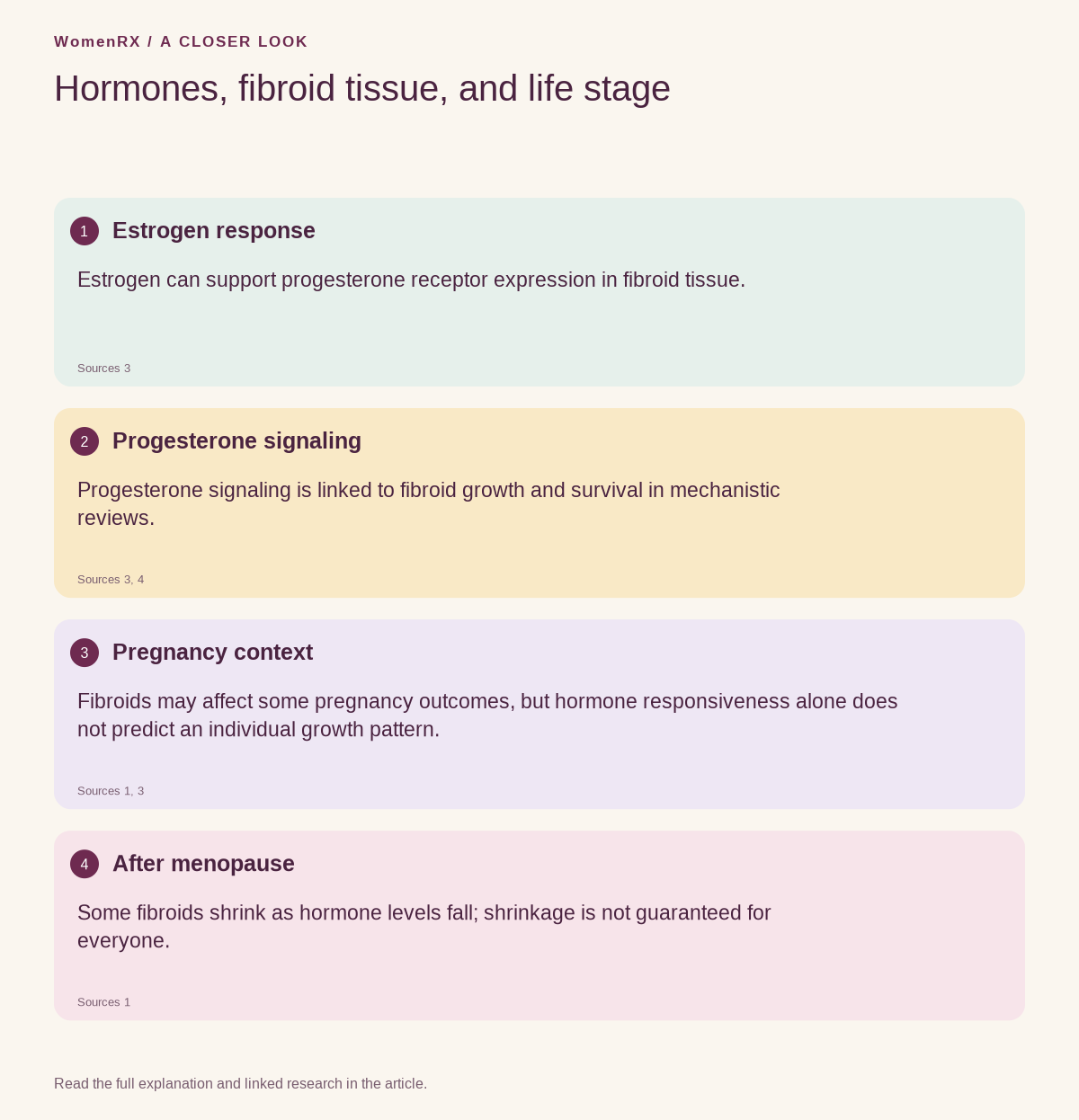
Hormones, fibroid tissue, and life stage
Estrogen response: Estrogen can support progesterone receptor expression in fibroid tissue.3
Progesterone signaling: Progesterone signaling is linked to fibroid growth and survival in mechanistic reviews.34
Pregnancy context: Fibroids may affect some pregnancy outcomes, but hormone responsiveness alone does not predict an individual growth pattern.13
After menopause: Some fibroids shrink as hormone levels fall; shrinkage is not guaranteed for everyone.1
Read the figure as text
This figure separates the tissue-level hormone relationship from what can and can’t be inferred about an individual fibroid across life stages.- Estrogen response: Estrogen can support progesterone receptor expression in fibroid tissue.3
- Progesterone signaling: Progesterone signaling is linked to fibroid growth and survival in mechanistic reviews.34
- Pregnancy context: Fibroids may affect some pregnancy outcomes, but hormone responsiveness alone does not predict an individual growth pattern.13
- After menopause: Some fibroids shrink as hormone levels fall; shrinkage is not guaranteed for everyone.1
More questions, answered
Do fibroids mean I have too much estrogen?
Not necessarily. Fibroid tissue can respond to estrogen and progesterone, but that is different from showing that your whole body has a hormone imbalance. The exact cause of fibroids is not known. 1 3
Will my fibroids go away after menopause?
Some fibroids shrink during or after menopause as hormone levels fall, but that doesn’t happen in a guaranteed or uniform way. Fibroids vary in size, number, and symptoms. 1
Sources you can check
- Uterine Fibroids | Fibroids | MedlinePlusAccessed 2026-09-25Return to first citation
- Fibroids - NHSAccessed 2026-09-25Return to first citation
- Influence of Vitamin D on the Growth and Development of Uterine Fibroids.Awad NE. · Cureus · 2026Return to first citation
- Progesterone signaling in uterine fibroids: Molecular mechanisms and therapeutic opportunities.Ploumaki I, Macri VI, Segars JH, Islam MS. · Life sciences · 2025Return to first citation