How Fibroid Symptoms Can Change Around Menopause
Fibroids may shrink during or after menopause, but symptoms don’t follow a predictable timeline, and new bleeding shouldn’t automatically be blamed on fibroids.
Fibroids can cause heavy or painful periods, bleeding between periods, and pelvic fullness, but there isn’t a predictable perimenopause timeline for how those symptoms will change. Fibroids sometimes shrink during or after menopause, though this isn’t guaranteed. New or persistent abnormal bleeding, especially bleeding after menopause, needs assessment because fibroids are only one possible cause. Treatment depends on symptoms and the fibroids’ size, type, and location. 1 2 4
Why the pattern can be hard to read
Fibroids can cause heavy or painful periods and bleeding between periods. Depending on their size, number, and location, they may also cause pelvic fullness. Some people with fibroids have no symptoms at all. 2 4
As you move through the menopause transition, it can be tempting to explain a change in bleeding as either “just hormones” or “just my fibroids.” Neither assumption identifies the cause. Abnormal bleeding can have several causes, including fibroids, polyps, and hormone or thyroid problems. A known fibroid doesn’t rule out another explanation. 1 4
What may change as menopause approaches
Fibroids sometimes shrink during and after menopause, when hormone levels fall. But that’s a general pattern, not a promise that a particular fibroid will shrink or that its symptoms will stop. Fibroids can still be present around and after menopause, and bleeding associated with them can be difficult to distinguish from bleeding due to another cause. 2 4
The useful distinction is not whether a symptom seems typical for a fibroid. It’s whether it is new, persistent, worsening, or happening after menopause. Bleeding between periods, bleeding that is unusually heavy or lasts longer than usual, and any bleeding after menopause are considered abnormal patterns that may need evaluation. 1
Pelvic fullness is a possible fibroid symptom, but there isn’t a reliable stage-by-stage rule for whether it will continue or change during perimenopause. A symptom alone can’t confirm that fibroids are responsible. If discomfort or fullness is new or worsening, or is affecting daily life, have the change assessed rather than relying on the expectation that menopause will make it go away. 3 4
What an assessment can clarify
An evaluation can help establish whether fibroids are present and whether they are the likely explanation for bleeding. Depending on the situation, assessment may include a pelvic exam, blood tests, and imaging; the right approach depends on the symptoms and findings. 1 2
If fibroids are found, their location, type, and size matter alongside your symptoms, age, and menopausal status. If fibroids aren’t causing symptoms, treatment may not be needed. When symptoms are significant, options can include medicines or procedures, but the choice depends on the problem being treated and your circumstances. 2
A practical way to describe the change is to be specific: when the bleeding or fullness started, how it differs from your usual pattern, and whether it is continuing or worsening. This gives the evaluation a clearer starting point without assuming the cause. The main takeaway is simple: fibroids sometimes shrink during or after menopause, but you can’t predict how your symptoms will change; bleeding that is new, persistent, or postmenopausal should still be assessed. 1 2 4
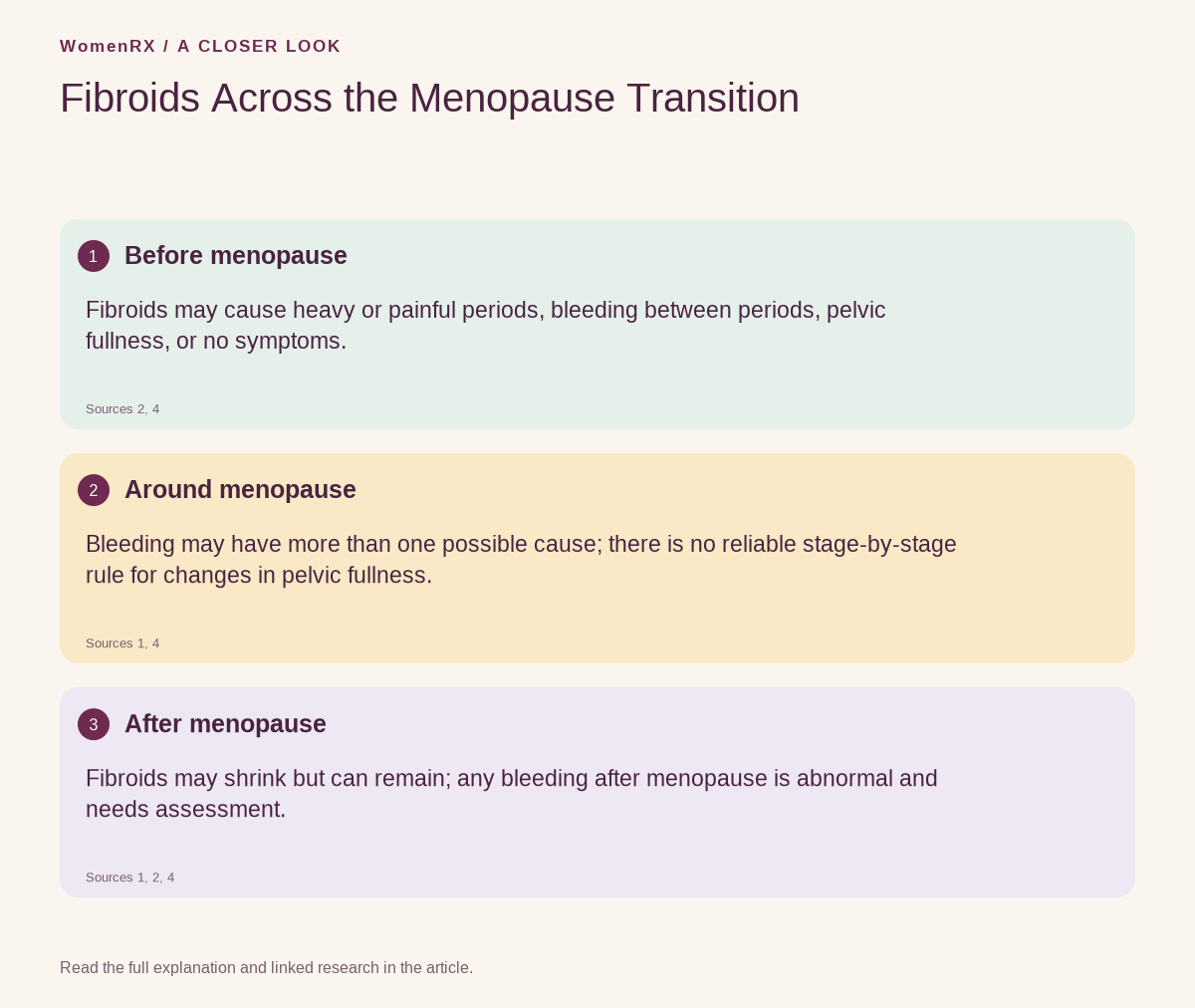
Fibroids Across the Menopause Transition
Before menopause: Fibroids may cause heavy or painful periods, bleeding between periods, pelvic fullness, or no symptoms.24
Around menopause: Bleeding may have more than one possible cause; there is no reliable stage-by-stage rule for changes in pelvic fullness.14
After menopause: Fibroids may shrink but can remain; any bleeding after menopause is abnormal and needs assessment.124
Read the figure as text
A broad comparison of possible fibroid symptoms and why bleeding should be interpreted in context at each stage.- Before menopause: Fibroids may cause heavy or painful periods, bleeding between periods, pelvic fullness, or no symptoms.24
- Around menopause: Bleeding may have more than one possible cause; there is no reliable stage-by-stage rule for changes in pelvic fullness.14
- After menopause: Fibroids may shrink but can remain; any bleeding after menopause is abnormal and needs assessment.124
More questions, answered
Does bleeding after menopause mean a fibroid has grown?
Not necessarily. Fibroids can be one cause of abnormal bleeding, but bleeding after menopause can have other causes too. It should be assessed rather than assumed to come from a known fibroid. 1 4
Do fibroids always need treatment?
No. If fibroids aren’t causing symptoms, treatment may not be needed. When symptoms are troubling, decisions depend on the symptoms and the fibroids’ size, type, and location, among other factors. 2
Sources you can check
- Vaginal Bleeding | Uterine Fibroids | MedlinePlusAccessed 2026-09-25Return to first citation
- Uterine Fibroids | Fibroids | MedlinePlusAccessed 2026-09-25Return to first citation
- Fibroids - NHSAccessed 2026-09-25Return to first citation
- Uterine fibroids in menopause and perimenopause.Ulin M, Ali M, Chaudhry ZT, Al-Hendy A, Yang Q. · Menopause (New York, N.Y.) · 2020Return to first citation