Fibroid Treatment: Match the Option to Your Goals
The right choice depends on how much fibroids affect you, where they are, and whether you want to preserve your uterus or plan a pregnancy.
Fibroids don’t always need treatment, particularly when they cause no symptoms. Medicines can help control bleeding or pain, while removal or shrinkage may be more relevant when pressure is the problem. Fibroid size, number, and location guide which procedures are considered. Myomectomy preserves the uterus; hysterectomy removes it. Pregnancy outcomes after uterine artery embolization are less certain. 2 3 5 7
Start with the problem you want to solve
Fibroids are noncancerous growths, and many cause no symptoms. When symptoms do occur, they can include heavy or painful periods, bleeding between periods, pelvic pain or pressure, and difficulty getting pregnant. Fibroids are only one possible cause of abnormal bleeding, so symptoms alone can’t confirm that a fibroid is responsible. 1 2 6
A useful first distinction is whether the main issue is bleeding, pain, or pressure. Medicines may help with bleeding or pain, but a medicine that eases a symptom isn’t the same as a procedure that removes or shrinks fibroids. If you have imaging, the number, size, and location of the fibroids help shape which procedures are considered. An ultrasound can show those details; location also helps determine which surgical approach may be possible. It doesn’t, on its own, tell you which treatment will work best. 2 3 7
When watching and waiting makes sense
If fibroids aren’t causing symptoms, treatment may not be needed. If bleeding, pain, or pressure begins to affect daily life, the balance may shift toward treatment. 3
Age and the menopause transition can matter. Fibroids sometimes shrink during and after menopause as hormone levels fall, but that isn’t a reason to assume symptoms will resolve on a particular schedule. If symptoms are significant, you may still want relief rather than waiting. 2
Medicines: relief without removing fibroids
For heavy bleeding, treatment may include tranexamic acid or hormonal medicines. Pain relievers may be used for painful symptoms. These options can be worth discussing if your priority is symptom control without a procedure; they don’t remove fibroids. 3
The trade-off is that medicine may not be enough when symptoms persist, fibroids are large, or symptoms worsen. At that point, imaging and your goals can help guide a discussion about procedures or surgery. 3
Procedures and surgery: what changes for the uterus
Myomectomy removes fibroids while keeping the uterus. It’s a surgical option often preferred for people who haven’t completed childbearing or want to retain their uterus. That makes it an important option to discuss when pregnancy is a goal, but it doesn’t guarantee that fertility or pregnancy outcomes will improve. 2 3 7
Uterine artery embolization (UAE) reduces blood supply to fibroids so they shrink. It preserves the uterus and may offer a shorter hospital stay and quicker recovery than surgery. But if future pregnancy matters to you, ask specifically about fertility: the review evidence describes this as an area where more evidence is needed. Preserving the uterus and knowing how a treatment affects pregnancy are not the same thing. 3 5
Hysterectomy removes the uterus and is a definitive treatment for fibroids. It does not fit a goal of retaining the uterus. 2 7
Endometrial ablation treats the uterine lining, not by removing fibroids. Pregnancy has been reported after ablation, and a systematic review found serious complications in reported pregnancies. The review advises discussing reliable contraception after the procedure. If you may want a pregnancy, make that clear before considering ablation. 3 4
If pressure is what’s disrupting your day, the distinction between treating bleeding and changing the fibroid itself becomes especially useful. Myomectomy removes fibroids, UAE shrinks them, and hysterectomy removes the uterus; medicines for bleeding and endometrial ablation do not remove fibroids. That comparison helps identify options to discuss, not predict how much pressure relief any one option will give you. 3 7
Some surgeries can be done through minimally invasive approaches, including hysteroscopic or laparoscopic myomectomy. A 2026 review reports faster recovery and less postoperative pain with minimally invasive surgery compared with an open abdominal approach; the approach that’s possible depends on the individual procedure and fibroid situation. 3 7
Let pregnancy plans guide the comparison
Many women with fibroids get pregnant without problems, while some fibroids may contribute to infertility, pregnancy loss, or other pregnancy difficulties. Fibroids alone therefore don’t show whether treatment is needed for fertility. 2
If you’re trying to conceive or hope to later, ask how the fibroid’s location and the proposed treatment relate to that goal. Myomectomy is commonly preferred when preserving the uterus matters; pregnancy evidence after UAE is less settled; and ablation carries a risk of serious complications in a later pregnancy. Hysterectomy removes the uterus, so it conflicts with a goal of keeping it. 4 5 7
A practical decision starts with three questions: Which symptom needs relief? What do the scans show about size, number, and location? And is your priority to preserve the uterus, pursue pregnancy, avoid surgery, or choose definitive treatment? The answers help compare trade-offs without assuming that every fibroid needs intervention.
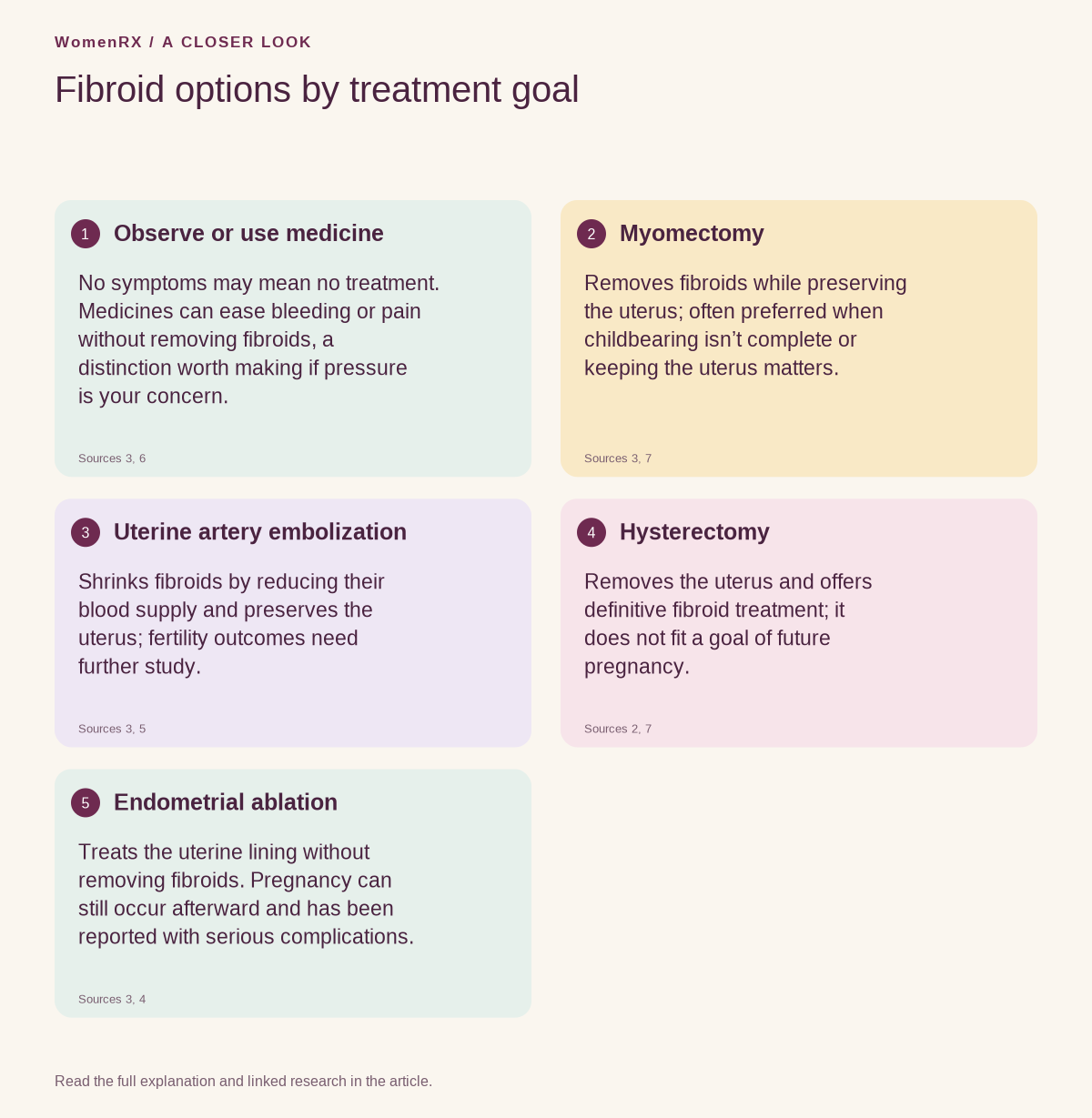
Fibroid options by treatment goal
Observe or use medicine: No symptoms may mean no treatment. Medicines can ease bleeding or pain without removing fibroids, a distinction worth making if pressure is your concern.36
Myomectomy: Removes fibroids while preserving the uterus; often preferred when childbearing isn’t complete or keeping the uterus matters.37
Uterine artery embolization: Shrinks fibroids by reducing their blood supply and preserves the uterus; fertility outcomes need further study.35
Hysterectomy: Removes the uterus and offers definitive fibroid treatment; it does not fit a goal of future pregnancy.27
Endometrial ablation: Treats the uterine lining without removing fibroids. Pregnancy can still occur afterward and has been reported with serious complications.34
Read the figure as text
Compare what each approach aims to do, whether it preserves the uterus, and what to consider if pressure or pregnancy is a concern.- Observe or use medicine: No symptoms may mean no treatment. Medicines can ease bleeding or pain without removing fibroids, a distinction worth making if pressure is your concern.36
- Myomectomy: Removes fibroids while preserving the uterus; often preferred when childbearing isn’t complete or keeping the uterus matters.37
- Uterine artery embolization: Shrinks fibroids by reducing their blood supply and preserves the uterus; fertility outcomes need further study.35
- Hysterectomy: Removes the uterus and offers definitive fibroid treatment; it does not fit a goal of future pregnancy.27
- Endometrial ablation: Treats the uterine lining without removing fibroids. Pregnancy can still occur afterward and has been reported with serious complications.34
More questions, answered
Does having fibroids mean I’ll have trouble getting pregnant?
No. Many women with fibroids get pregnant without problems, though some fibroids may be linked with infertility or pregnancy complications. Fibroids alone don’t establish that they are the cause of a fertility concern. 2
Can fibroids shrink around menopause?
They sometimes shrink during and after menopause as hormone levels fall. The timing and degree of change aren’t guaranteed, so symptom severity and your preferences still matter. 2
Sources you can check
- Vaginal Bleeding | Uterine Fibroids | MedlinePlusAccessed 2026-09-25Return to first citation
- Uterine Fibroids | Fibroids | MedlinePlusAccessed 2026-09-25Return to first citation
- Fibroids - NHSAccessed 2026-09-25Return to first citation
- Pregnancy after endometrial ablation: a systematic review.Kohn JR, Shamshirsaz AA, Popek E, Guan X, Belfort MA, Fox KA. · BJOG : an international journal of obstetrics and gynaecology · 2018Return to first citation
- Can uterine artery embolization be an alternative to plastic and reconstructive uterus operation by minimally invasive surgery?Cezar C, Torres de la Roche LA, Hennefründ J, Verhoeven HC, Devassy R, De Wilde RL, Working Group on Minimally Invasive Therapy in Benign Disease of the Uterine Wall (European Soci... · GMS Interdisciplinary plastic and reconstructive surgery DGPW · 2021Return to first citation
- Uterine-Preserving Interventions for the Management of Symptomatic Uterine Fibroids: A Systematic Review of Clinical and Cost-EffectivenessChen S, Pitre E, Kaunelis D, Singh S. · 2016Return to first citation
- Surgical management of uterine fibroids.Lewis JM, Wu H, Rojas AC, Boekhorst F, Osório F, Topcu EG, Baba T, Lopez CC, Wang K, Meinhold-Heerlein I, Wasson M. · International journal of gynaecology and obstetrics: the official organ of the International Federation of Gynaecology and Obstetrics · 2026Return to first citation