Irregular Periods in Perimenopause: When Bleeding Needs Attention
Periods can become less predictable near menopause, but the amount, timing and severity of bleeding still matter.
Changing cycle timing is common as menopause approaches, but don’t assume every new bleeding pattern is hormonal. Arrange a routine visit for bleeding between periods, after sex, lasting more than seven days or disrupting daily life. If bleeding suddenly becomes much heavier, contact a clinician promptly; if it’s severe, seek emergency care. After menopause, even spotting needs prompt assessment. 1236
A period that arrives early, skips a month or becomes heavier can leave you wondering whether perimenopause explains it. Cycle changes are more likely near menopause, and heavy periods can happen then too. But a change in timing and a change in how much you bleed are different clues. Neither tells you the cause on its own. 23
Why timing can change, and why it isn’t the whole story
Bleeding depends partly on the hormonal changes that build and shed the uterine lining. When ovulation is infrequent or irregular, progesterone production can be irregular too, contributing to unpredictable bleeding. This is one possible mechanism for abnormal bleeding, not an explanation for every change near menopause. 5
It’s not the only explanation. Fibroids, adenomyosis, other conditions affecting the uterus or ovaries, and some medicines can be associated with heavy bleeding. Thyroid problems can also be associated with irregular periods. More than one factor may be present during perimenopause, so a familiar pattern of skipped periods doesn’t automatically explain a new, much heavier flow. 234
If timing is the main change and you otherwise feel well, note when each period starts and how long it lasts. This can make the pattern clearer when you discuss it at a routine visit. You don’t need to wait for a perfect record before making that appointment: a change from your usual pattern is itself a reason to bring it up. 3
Bleeding patterns worth a routine appointment
Make an appointment if your periods repeatedly disrupt work, sleep or everyday plans; last longer than seven days; or come with severe period pain. Bleeding between periods or after sex also deserves assessment rather than being filed under “probably perimenopause.” 23
What counts as heavy is partly about its effect on you. Having to change a pad or tampon every one to two hours, or needing two period products together, are useful details to report. So are ongoing tiredness or shortness of breath. Those signs don’t identify the cause, but they help describe the burden of the bleeding and whether you may need care sooner. 2
For example, a period that’s a few days late is a different situation from bleeding between periods followed by a flow that repeatedly interrupts your day. The first may be a timing change to discuss at a routine visit. The second gives a clinician more to assess than cycle timing alone. 23
If bleeding suddenly gets heavier
If bleeding suddenly becomes much heavier than usual, contact a clinician promptly to discuss how soon you need assessment. If the bleeding is severe, seek emergency care: acute heavy uterine bleeding can require immediate intervention to prevent serious blood loss. Changing products every one to two hours describes heavy bleeding, but it isn’t, by itself, an emergency threshold. If heavy bleeding continues or affects your life, arrange an appointment. 26
After menopause, use a different rule
In women over 45, menopause is usually diagnosed after more than a year without a period. Once menopause has been established, any new vaginal bleeding should be checked promptly. That includes a single episode of spotting or pink or brown discharge, even if you have no other symptoms. Don’t restart the clock or assume it’s just another irregular perimenopausal period. 1
There are several possible causes. Lower estrogen can leave vaginal or uterine tissue thin and prone to bleeding; polyps and changes in the uterine lining are other possibilities. Cancer is a less common cause, but it’s one reason the bleeding needs assessment. A clinician may examine the vagina and cervix and consider tests such as transvaginal ultrasound or a sample of the uterine lining, depending on the findings. 1
What happens once the cause is clearer
Care isn’t always about making periods regular. If heavy bleeding is affecting your life, treatment options may include a hormonal intrauterine system or tranexamic acid; if a condition such as fibroids is involved, the choices may be different. The right approach depends on what’s causing the bleeding and what matters to you. 24
A useful way to describe the change is: when bleeding started, how long it lasted, whether it happened between periods or after sex, how quickly products filled, and whether pain, tiredness or breathlessness came with it. Those details help separate a timing change from a bleeding problem that needs a closer look. 23
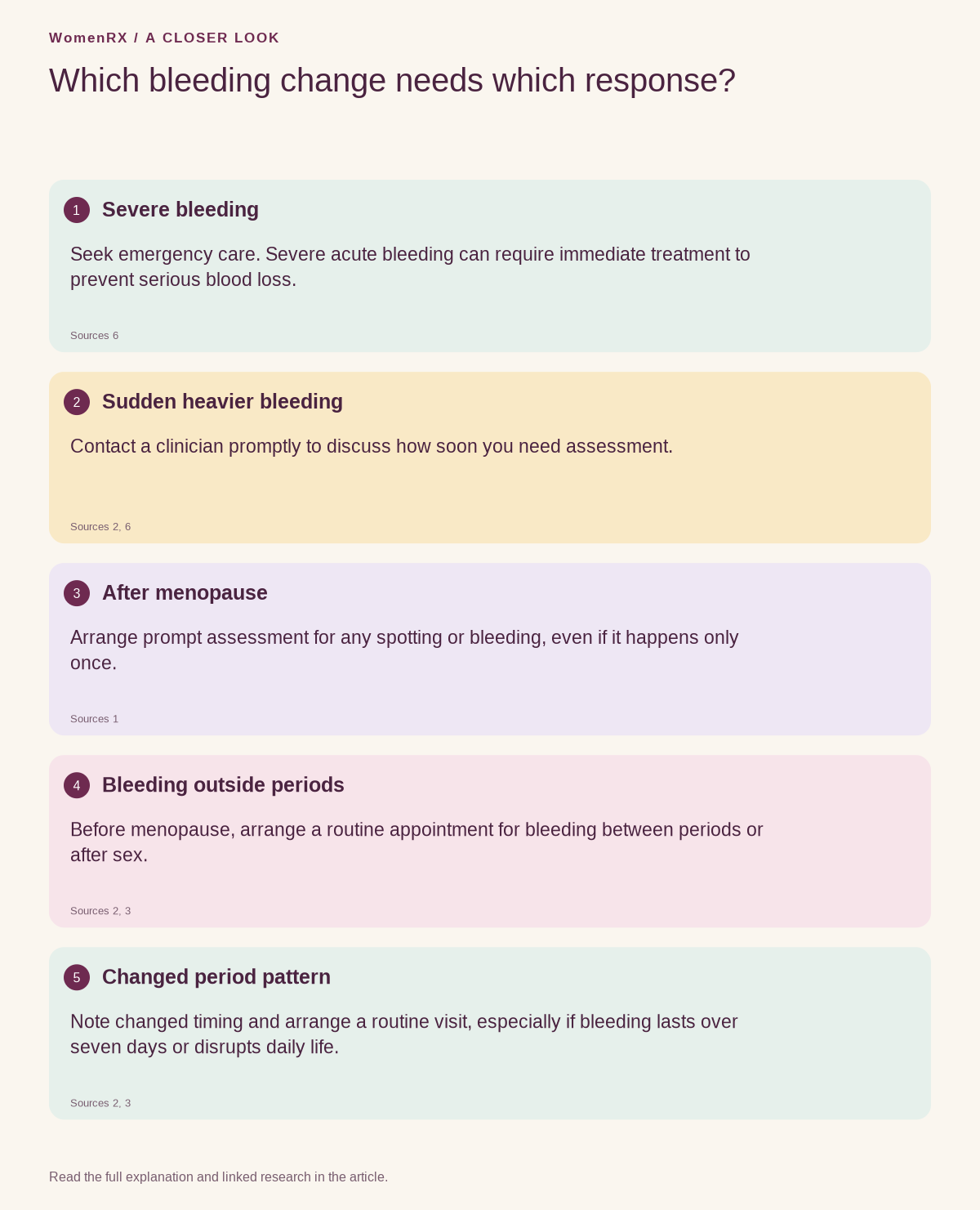
Which bleeding change needs which response?
Severe bleeding: Seek emergency care. Severe acute bleeding can require immediate treatment to prevent serious blood loss.6
Sudden heavier bleeding: Contact a clinician promptly to discuss how soon you need assessment.26
After menopause: Arrange prompt assessment for any spotting or bleeding, even if it happens only once.1
Bleeding outside periods: Before menopause, arrange a routine appointment for bleeding between periods or after sex.23
Changed period pattern: Note changed timing and arrange a routine visit, especially if bleeding lasts over seven days or disrupts daily life.23
Read the figure as text
Start with severity, then consider whether menopause has been established and what changed in your bleeding.- Severe bleeding: Seek emergency care. Severe acute bleeding can require immediate treatment to prevent serious blood loss.6
- Sudden heavier bleeding: Contact a clinician promptly to discuss how soon you need assessment.26
- After menopause: Arrange prompt assessment for any spotting or bleeding, even if it happens only once.1
- Bleeding outside periods: Before menopause, arrange a routine appointment for bleeding between periods or after sex.23
- Changed period pattern: Note changed timing and arrange a routine visit, especially if bleeding lasts over seven days or disrupts daily life.23
More questions, answered
Can a period be heavy and still be related to perimenopause?
Yes. Heavy periods can occur as menopause approaches. But that doesn’t establish the cause of a new heavy period. If bleeding is prolonged, affects your life or comes with other concerning changes, arrange an assessment. 24
Does one spot of blood after menopause really need checking?
Yes. After menopause, even one episode of spotting or pink or brown discharge warrants a prompt appointment. In women over 45, menopause is usually diagnosed after more than a year without a period. Many causes aren’t serious, but the amount of blood alone can’t rule out a condition that needs treatment. 1
Sources you can check
- Postmenopausal bleeding - NHSAccessed 2026-09-25Return to first citation
- Heavy periods - NHSAccessed 2026-09-25Return to first citation
- Irregular periods - NHSAccessed 2026-09-25Return to first citation
- Complex benign gynecology in perimenopause: current evidence and future directions.Goren R, Shats M, Ciesielski K, Siedhoff M, Meyer R. · Current opinion in obstetrics & gynecology · 2026Return to first citation
- Diagnostic and therapeutic use of oral micronized progesterone in endocrinology.Memi E, Pavli P, Papagianni M, Vrachnis N, Mastorakos G. · Reviews in endocrine & metabolic disorders · 2024Return to first citation
- Physicians' Perceptions of Intravenous Estrogen for the Management of Acute Abnormal Uterine Bleeding.Tjaden Peiffer A, Kistner M, Otto A, Schultz E, Wesolowski M, White P, Yang LC. · Cureus · 2025Return to first citation