Irregular Periods in Midlife: What Else Could Be Going On?
Changing cycles can be part of perimenopause, but the timing and amount of bleeding help show when another cause needs a closer look.
Periods can become less predictable as ovarian function changes in perimenopause. Pregnancy, thyroid problems, contraception changes, polyps, and fibroids are other possibilities. Note changes in timing, duration, flow, and bleeding between periods, and arrange an assessment for a changed pattern. Heavy bleeding that has caused anemia needs prompt care rather than waiting for another cycle. 1 2 3
A changing cycle isn’t one single symptom
In perimenopause, ovarian function becomes less steady, and the time between periods or the amount of bleeding may change. That makes perimenopause a plausible explanation for an unfamiliar cycle, not a way to rule out other causes. Hormonal changes and conditions inside the uterus can occur at the same time. 1 3
Start by separating when you bleed from how much you bleed. A cycle runs from the first day of one period to the first day of the next. About 28 days is an average, not a target: regularly occurring cycles of 21 to 35 days are within the range described in public health guidance. A cycle that’s usually 32 days, for example, isn’t irregular just because it isn’t 28. A new shift from your own usual pattern is useful information, even if you haven’t counted the exact number of days. 1 2
Then look beyond the dates. Has bleeding started between periods? Does a period last longer than it used to? Has the flow become much heavier? Those details can point to a different question than cycle timing alone, and they help guide an assessment. 2 3
What else can change the pattern?
If pregnancy is possible, it belongs on the list even when you think perimenopause has begun. Pregnancy is one of the possibilities clinicians rule out when assessing abnormal bleeding at this stage. Thyroid problems can also affect cycle regularity, and changing contraception can disturb a previously familiar pattern. PCOS is another possible cause of irregular periods; age alone doesn’t establish which explanation fits. 1 2 3
Bleeding can also come from a condition in or around the uterus. Polyps and fibroids are benign findings associated with abnormal bleeding in perimenopause. Endometriosis can be associated with heavy or irregular periods, particularly when pain is also part of the picture. Assessment can check for precancerous or cancerous changes as well. A bleeding pattern can’t identify any of these causes by itself. 2 3
Which changes can wait for an appointment?
Arrange a medical assessment if your usual period pattern changes, your periods are irregular, or bleeding lasts more than seven days. Bleeding between periods is also worth describing, even if the amount is small. An appointment is especially useful when the change continues or affects your life; you don’t have to decide on your own whether it’s “just perimenopause.” 1 2 3
Heavy bleeding deserves a different level of attention. If you’re changing a pad or tampon every one to two hours, say so when you contact a care team: that detail helps convey how heavy the flow is. Heavy menstrual bleeding that has caused anemia needs prompt treatment, rather than waiting to see whether the next cycle is lighter. 2 3
The next step depends on the pattern. An evaluation may include a pregnancy test when relevant, blood tests for anemia or selected hormone concerns, or an ultrasound to look at the uterus. Further evaluation may be needed depending on what those findings show. The purpose is to find a cause before deciding whether watching the pattern, treating the bleeding, or treating an underlying condition makes sense. 3
A short record that answers better questions
You don’t need an elaborate tracking system. Record the first day of each period, how many days bleeding lasts, and any bleeding between periods. For flow, a concrete note such as “changing a pad every two hours” says more than “heavy.” Add a recent contraception change and whether pregnancy could be possible. A diary or app can help you see what changed and give a clinician a clearer account of it. 1 2 3
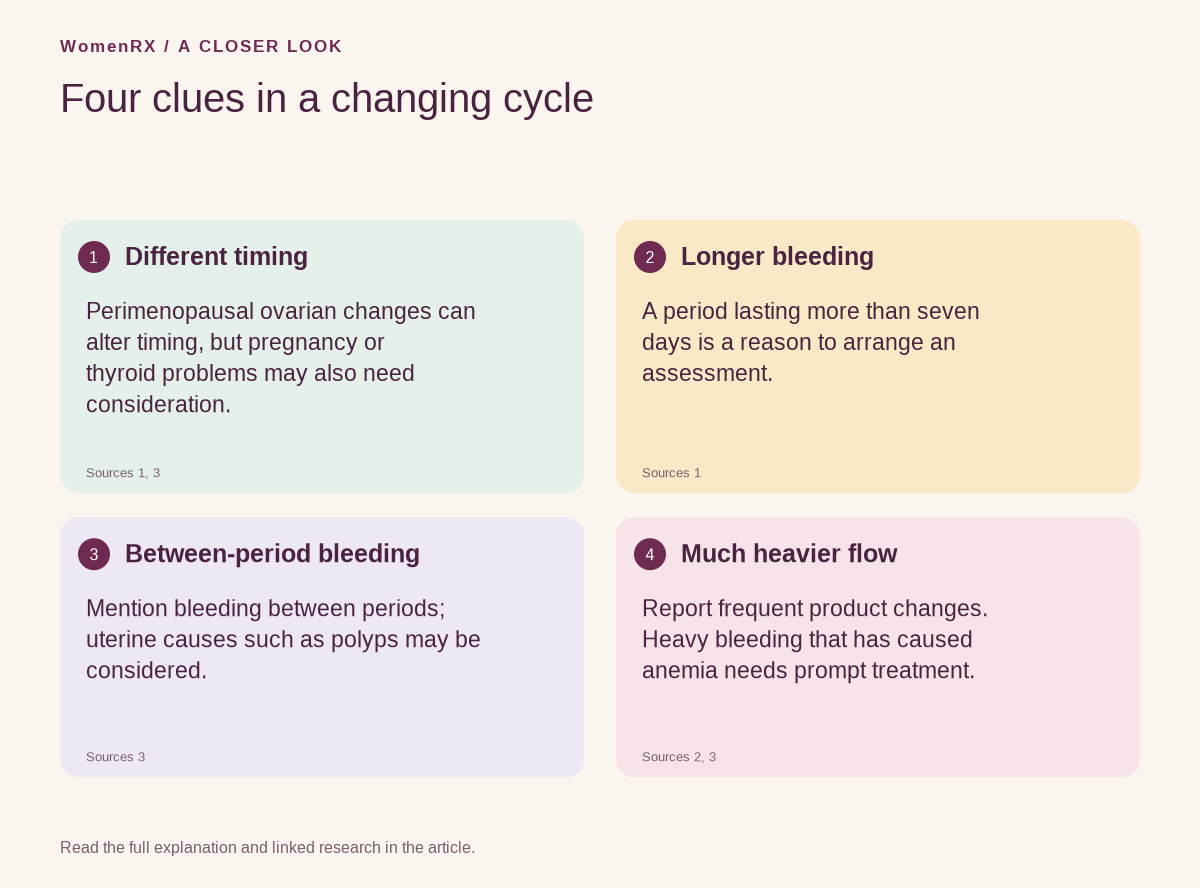
Four clues in a changing cycle
Different timing: Perimenopausal ovarian changes can alter timing, but pregnancy or thyroid problems may also need consideration.13
Longer bleeding: A period lasting more than seven days is a reason to arrange an assessment.1
Between-period bleeding: Mention bleeding between periods; uterine causes such as polyps may be considered.3
Much heavier flow: Report frequent product changes. Heavy bleeding that has caused anemia needs prompt treatment.23
Read the figure as text
Timing and flow answer different questions; neither identifies a cause on its own.- Different timing: Perimenopausal ovarian changes can alter timing, but pregnancy or thyroid problems may also need consideration.13
- Longer bleeding: A period lasting more than seven days is a reason to arrange an assessment.1
- Between-period bleeding: Mention bleeding between periods; uterine causes such as polyps may be considered.3
- Much heavier flow: Report frequent product changes. Heavy bleeding that has caused anemia needs prompt treatment.23
More questions, answered
Can an irregular period still be caused by pregnancy?
Yes. If pregnancy is possible, it remains one of the explanations to consider when bleeding changes during perimenopause. A pregnancy test may be part of the evaluation. 3
Will irregular periods always need treatment?
No. Treatment depends on the cause, the amount of bleeding, and how much it affects your life. After concerning causes are excluded, monitoring may be reasonable for less severe bleeding; heavy bleeding causing anemia needs prompt treatment. 1 3
Sources you can check
- Irregular periods - NHSAccessed 2026-09-25Return to first citation
- Period problems - NHSAccessed 2026-09-25Return to first citation
- Perimenopausal abnormal uterine bleeding.Dreisler E, Frandsen CS, Ulrich L. · Maturitas · 2024Return to first citation