Menopause Brain Fog: What Else Could Be Going On?
Sleep disruption and mood changes can overlap with brain fog during menopause, but they aren’t the only factors worth reviewing.
Focus and memory complaints are common during the menopause transition, when sleep and mood may also change. Hot flashes can contribute to sleep problems, but they don’t explain every restless night. Look for patterns in what feels difficult, sleep and mood, and bring up changes that affect work or daily tasks. Don’t assume that treating hot flashes will also improve memory. 3 4 2
Start with what feels different
“Brain fog” can mean several things: losing your train of thought in a meeting, struggling to concentrate on a task, or having trouble retrieving a word you know. Cognitive complaints, sleep disruption and mood changes are all common during the menopause transition. They can happen together without having the same cause. 3
Try noting a few specific examples rather than judging whether your memory is “good” or “bad.” What were you trying to do? Did you lose focus, forget information, or have trouble finding a word? Has the change begun to affect work or ordinary tasks? Those details make it easier to decide what needs attention.
Look at sleep, including what wakes you
If a difficult morning follows a night of repeated waking, sleep is a useful place to start. Hot flashes and reproductive hormone changes are associated with sleep problems during and after the menopause transition, but neither explains every sleep disturbance. Notice whether hot flashes wake you, whether you’re awake for other reasons, or whether you have trouble sleeping even on nights without hot flashes. 4
The distinction can change the conversation about relief. Menopause hormone therapy is the most effective treatment for bothersome hot flashes. If insomnia itself is the persistent problem, cognitive behavioral therapy for insomnia, or CBT-I, is another evidence-supported approach to discuss. These treatments address different symptoms; improvement in hot flashes or sleep should not be assumed to restore memory. 2 4
Put mood and health history in the picture
Notice whether stress, anxiety or low mood has changed alongside your concentration. Reviews of the menopause transition describe mood, sleep and cognitive complaints occurring together, but that overlap cannot tell you which concern is driving another. 3
Menopause also shouldn’t become the automatic explanation for every new memory problem. Thyroid, kidney and liver problems are among the health conditions MedlinePlus identifies as possible causes of memory difficulties. A broader assessment can consider your health history, as well as prescription medicines, over-the-counter products or supplements that changed around the time you noticed a difference. A medicine list is useful context, not a reason to stop a prescribed treatment on your own. 1
Know when to bring it up
If the change is affecting your work, conversations or daily tasks, make time to discuss it with a clinician. You can describe when it began, whether it’s getting worse, and a couple of concrete examples. Mention sleep, hot flashes and mood, but leave room to consider other explanations too. The same approach makes sense if difficulties continue after menopause rather than fading with other transition symptoms.
Some changes deserve particular attention. Forgetting how to use a familiar phone or finding it difficult to find your way home can signal a more serious memory problem than an occasional misplaced word or set of keys. Seek medical assessment for changes like these. 1
The aim isn’t to prove whether menopause is responsible. It’s to identify what has changed, what may be addressed, and whether the memory difficulty needs a closer look.
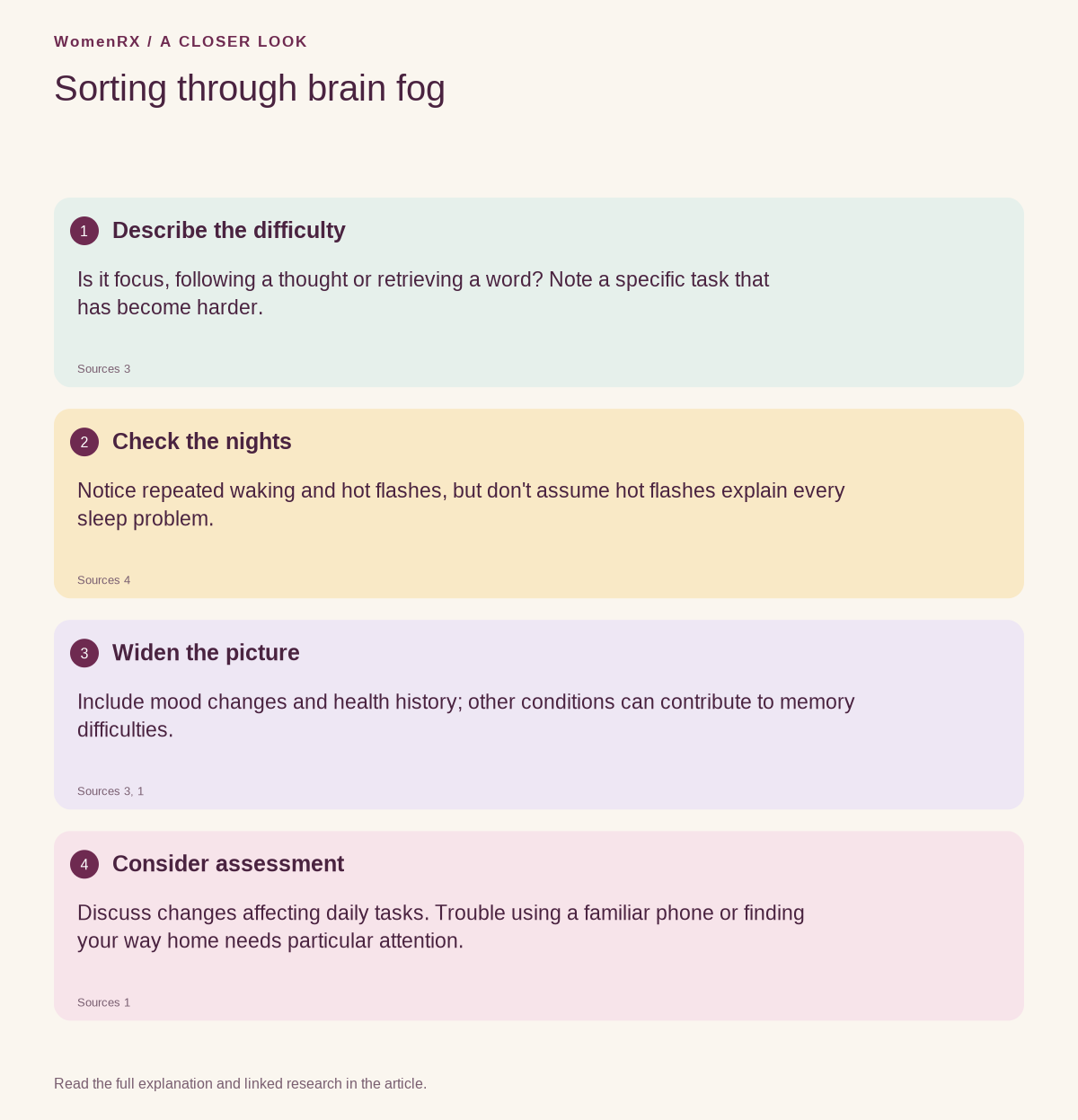
Sorting through brain fog
Describe the difficulty: Is it focus, following a thought or retrieving a word? Note a specific task that has become harder.3
Check the nights: Notice repeated waking and hot flashes, but don't assume hot flashes explain every sleep problem.4
Widen the picture: Include mood changes and health history; other conditions can contribute to memory difficulties.31
Consider assessment: Discuss changes affecting daily tasks. Trouble using a familiar phone or finding your way home needs particular attention.1
Read the figure as text
Use the flow to organize what has changed and what else may need attention. It is not a diagnostic test.- Describe the difficulty: Is it focus, following a thought or retrieving a word? Note a specific task that has become harder.3
- Check the nights: Notice repeated waking and hot flashes, but don't assume hot flashes explain every sleep problem.4
- Widen the picture: Include mood changes and health history; other conditions can contribute to memory difficulties.31
- Consider assessment: Discuss changes affecting daily tasks. Trouble using a familiar phone or finding your way home needs particular attention.1
Sources you can check
- Memory | MedlinePlusAccessed 2026-09-25Return to first citation
- The 2022 hormone therapy position statement of The North American Menopause Society.“The 2022 Hormone Therapy Position Statement of The North American Menopause Society” Advisory Panel. · Menopause (New York, N.Y.) · 2022Return to first citation
- A Review of Cognitive, Sleep, and Mood Changes in the Menopausal Transition: Beyond Vasomotor Symptoms.Williams M, Maki PM. · Obstetrics and gynecology · 2025Return to first citation
- Sleep disturbance and menopause.Carmona NE, Solomon NL, Adams KE. · Current opinion in obstetrics & gynecology · 2025Return to first citation