Brain Fog in Perimenopause and After Menopause
The timing around your final period doesn’t create a clear before-and-after line for concentration or memory.
Brain fog is reported during perimenopause, but research doesn’t show a consistent pattern in which it necessarily gets worse or resolves after the final menstrual period. A 2026 meta-analysis found no overall difference in cognitive outcomes between perimenopausal and postmenopausal groups, while one smaller study found some test-score changes in the first year after the final period. Self-reported fog and performance on specific tests aren’t the same measure. 1 2
The short answer: there’s no reliable cutoff
If you’re misplacing a word or losing your train of thought, reaching your final menstrual period doesn’t automatically explain what happens next. Cognitive complaints are common during perimenopause, and some women may notice them after menopause too. Research hasn’t found one dependable pattern that says brain fog must peak before the final period, continue afterward, or disappear. 1 3
That’s partly because “brain fog” isn’t one standardized research measure. Studies may ask women about memory or concentration, test a particular skill such as verbal learning, or do both. Those measures can tell different stories: a woman may feel less sharp without showing the same change on a test, or a test may detect a difference that doesn’t capture how she feels in everyday life. 1
What the stage-by-stage evidence says
A 2026 systematic review and meta-analysis combined 26 articles involving 9,428 participants. Perimenopausal groups had poorer cognitive outcomes than premenopausal groups on average, but this finding appeared only in studies that used a standardized method to categorize reproductive stages. When researchers compared perimenopausal and postmenopausal groups, they found no overall difference. In those comparisons, perimenopausal participants had better results on some objective measures, while their self-reported outcomes showed a trend in the other direction. 1
One smaller cross-sectional study offers a more specific snapshot. Among 117 women assigned to reproductive stages using standardized criteria, the 14 women in their first year after the final menstrual period performed worse on some measures of verbal learning, memory, motor function, and attention or working memory than women in certain earlier stages. Because this was a snapshot of a small group, it doesn’t establish a typical course for every woman after menopause. 2
These findings aren’t necessarily contradictory. The studies differed in how they classified stages and which outcomes they measured. A group average or a difference on a memory task also can’t predict exactly what one woman will experience. 1 2
Symptoms and test scores are different kinds of evidence
Reviews describe verbal learning and memory as areas that may be affected during perimenopause, with possible changes in attention, processing speed, or working memory also reported. But cognitive profiles vary: findings don’t mean every woman will have the same difficulty or that a particular lapse signals a lasting decline. 3
Sleep problems, hot flashes, and depression have been associated with cognitive difficulties during perimenopause. These are useful parts of the context, not proof that any one symptom causes brain fog in an individual. If your concentration seems worse after a disrupted night or alongside bothersome hot flashes, that pattern may be worth noticing; it doesn’t establish the cause. 3
What this does, and doesn’t, say about the future
Studies comparing menopause stages or performance on particular tasks do not, by themselves, show whether brain fog predicts long-term cognitive decline or dementia. A subjective complaint, a test result at one point in time, and a person’s future cognitive health are different questions. The current stage-comparison findings can help explain why experiences vary, but they don’t provide a personal forecast. 1 2 3
The most useful takeaway is that timing can be part of the picture, but it isn’t a sharp dividing line. Perimenopause and the years after the final period can both be associated with cognitive complaints, and research does not support assuming that symptoms must worsen or resolve at that transition. 1 3
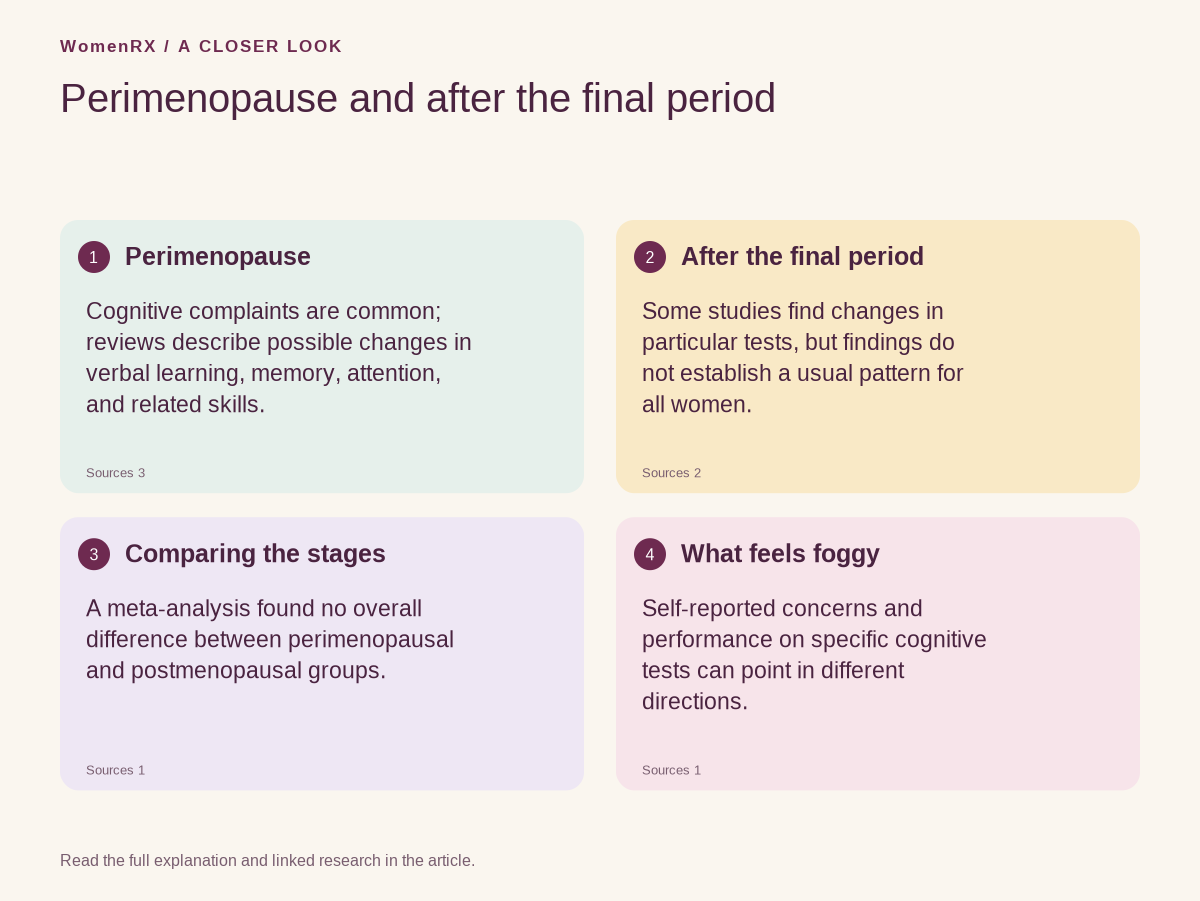
Perimenopause and after the final period
Perimenopause: Cognitive complaints are common; reviews describe possible changes in verbal learning, memory, attention, and related skills.3
After the final period: Some studies find changes in particular tests, but findings do not establish a usual pattern for all women.2
Comparing the stages: A meta-analysis found no overall difference between perimenopausal and postmenopausal groups.1
What feels foggy: Self-reported concerns and performance on specific cognitive tests can point in different directions.1
Read the figure as text
The evidence compares reported concerns and test performance, but it does not show a consistent cognitive turning point at the final menstrual period.- Perimenopause: Cognitive complaints are common; reviews describe possible changes in verbal learning, memory, attention, and related skills.3
- After the final period: Some studies find changes in particular tests, but findings do not establish a usual pattern for all women.2
- Comparing the stages: A meta-analysis found no overall difference between perimenopausal and postmenopausal groups.1
- What feels foggy: Self-reported concerns and performance on specific cognitive tests can point in different directions.1
More questions, answered
Does brain fog mean my long-term memory is declining?
Not necessarily. A feeling of forgetfulness, performance on a specific memory test, and long-term cognitive decline are separate measures. The stage-comparison research doesn’t establish that a woman’s reported brain fog predicts future dementia. 1 2
Sources you can check
- Cognitive functioning in perimenopause: An updated systematic review and meta-analysis.Bangle A, Williams D, Walters J, Nguyen L. · Psychology and aging · 2026Return to first citation
- Cognition in perimenopause: the effect of transition stage.Weber MT, Rubin LH, Maki PM. · Menopause (New York, N.Y.) · 2013Return to first citation
- Cognitive Problems in Perimenopause: A Review of Recent Evidence.Metcalf CA, Duffy KA, Page CE, Novick AM. · Current psychiatry reports · 2023Return to first citation