Brain Fog in Perimenopause: What Evidence Says and When to Get Checked
Memory and focus complaints are part of perimenopause research, but reported brain fog and performance on cognitive tests aren’t the same thing.
Yes, women report forgetfulness and trouble concentrating during perimenopause. Studies also find differences on some cognitive tests, but results vary by the skill measured and how researchers define reproductive stages. Brain fog alone can’t identify its cause. Consider an assessment if the change is worsening, interfering with daily life, or affecting abilities you’ve relied on. 2 3 1

What you feel and what a test measures
“Brain fog” can mean losing your train of thought, struggling to concentrate, or taking longer to find a word. Those experiences matter, but they aren’t the same as performance on a test of memory, attention, or another specific skill. A test result is also only about the abilities and conditions it measures; it doesn’t, by itself, explain why you feel different.
A 2026 systematic review and meta-analysis combined 26 studies involving 9,428 participants. Compared with premenopausal women, perimenopausal women had poorer cognitive outcomes in some analyses. That pattern appeared only in studies that used STRAW+10 criteria to classify reproductive stages. The review found no overall difference between perimenopausal and postmenopausal groups, while a separate comparison of reported and objective outcomes found better objective results but a trend toward poorer self-reported outcomes for perimenopausal women. The takeaway is not that every woman will experience a decline. Results depend on the comparison group, staging method, and type of outcome measured. 2
In a study of 687 women, the group combining early and late perimenopause performed less well on a measure of learning efficiency than reproductive-stage and postmenopausal groups. The study did not find significant differences between early and late perimenopause in reported memory complaints or objective performance. That’s a group finding on particular measures, not a forecast for any one person. 3
The transition isn’t a simple, steady decline
Cognitive performance may not change in a straight line across reproductive stages. In a cross-sectional study of 117 women, differences in several measured skills were most apparent in the first year after the final menstrual period. Because the researchers compared groups at one point in time, the study cannot show how any individual woman’s abilities changed over time. 4
Taken together, these findings support taking a noticeable change seriously without assuming hormones are the only explanation. They don’t establish why a particular woman feels foggy or whether a specific treatment will resolve it.
Consider the wider picture
Sleep, mood, and hot flashes are useful context to describe. Perimenopause studies have assessed some of these alongside cognitive complaints or test results, but that doesn’t show that any one factor caused an individual’s symptoms. 3 4
It can help to be specific about what’s changed. For example, are you occasionally searching for a word, losing track of a familiar task, or forgetting a conversation? You can also mention changes in sleep, mood, or hot flashes, along with medicines and supplements you take and any recent changes. That information helps describe the full picture; it doesn’t prove that any one item is responsible.
Memory changes can also have causes other than perimenopause. MedlinePlus lists thyroid, kidney, and liver problems among possible causes of memory problems, as well as head injuries and certain conditions affecting the brain. Those examples don’t mean one of these problems is likely in your case. They are a reason to avoid assuming that a persistent or concerning change is automatically menopause-related. 1
When to seek an assessment
Consider getting an assessment if the change is getting worse, interfering with everyday responsibilities, or affecting abilities you’ve relied on. These are practical reasons to seek help, not diagnostic criteria. Occasional forgetfulness is different from losing the ability to do a familiar task: MedlinePlus gives forgetting how to use a phone or find your way home as examples of difficulties that may point to a more serious memory problem. Don’t dismiss changes like those as simply part of perimenopause. 1
The useful distinction is not “it’s hormones” versus “it must be something serious.” Brain fog is a real experience, but it doesn’t identify its cause. A clear account of what has changed, when you notice it, and how it affects daily life can help make an assessment more informative.
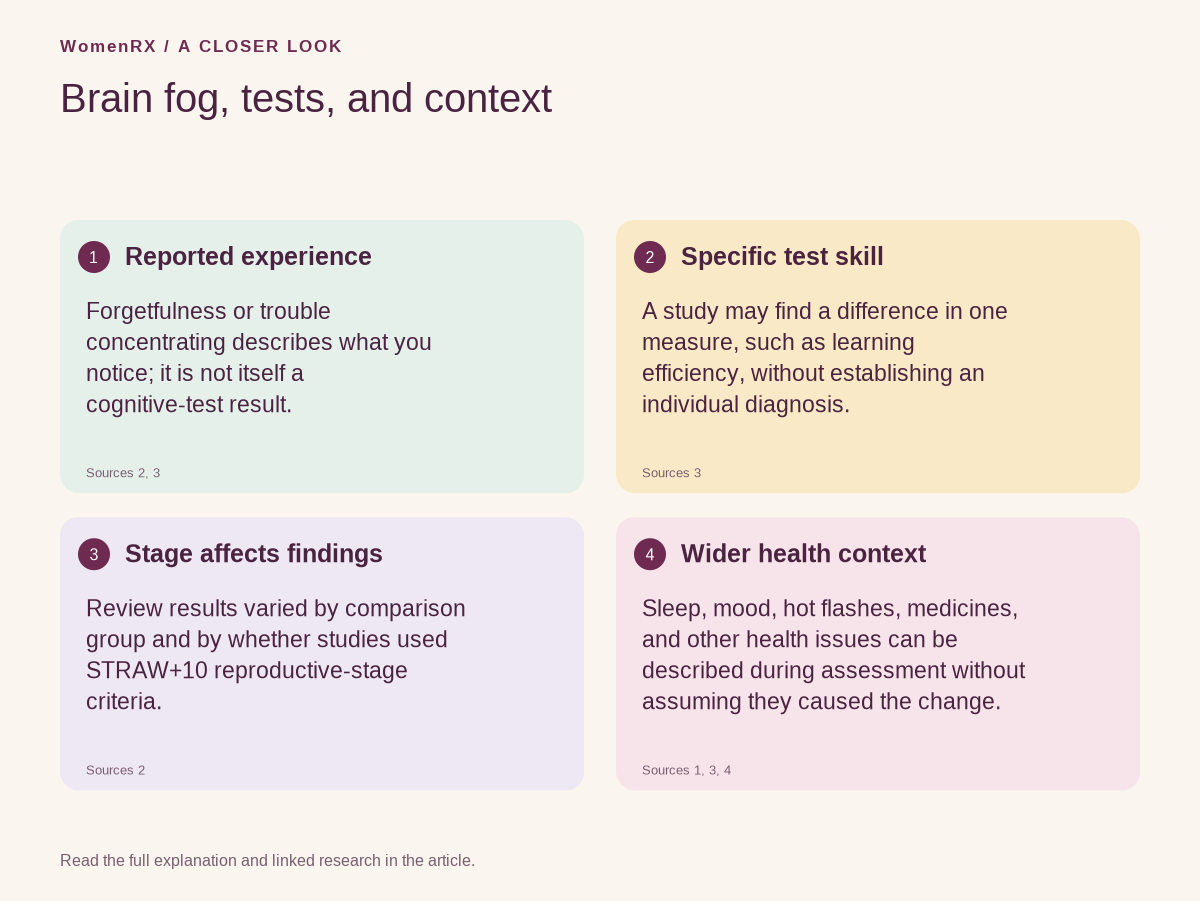
Brain fog, tests, and context
Reported experience: Forgetfulness or trouble concentrating describes what you notice; it is not itself a cognitive-test result.23
Specific test skill: A study may find a difference in one measure, such as learning efficiency, without establishing an individual diagnosis.3
Stage affects findings: Review results varied by comparison group and by whether studies used STRAW+10 reproductive-stage criteria.2
Wider health context: Sleep, mood, hot flashes, medicines, and other health issues can be described during assessment without assuming they caused the change.134
Read the figure as text
These distinctions show why a reported change, a test result, and possible contributing context should not be treated as interchangeable.- Reported experience: Forgetfulness or trouble concentrating describes what you notice; it is not itself a cognitive-test result.23
- Specific test skill: A study may find a difference in one measure, such as learning efficiency, without establishing an individual diagnosis.3
- Stage affects findings: Review results varied by comparison group and by whether studies used STRAW+10 reproductive-stage criteria.2
- Wider health context: Sleep, mood, hot flashes, medicines, and other health issues can be described during assessment without assuming they caused the change.134
More questions, answered
Does brain fog mean I’m developing dementia?
Not necessarily. Brain fog describes an experience; by itself, it can’t establish a diagnosis or rule one out. Perimenopause research finds different results for reported complaints and performance on specific cognitive tests. If you’re losing familiar abilities or the change is worsening, seek an assessment rather than trying to diagnose the cause yourself. 1 2
Sources you can check
- Memory | MedlinePlusAccessed 2026-09-25Return to first citation
- Cognitive functioning in perimenopause: An updated systematic review and meta-analysis.Bangle A, Williams D, Walters J, Nguyen L. · Psychology and aging · 2026Return to first citation
- Subjective cognition and objective cognitive performance in early versus late perimenopause.Furey RT, Zhu C, Li Q, Gurvich C. · Journal of clinical and experimental neuropsychology · 2026Return to first citation
- Cognition in perimenopause: the effect of transition stage.Weber MT, Rubin LH, Maki PM. · Menopause (New York, N.Y.) · 2013Return to first citation