Menopause Brain Fog: What May Help and When to Get Checked
Concentration and memory can feel different during perimenopause, and the pattern of change helps you decide what to do next.
Brain fog can show up during perimenopause, but a memory complaint alone can’t tell you whether menopause, disrupted sleep, mood, or another health problem is responsible. Notice what has changed, what else is happening on difficult days, and whether familiar tasks are becoming harder. Occasional lapses are different from worsening problems or trouble finding your way home, which deserves medical evaluation.731
What might be changing?
“Brain fog” is a useful description, not a diagnosis. For example, you might lose your train of thought, struggle to take in new information, or forget what you meant to do next. An occasional forgotten name or misplaced set of keys happens to many people. The more useful question is whether a change is becoming more frequent or making everyday activities harder.1
There is some evidence of cognitive differences during the menopause transition. In a 2026 online study of 687 women across reproductive and menopause stages, the combined perimenopause group performed less well on measures of learning efficiency than the reproductive and postmenopausal groups. The researchers found no significant difference between early and late perimenopause in either reported memory complaints or cognitive test performance. These group findings don’t predict what an individual woman’s symptoms mean, and the researchers called for supervised testing to characterize the changes more precisely.7
Look at sleep and mood alongside memory
A night of sweats, broken sleep, and a hard time concentrating the next day may feel like one problem. Menopause research finds links among hot flashes, sleep disturbance, mood symptoms, and cognitive difficulties, but those links don’t prove which symptom is causing another.3
Try describing the whole pattern rather than deciding in advance that hormones must be the cause. Does the difficulty cluster after poor sleep? Does it happen during a stretch of low mood or anxiety? Has a medicine or supplement changed around the same time? Those details can make a clinical review more useful. Other health problems can also affect memory; MedlinePlus includes thyroid, kidney, and liver problems among possible causes of more serious memory difficulties.1
What can you do about it?
If night sweats are repeatedly disrupting sleep, or mood symptoms are affecting your day, those concerns are worth addressing in their own right. Treatments for hot flashes and night sweats have evidence for those symptoms: a North American Menopause Society position statement identifies hormone therapy as the most effective treatment for vasomotor symptoms, while its nonhormone statement identifies options including cognitive-behavioral therapy and certain prescription medicines.56 That isn’t evidence that either approach reliably restores memory. The choice of treatment depends on the symptom being treated and a person’s circumstances.5
A healthy eating pattern can support health through midlife, but evidence linking dietary patterns to better cognition during menopause remains largely observational. It doesn’t establish that changing your diet will clear brain fog.2 Supplements aren’t a proven shortcut either. A systematic review of 12 randomized trials found possible cognitive benefits in five trials of isoflavones, soy, or ginkgo, but most trials had serious methodological flaws. The reviewers concluded that the evidence for a cognitive benefit was not compelling.4
When a memory change needs a closer look
If the problem is worsening, affecting responsibilities, or making familiar activities difficult, arrange a medical evaluation rather than assuming it’s menopause. Be specific about what happens. For example, forgetting where you put your phone is different from forgetting how to use it. MedlinePlus identifies difficulty using a familiar phone or finding your way home as possible signs of a more serious problem.1
You don’t need to solve the cause before asking for help. A short description of when the change began, whether it varies with sleep or mood, and which tasks it affects gives a clinician something more useful to assess than the label “brain fog” alone.
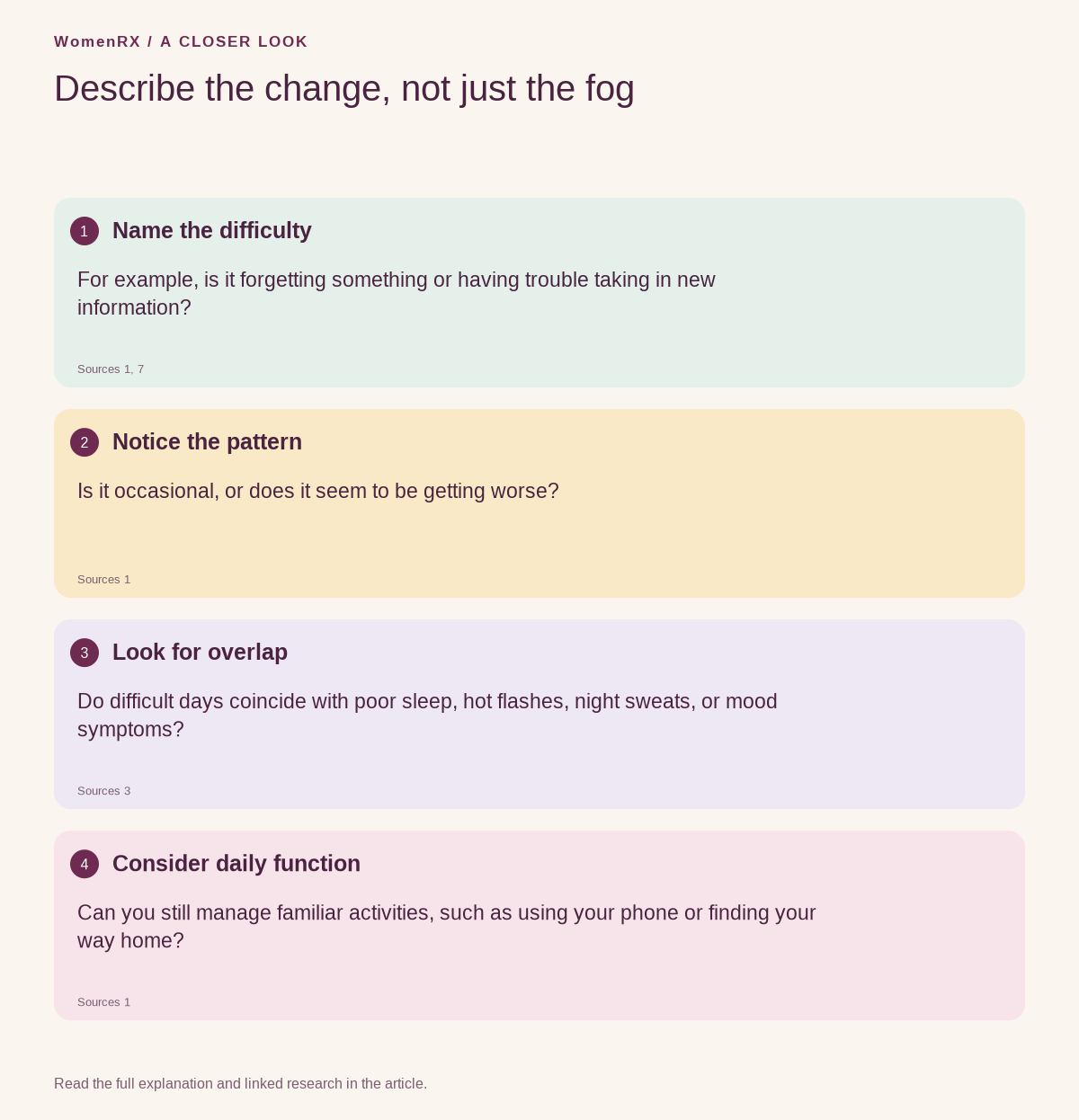
Describe the change, not just the fog
Name the difficulty: For example, is it forgetting something or having trouble taking in new information?17
Notice the pattern: Is it occasional, or does it seem to be getting worse?1
Look for overlap: Do difficult days coincide with poor sleep, hot flashes, night sweats, or mood symptoms?3
Consider daily function: Can you still manage familiar activities, such as using your phone or finding your way home?1
Read the figure as text
These prompts can help you put a cognitive concern into words. They aren’t a diagnostic score.- Name the difficulty: For example, is it forgetting something or having trouble taking in new information?17
- Notice the pattern: Is it occasional, or does it seem to be getting worse?1
- Look for overlap: Do difficult days coincide with poor sleep, hot flashes, night sweats, or mood symptoms?3
- Consider daily function: Can you still manage familiar activities, such as using your phone or finding your way home?1
More questions, answered
Does menopause brain fog mean dementia?
No. An occasional lapse doesn’t mean dementia. What matters is whether difficulties are worsening or affecting familiar activities. Trouble finding your way home or using a familiar phone calls for an evaluation rather than an assumption that menopause is the cause.1
Sources you can check
- Memory | MedlinePlusAccessed 2026-09-25Return to first citation
- The role of diet in managing menopausal symptoms: A narrative review.Yelland S, Steenson S, Creedon A, Stanner S. · Nutrition bulletin · 2023Return to first citation
- Psychosomatic and vasomotor symptom changes during transition to menopause.Augoulea A, Moros M, Lykeridou A, Kaparos G, Lyberi R, Panoulis K. · Przeglad menopauzalny = Menopause review · 2019Return to first citation
- Effects of herbal and dietary supplements on cognition in menopause: a systematic review.Clement YN, Onakpoya I, Hung SK, Ernst E. · Maturitas · 2011Return to first citation
- The 2022 hormone therapy position statement of The North American Menopause Society.“The 2022 Hormone Therapy Position Statement of The North American Menopause Society” Advisory Panel. · Menopause (New York, N.Y.) · 2022Return to first citation
- The 2023 nonhormone therapy position statement of The North American Menopause Society.Menopause (New York, N.Y.) · 2023Return to first citation
- Subjective cognition and objective cognitive performance in early versus late perimenopause.Furey RT, Zhu C, Li Q, Gurvich C. · Journal of clinical and experimental neuropsychology · 2026Return to first citation