Menopause, Hormones, and the Meaning of Brain Fog
Memory slips and trouble concentrating can show up around menopause, but they don’t by themselves prove that hormones have impaired your thinking.
Brain fog is a real experience, but reported forgetfulness and performance on cognitive tests aren’t the same thing. Research finds some overlap between the two, especially for learning efficiency, but the relationship is small. Hormone changes are one possible part of the picture; current findings don’t show that estrogen shifts alone cause brain fog or that it affects every woman the same way. 2
Two kinds of evidence, two different questions
When you say you have brain fog, you’re describing your experience: perhaps losing your train of thought in a conversation or needing longer to remember a name. Those experiences matter, but they don’t automatically mean a cognitive test would show impairment. Tests measure particular skills under particular conditions; daily life brings interruptions, competing demands, mood, and symptoms into the mix.
A 2025 systematic review and meta-analysis of 24 studies included 5,629 women in perimenopausal, postmenopausal, or mixed groups. Only six studies could be combined to examine the relationship between reported and tested cognition. The link was small for learning efficiency (correlation r = .12, 95% confidence interval .02 to .23); correlations for other cognitive areas weren’t significant. The review also found that studies used 12 different measures of subjective cognition, making comparisons difficult. 2
So the research doesn’t say that brain fog is imaginary, nor that every memory lapse reflects measurable decline. It says the two can overlap, but one is not a simple stand-in for the other.
What menopause-stage studies suggest
A 2026 secondary analysis of online study data from 687 participants compared cognitive complaints and test performance across reproductive, perimenopausal, and postmenopausal groups. When early and late perimenopause were combined, that group performed less well on measures of learning efficiency than reproductive and postmenopausal participants. But the study found no significant difference between early and late perimenopause in reported memory complaints or objective performance. It did find higher vasomotor symptom levels in late perimenopause. These results are group comparisons, not proof that an individual’s hormones caused a change in her cognition. 1
That distinction matters: one study finding in one test area doesn’t mean everyone in perimenopause has a broad cognitive problem. And a symptom being more common during a life stage doesn’t make it inevitable for you.
Where hormones, mood, and symptoms fit
Changing hormone levels are a proposed part of the explanation for cognitive experiences during the menopause transition. But the 2026 study’s authors say that research with hormonal measurements is needed to characterize cognitive changes more precisely. That leaves an important gap between “this can happen around the same time” and “this hormone change directly caused it.” 1
Other factors may sit alongside hormone change. In a cross-sectional study of 120 pre-, peri-, and postmenopausal women, reported attention and memory problems were associated with menopause-related symptoms, psychological symptoms, psychosocial factors, and some objective performance measures. Because the study observed associations at one point in time, it can’t tell which factor came first or establish a cause. 3
Sleep is another possible piece, but evidence in women is not established by the findings above. In a study of common marmosets with surgically induced menopause, hormone treatments changed both sleep measures and performance on a learning task. That animal experiment can suggest a question for human research; it cannot show that sleep disruption causes brain fog in women. 4
A grounded way to read your own experience
If you’re trying to make sense of a change, notice what you mean by “fog.” For example, is it mainly trouble finding words, keeping track of a task, or learning something new? Also notice whether it tends to coincide with other symptoms or a period of poor mood. Those patterns can help describe what’s happening, but they don’t identify hormones, sleep, or mood as the cause.
The clearest takeaway is that cognitive complaints are reported during the menopause transition, and research finds some, but limited, correspondence with test performance. Hormone change is a plausible area of study, not a diagnosis you can read from a memory slip. Findings vary, and the evidence doesn’t support treating brain fog as proof of hormone deficiency, dementia, or a guaranteed menopause effect. 1 2
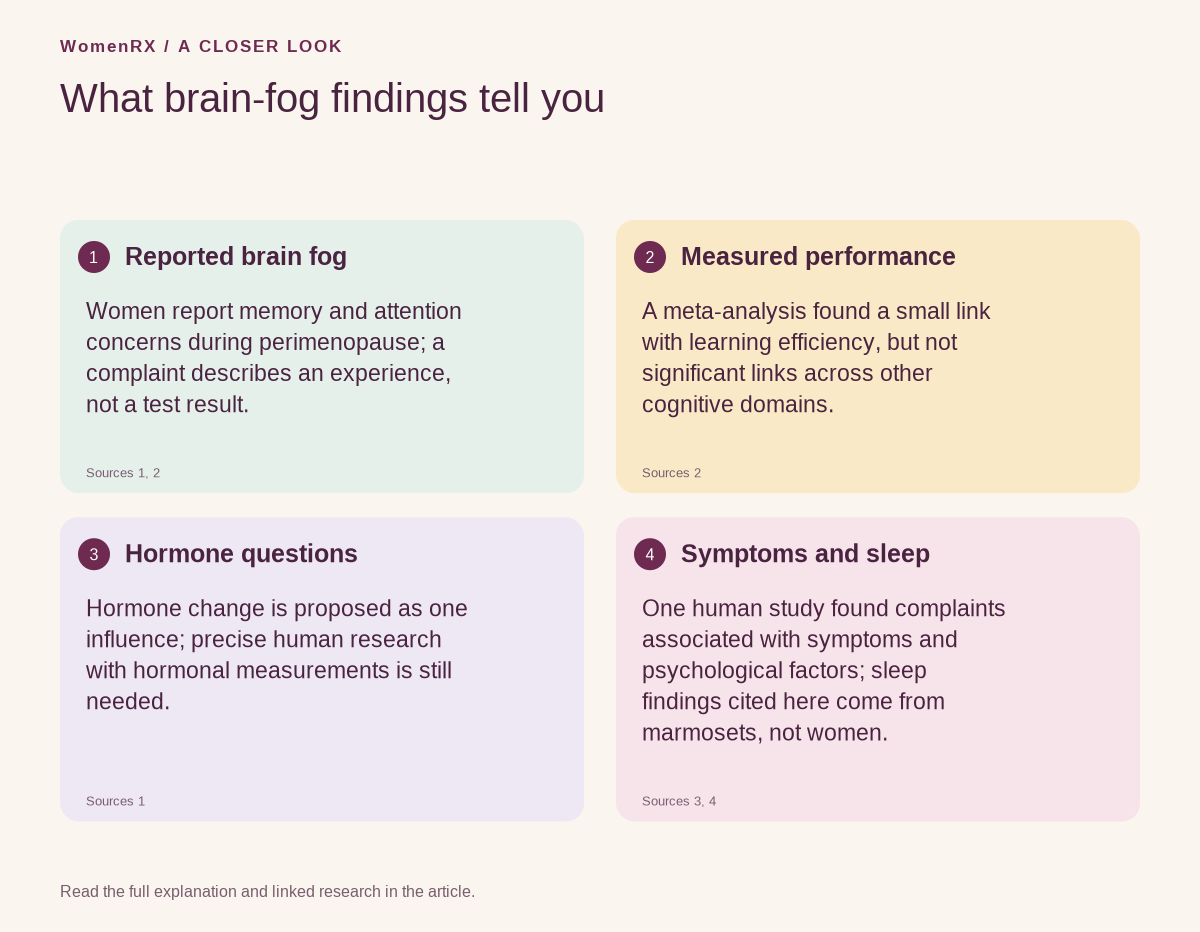
What brain-fog findings tell you
Reported brain fog: Women report memory and attention concerns during perimenopause; a complaint describes an experience, not a test result.12
Measured performance: A meta-analysis found a small link with learning efficiency, but not significant links across other cognitive domains.2
Hormone questions: Hormone change is proposed as one influence; precise human research with hormonal measurements is still needed.1
Symptoms and sleep: One human study found complaints associated with symptoms and psychological factors; sleep findings cited here come from marmosets, not women.34
Read the figure as text
Reported experiences, test results, and possible contributors are related questions, but the evidence does not make them interchangeable.- Reported brain fog: Women report memory and attention concerns during perimenopause; a complaint describes an experience, not a test result.12
- Measured performance: A meta-analysis found a small link with learning efficiency, but not significant links across other cognitive domains.2
- Hormone questions: Hormone change is proposed as one influence; precise human research with hormonal measurements is still needed.1
- Symptoms and sleep: One human study found complaints associated with symptoms and psychological factors; sleep findings cited here come from marmosets, not women.34
Sources you can check
- Subjective cognition and objective cognitive performance in early versus late perimenopause.Furey RT, Zhu C, Li Q, Gurvich C. · Journal of clinical and experimental neuropsychology · 2026Return to first citation
- Subjective versus objective cognition during menopause: A systematic review and meta-analysis.Furey RT, Thomas EHX, Kulkarni J, Gurvich C. · Journal of the International Neuropsychological Society : JINS · 2025Return to first citation
- Subjective cognitive complaints at menopause associated with declines in performance of verbal memory and attentional processes.Schaafsma M, Homewood J, Taylor A. · Climacteric : the journal of the International Menopause Society · 2010Return to first citation
- Oral administration of ethinyl estradiol and the brain-selective estrogen prodrug DHED in a female common marmoset model of menopause: Effects on cognition, thermoregulation, and sleep.Rothwell ES, Viechweg SS, Prokai L, Mong JA, Lacreuse A. · Hormones and behavior · 2025Return to first citation