Menopause Brain Fog: When to Seek an Assessment
Memory and concentration complaints can occur during perimenopause, but sudden stroke-like symptoms call for emergency help, not a routine appointment.
If trouble remembering or concentrating has come on gradually and keeps affecting work or everyday tasks, consider bringing it up with a clinician. Describe what has changed rather than assuming menopause is the cause. Research on measured cognitive changes is mixed. Sudden confusion or trouble speaking may be a stroke sign: call 911 if you suspect a stroke. 23
Start with the pattern, not the label
“Brain fog” can describe losing your train of thought, struggling to focus, or taking longer to recall a word. Cognitive complaints are reported during perimenopause, but that doesn’t establish that menopause is the only cause, or that a subjective feeling of fog means dementia. Research findings on measured cognitive performance are mixed. 3
The pattern is useful. A gradual change that comes and goes is different from a sudden change in thinking or speech. Note when you first noticed the problem, whether it is getting worse, and what it makes harder. For example, forgetting why you walked into a room is not the same as repeatedly being unable to complete a familiar task. These examples are prompts for describing your experience, not a test for diagnosing a condition.
When to get emergency help
Call 911 for sudden confusion or trouble speaking when it may be part of a stroke, especially if it occurs with sudden weakness or numbness on one side, trouble seeing, trouble walking, dizziness or loss of balance, or a sudden severe headache with no known cause. A U.S. stroke-awareness report states that the recommended response at the first sign of a suspected stroke is to call 911. Don’t wait to see whether symptoms pass. 2
That emergency advice is about sudden stroke-like symptoms. It does not mean every gradual lapse in concentration is an emergency, and it does not provide a complete urgency rule for every kind of sudden confusion.
When a routine assessment makes sense
If the changes persist, are worsening, or are disrupting your daily life, consider raising them with a clinician. This is a practical reason to have a conversation, not a diagnostic cutoff. An assessment can help put the concern in context instead of assuming that menopause explains it. MedlinePlus notes that occasional forgetfulness is common, while difficulty with familiar abilities, such as using a phone or finding the way home, can be a sign of a more serious problem. That specific guidance is about older adults, so it should not be used as a midlife diagnostic rule; the practical point is to mention meaningful changes in everyday function. 1
Menopause-related symptoms can overlap. A systematic review of menopause guidelines lists disturbed sleep and mood changes among symptoms associated with perimenopause and menopause. Tell the clinician if these are happening alongside the concentration or memory concerns. Their presence may help frame the conversation, but this evidence does not show that sleep or mood explains an individual woman’s cognitive symptoms. 4
A short, useful account of what’s changed
Before the appointment, jot down a few examples rather than trying to monitor every lapse. Include:
- Onset and pattern: When it started, whether it is gradual or sudden, and whether it is changing.
- The specific difficulty: For example, losing your train of thought, forgetting recent information, or struggling to focus.
- Daily impact: What has become harder at work, at home, or in other familiar activities.
- Other symptoms: Changes in sleep or mood, and where you are in the menopause transition if you know.
- Medicines and supplements: Bring a current list so the clinician has the full context. This list is information to review, not proof that a product is causing the problem.
A few concrete examples can make a conversation more useful than the broad label “brain fog.” If someone close to you has noticed a change, you can include what they observed, while keeping your own experience at the center.
What the menopause evidence can and can’t say
A 2026 systematic review and meta-analysis brought together 26 articles with 9,428 participants. Perimenopausal women had poorer cognitive outcomes than premenopausal women in analyses using standardized STRAW+10 reproductive-stage criteria, but the review found no overall difference between perimenopausal and postmenopausal groups. Results also differed depending on whether studies measured people’s reported concerns or performance on cognitive tasks. So the evidence supports taking symptoms seriously, not treating them as proof of a specific cause or diagnosis. 3
Menopause guidelines also do not recommend menopausal hormone therapy to treat cognitive symptoms. That doesn’t settle what is causing an individual woman’s symptoms; it does mean cognitive fog alone is not a guideline-supported reason to use hormone therapy. 4
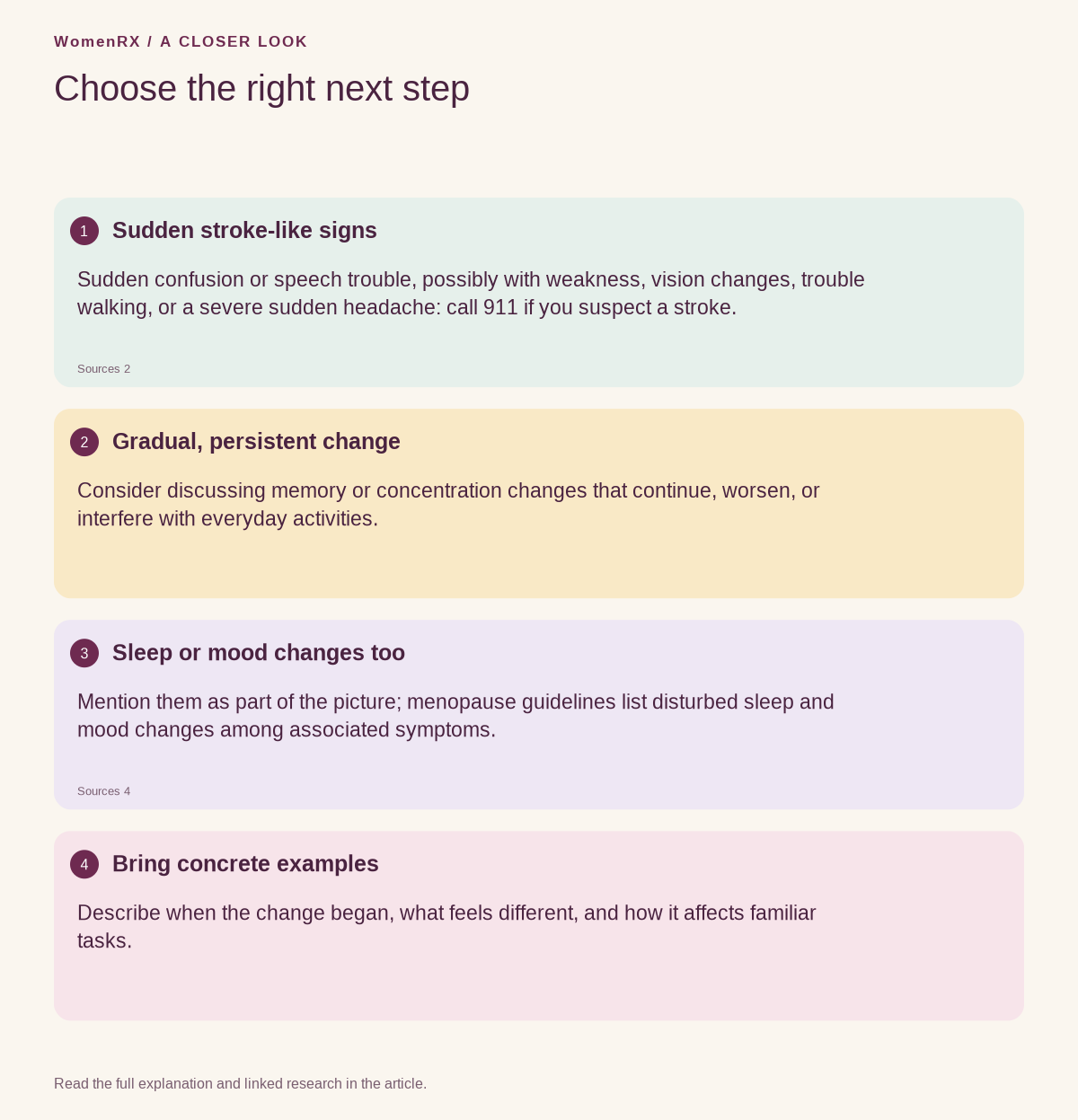
Choose the right next step
Sudden stroke-like signs: Sudden confusion or speech trouble, possibly with weakness, vision changes, trouble walking, or a severe sudden headache: call 911 if you suspect a stroke.2
Gradual, persistent change: Consider discussing memory or concentration changes that continue, worsen, or interfere with everyday activities.
Sleep or mood changes too: Mention them as part of the picture; menopause guidelines list disturbed sleep and mood changes among associated symptoms.4
Bring concrete examples: Describe when the change began, what feels different, and how it affects familiar tasks.
Read the figure as text
A distinction between sudden possible stroke symptoms and gradual cognitive concerns you may want to discuss.- Sudden stroke-like signs: Sudden confusion or speech trouble, possibly with weakness, vision changes, trouble walking, or a severe sudden headache: call 911 if you suspect a stroke.2
- Gradual, persistent change: Consider discussing memory or concentration changes that continue, worsen, or interfere with everyday activities.
- Sleep or mood changes too: Mention them as part of the picture; menopause guidelines list disturbed sleep and mood changes among associated symptoms.4
- Bring concrete examples: Describe when the change began, what feels different, and how it affects familiar tasks.
More questions, answered
Does brain fog mean I’m developing dementia?
No. A subjective complaint about memory or concentration is not the same as a dementia diagnosis. Menopause research finds differences between reported concerns and objective test results, and findings vary by study design. A persistent or disruptive change is still worth discussing. 3
Should I ask about hormone therapy for brain fog?
You can discuss menopause symptoms and treatment goals, but reviewed menopause guidelines do not recommend hormone therapy specifically for cognitive symptoms. 4
Sources you can check
- Memory | MedlinePlusAccessed 2026-09-25Return to first citation
- Sociodemographic and Geographic Variation in Awareness of Stroke Signs and Symptoms Among Adults - United States, 2017.Jackson SL, Legvold B, Vahratian A, Blackwell DL, Fang J, Gillespie C, Hayes D, Loustalot F. · MMWR. Morbidity and mortality weekly report · 2020Return to first citation
- Cognitive functioning in perimenopause: An updated systematic review and meta-analysis.Bangle A, Williams D, Walters J, Nguyen L. · Psychology and aging · 2026Return to first citation
- A systematic review and critical appraisal of menopause guidelines.Hemachandra C, Taylor S, Islam RM, Fooladi E, Davis SR. · BMJ sexual & reproductive health · 2024Return to first citation