Memory Changes Around Menopause: Brain Fog, Assessment and When to Seek Help
Memory and attention changes can happen during the menopause transition, but a complaint alone can’t show what’s causing it or whether thinking skills have changed on testing.
Some women report memory or attention difficulties during perimenopause and after menopause. In one study, these complaints were associated with performance on selected memory and attention tests, but that doesn’t explain an individual’s symptoms. If changes are progressing or interfering with daily tasks, asking about an assessment is a sensible next step, not a formal diagnostic cutoff. 2

“Brain fog” describes an experience, not a test result
You might lose a word mid-sentence, forget why you walked into a room, or find it harder to keep several tasks in mind. “Brain fog” is a common way to describe experiences like these, but it doesn’t name a single cause or diagnosis.
A cognitive test measures performance on particular tasks, such as recalling words or responding to information. Everyday complaints and test performance are different kinds of information, though they can be related. In a cross-sectional study of 120 pre-, peri- and postmenopausal women, reported attention and memory problems were associated with lower verbal-memory and reaction-time performance. Menopause-related symptoms, psychological symptoms and psychosocial factors were also associated with complaints. The study shows patterns across a group, not what caused one person’s symptoms or what her test results would be. 2
A 2025 study also found an association between reported cognitive decline and verbal-memory and executive-function test performance. Its 156 participants were cognitively normal perimenopausal and postmenopausal women with a family history of Alzheimer’s disease and/or a related genetic risk factor. That selected group can’t tell us what a memory complaint means for women generally, and the results don’t diagnose Alzheimer’s disease in an individual. 3
Put the change in context
Menopause may be part of the picture, but it isn’t the only possible explanation for a change in concentration or memory. The study of 120 women found that complaints were associated with psychological and psychosocial factors as well as menopause-related symptoms. It can help to describe what else changed around the same time, such as sleep, mood or medicines. Those details are useful context for a discussion; they don’t establish a cause. 2
Try to make the concern specific. For example: “I lose track of what I’m saying when I’m interrupted,” or “I’ve started missing steps in a familiar task.” Note when you first noticed the change, whether it seems to be worsening, and what has become harder in daily life. This gives a clearer picture than the general phrase “my memory is bad.”
When it makes sense to ask for an assessment
There isn’t a menopause-specific cutoff in this research for deciding when a complaint needs evaluation. As a practical matter, if changes are progressing, troubling you, or interfering with everyday tasks, it’s reasonable to ask about an assessment. That’s a reason to start a conversation, not proof of a particular condition.
Some difficulties are more concerning than occasionally misplacing an item. MedlinePlus says that, in older adults, forgetting how to use a phone or find the way home can be signs of a more serious problem. If you’re experiencing changes of that kind, don’t assume they’re just menopause-related; seek medical evaluation. 1
In a conversation about your symptoms, explain what you can do easily now and what has become difficult. Mention whether sleep, mood or medicines changed around the same time, and ask what further evaluation, if any, makes sense. A test can add information about specific skills, but it doesn’t replace the context of your experience and daily functioning.
The useful distinction isn’t “menopause or dementia” based on one lapse. It’s the difference between a reported difficulty, performance on selected tests, and a change in familiar abilities that deserves attention.
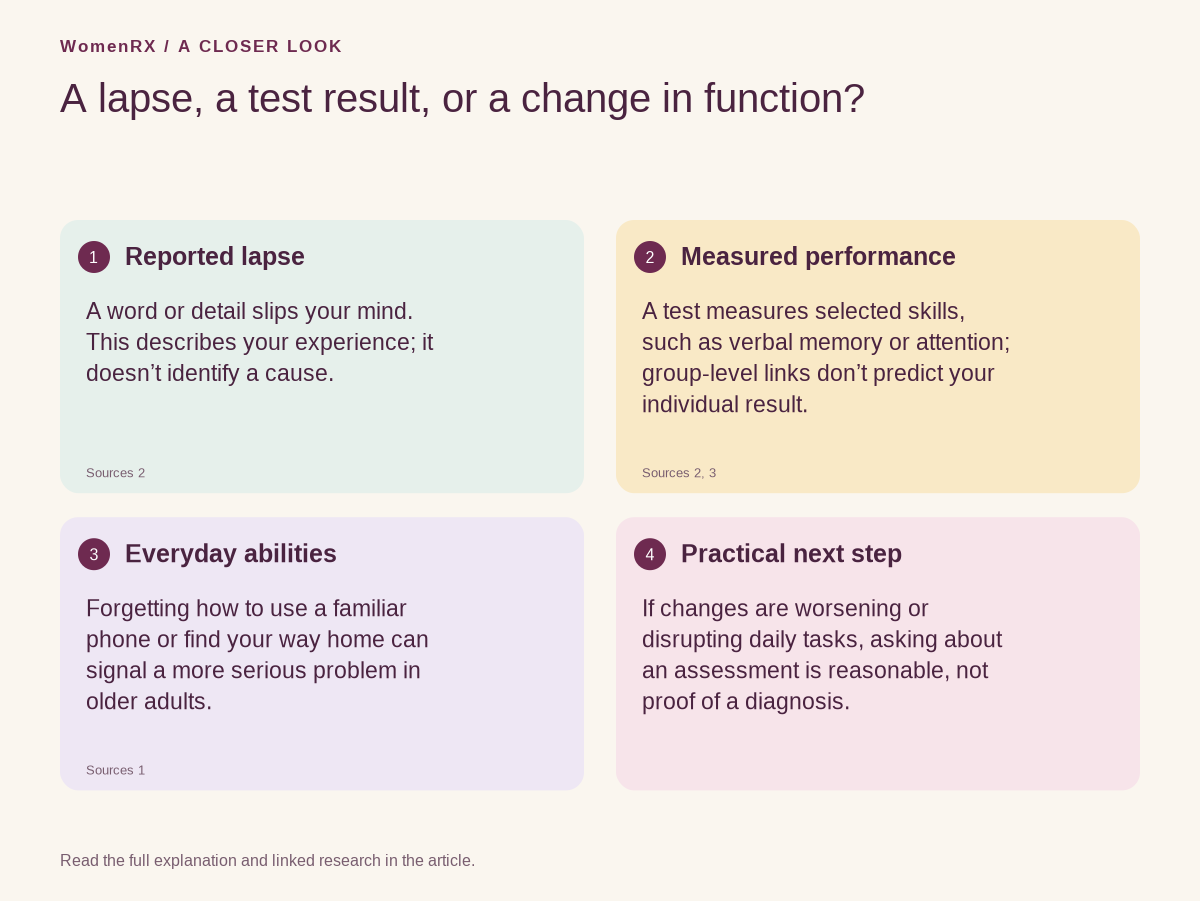
A lapse, a test result, or a change in function?
Reported lapse: A word or detail slips your mind. This describes your experience; it doesn’t identify a cause.2
Measured performance: A test measures selected skills, such as verbal memory or attention; group-level links don’t predict your individual result.23
Everyday abilities: Forgetting how to use a familiar phone or find your way home can signal a more serious problem in older adults.1
Practical next step: If changes are worsening or disrupting daily tasks, asking about an assessment is reasonable, not proof of a diagnosis.
Read the figure as text
These are different kinds of information. Seeing the difference can help you explain what you’re noticing without treating one lapse as a diagnosis.- Reported lapse: A word or detail slips your mind. This describes your experience; it doesn’t identify a cause.2
- Measured performance: A test measures selected skills, such as verbal memory or attention; group-level links don’t predict your individual result.23
- Everyday abilities: Forgetting how to use a familiar phone or find your way home can signal a more serious problem in older adults.1
- Practical next step: If changes are worsening or disrupting daily tasks, asking about an assessment is reasonable, not proof of a diagnosis.
More questions, answered
Does brain fog during menopause mean I have Alzheimer’s disease?
No. A memory complaint by itself doesn’t establish Alzheimer’s disease. A study found an association between reported cognitive decline and test performance among midlife women selected for Alzheimer’s risk, but it wasn’t a diagnostic test and can’t predict an individual woman’s outcome. 3
Can I tell from my symptoms whether a cognitive test would show a problem?
Not reliably. In a study of women across menopause stages, reported attention and memory problems were associated with performance on selected tests at the group level. That doesn’t determine any one person’s result. 2
Sources you can check
- Memory | MedlinePlusAccessed 2026-09-25Return to first citation
- Subjective cognitive complaints at menopause associated with declines in performance of verbal memory and attentional processes.Schaafsma M, Homewood J, Taylor A. · Climacteric : the journal of the International Menopause Society · 2010Return to first citation
- Neurophysiological correlates of subjective cognitive decline in perimenopausal and postmenopausal midlife women at risk for Alzheimer's disease.Mosconi L, Williams S, Carlton C, Andy C, Fauci F, Zarate C, Boneu C, Ajila T, Nerattini M, Jett S, Battista M, Pahlajani S, Fink ME, Brinton RD, Dyke JP. · Menopause (New York, N.Y.) · 2025Return to first citation