Can food ease brain fog during menopause?
A varied eating pattern may support cognitive health, but no individual food is proven to clear menopause-related brain fog.
Food may be one part of the picture, but evidence that a particular food relieves brain fog during menopause is limited. A review of trials in midlife and older adults found a small possible benefit from a Mediterranean-style diet with olive oil, but those results don’t establish a menopause-specific effect or a quick fix. A flexible food experiment can be useful, alongside a broader look at sleep, mood, medicines, and health changes. 2
Start with the pattern, not a “brain food”
If you’re losing your train of thought or finding it harder to focus, it’s understandable to look for a food that will help. But research hasn’t established a single food as a treatment for brain fog during the menopause transition.
The most relevant trial review offers a modest, indirect signal: across studies of healthy midlife and older adults, a Mediterranean diet supplemented with olive oil may improve global cognition. The measured effects across the interventions reviewed were small. The review wasn’t specifically about menopause-related concentration complaints, and it can’t show that one ingredient was responsible for the possible benefit. 2
That makes a broader eating pattern a more reasonable thing to explore than a “brain-boosting” ingredient. A systematic review of prospective studies in Asian populations found that varied, healthier dietary patterns and foods including vegetables, fruit, fish, nuts, and legumes were associated with better cognitive outcomes later in life. Those were associations in older adults, not tests of whether changing your diet eases brain fog during menopause. 1
What the claims about individual foods can tell you
Soy is worth separating from the general pattern evidence because it has been studied in relation to menopause. But the cognitive findings are preliminary. A symposium report described mixed results in midlife women and called for more research; a separate review of human soy-isoflavone studies identified only three studies focused on cognition. That isn’t enough to promise that soy foods or isoflavone supplements will improve concentration. 4 5
Dairy is another reminder that a familiar food doesn’t automatically have a clear cognitive effect. A systematic review of six studies in older adults found contradictory results for dairy and cognitive decline. That evidence doesn’t justify treating milk, yogurt, or another dairy food as a brain-fog remedy. 3
Try a food change without treating it as a cure
If you want to see whether your eating pattern seems to matter, try one realistic shift at a time. For example, you might add a fruit or vegetable, beans, nuts, or fish to meals more often, drawing on foods included in the observational research. Think of this as a practical experiment, not a proven menopause treatment. 1
Keep a brief note of the change you made and how your concentration feels in everyday situations. If you change several things at once, it’ll be harder to tell what, if anything, made a difference. You don’t need a perfect menu or a special “brain food” product to test a simple change.
A food experiment also can’t explain every concentration problem. If brain fog persists, worsens, or is affecting your usual activities, consider a broader review of sleep, mood, medicines, and other health changes with a clinician. That keeps diet in perspective instead of asking it to answer a question it can’t answer on its own.
The useful takeaway
Choose a varied eating pattern you can live with if it suits you, but don’t count on one food to clear brain fog. Research on general cognitive aging offers a small, indirect signal for some dietary patterns; direct evidence for menopause-related cognitive complaints remains limited. 1 2
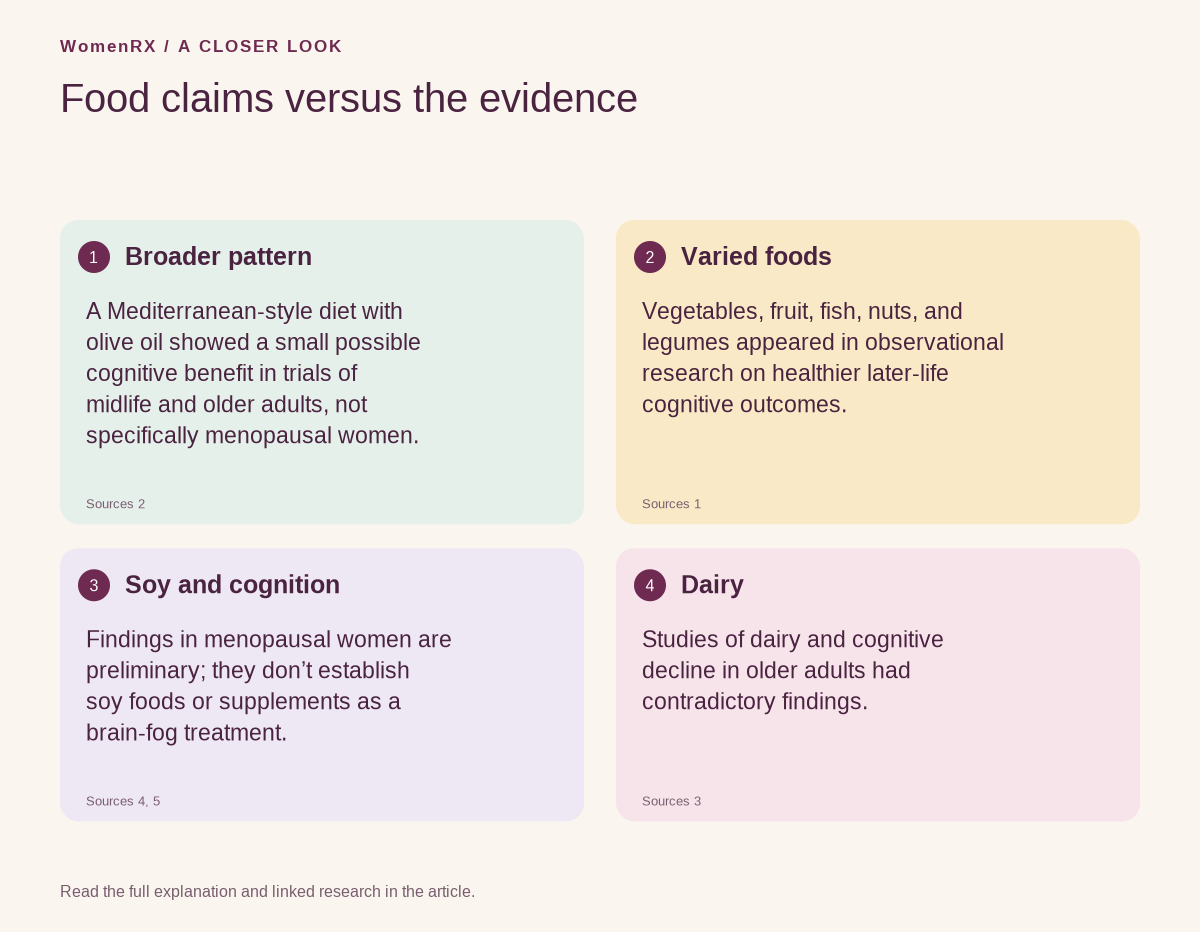
Food claims versus the evidence
Broader pattern: A Mediterranean-style diet with olive oil showed a small possible cognitive benefit in trials of midlife and older adults, not specifically menopausal women.2
Varied foods: Vegetables, fruit, fish, nuts, and legumes appeared in observational research on healthier later-life cognitive outcomes.1
Soy and cognition: Findings in menopausal women are preliminary; they don’t establish soy foods or supplements as a brain-fog treatment.45
Dairy: Studies of dairy and cognitive decline in older adults had contradictory findings.3
Read the figure as text
Compare what the research suggests about broad eating patterns with what it can say about individual foods and menopause-related brain fog.- Broader pattern: A Mediterranean-style diet with olive oil showed a small possible cognitive benefit in trials of midlife and older adults, not specifically menopausal women.2
- Varied foods: Vegetables, fruit, fish, nuts, and legumes appeared in observational research on healthier later-life cognitive outcomes.1
- Soy and cognition: Findings in menopausal women are preliminary; they don’t establish soy foods or supplements as a brain-fog treatment.45
- Dairy: Studies of dairy and cognitive decline in older adults had contradictory findings.3
More questions, answered
Should I take a soy-isoflavone supplement for brain fog?
The evidence is preliminary, and the available reviews don’t establish soy-isoflavone supplements as a treatment for menopause-related brain fog. Findings about soy foods shouldn’t be assumed to prove a supplement works. 4 5
Sources you can check
- Nutrition and Healthy Ageing in Asia: A Systematic Review.Zhou YF, Song XY, Pan A, Koh WP. · Nutrients · 2023Return to first citation
- Individually modifiable risk factors to ameliorate cognitive aging: a systematic review and meta-analysis.Lehert P, Villaseca P, Hogervorst E, Maki PM, Henderson VW. · Climacteric : the journal of the International Menopause Society · 2015Return to first citation
- Effect of Milk and Other Dairy Products on the Risk of Frailty, Sarcopenia, and Cognitive Performance Decline in the Elderly: A Systematic Review.Cuesta-Triana F, Verdejo-Bravo C, Fernández-Pérez C, Martín-Sánchez FJ. · Advances in nutrition (Bethesda, Md.) · 2019Return to first citation
- Multidimensional Effects of Soy Isoflavone by Food or Supplements in Menopause Women: a Systematic Review and Bibliometric Analysis.Perna S, Peroni G, Miccono A, Riva A, Morazzoni P, Allegrini P, Preda S, Baldiraghi V, Guido D, Rondanelli M. · Natural product communications · 2016Return to first citation
- The role of soy isoflavones in menopausal health: report of The North American Menopause Society/Wulf H. Utian Translational Science Symposium in Chicago, IL (October 2010).North American Menopause Society. · Menopause (New York, N.Y.) · 2011Return to first citation