Brain Fog During Perimenopause: What Might Help?
Concentration changes can coincide with perimenopause, but sleep and other factors are worth considering; brain fog alone doesn’t establish a hormonal cause.
Brain fog can mean losing your train of thought, struggling to focus, or forgetting a word. Cognitive findings vary during perimenopause, and a symptom alone can’t show whether changing hormones caused it. 6 Start with what else has changed, especially sleep and mood. In its discussion of memory in older adults, MedlinePlus describes forgetting how to find your way home as a possible sign of a more serious problem. 1
Brain fog describes a feeling, not a diagnosis
Maybe you’ve reread the same paragraph three times, or a familiar word won’t come when you need it. Those experiences can be frustrating. But “brain fog” doesn’t name a specific cognitive condition, and feeling less sharp isn’t the same as having a diagnosed impairment.
Researchers can test abilities such as attention and verbal learning. In one longitudinal study, 85 women were assessed across more than 400 visits during perimenopause. The researchers found different cognitive profiles, including a cognitively normal profile and profiles with relative strengths or weaknesses in particular abilities. A test result, though, cannot identify the cause of one person’s foggy day. 6
Why sleep deserves a closer look
In that study, the profile with weaker verbal learning and memory was associated with more sleep disturbance than the cognitively normal profile. It was also associated with less hormonal variability, a reminder that the relationship isn’t as simple as “more hormone change equals more brain fog.” These were associations, not proof of what caused the differences. 6
A separate study of 2,097 postmenopausal women linked recalled sleep disturbance during perimenopause with lower cognitive test scores decades later. The pattern wasn’t the same for everyone: researchers found no association among women who were never or rarely woken by menopausal symptoms, while the association was stronger among women who were woken sometimes or always. Because women reported their earlier sleep retrospectively, the study can’t tell you that poor sleep caused a later score or predict your own future cognition. It does reinforce a practical question for today: are night wakings part of what’s going on? 4
For example, if trouble concentrating tends to follow nights interrupted by hot flashes, the sleep disruption and hot flashes are worth addressing on their own terms. Hormone therapy is an effective treatment for bothersome hot flashes. Recommended nonhormonal options for hot flashes include cognitive-behavioral therapy, clinical hypnosis, and prescription treatments such as SSRIs or SNRIs and fezolinetant. These are treatments for bothersome hot flashes, not established treatments for brain fog or memory problems. 2 3 5
Look beyond one possible cause
Sleep disturbance and mood changes are both commonly listed in clinical guidance on perimenopause and menopause. If low mood has appeared alongside the concentration trouble, it belongs in the conversation too, rather than being treated as an afterthought. 5
In its discussion of memory in older adults, MedlinePlus lists thyroid, kidney, and liver problems among possible explanations for more serious memory difficulties. An occasional forgotten word does not, by itself, point to any of them. 1
If you started or changed a medication around the time your concentration changed, mention that timing when you discuss the symptom. It’s a lead to review, not a reason to assume the medication is the cause.
The distinction is between noticing a pattern and diagnosing yourself from it. “I’m losing focus after nights when I wake repeatedly” is useful information. “My estradiol must be too low” goes further than the symptom can support. The perimenopause study found substantial variation between women, not a hormone pattern that explains every concentration complaint. 6
When a memory change may be more serious
Occasionally forgetting a name or where you put your keys is common. In its discussion of memory in older adults, MedlinePlus describes forgetting how to use a phone or find the way home as possible signs of a more serious problem. 1
Hormone therapy isn’t an established treatment for brain fog itself. A systematic review of menopause guidelines found that none of the guidelines it assessed recommended hormone therapy for cognitive symptoms or dementia prevention. You can still discuss treatment for a distinct symptom, such as bothersome hot flashes, without expecting it to act as a memory treatment. 5 2
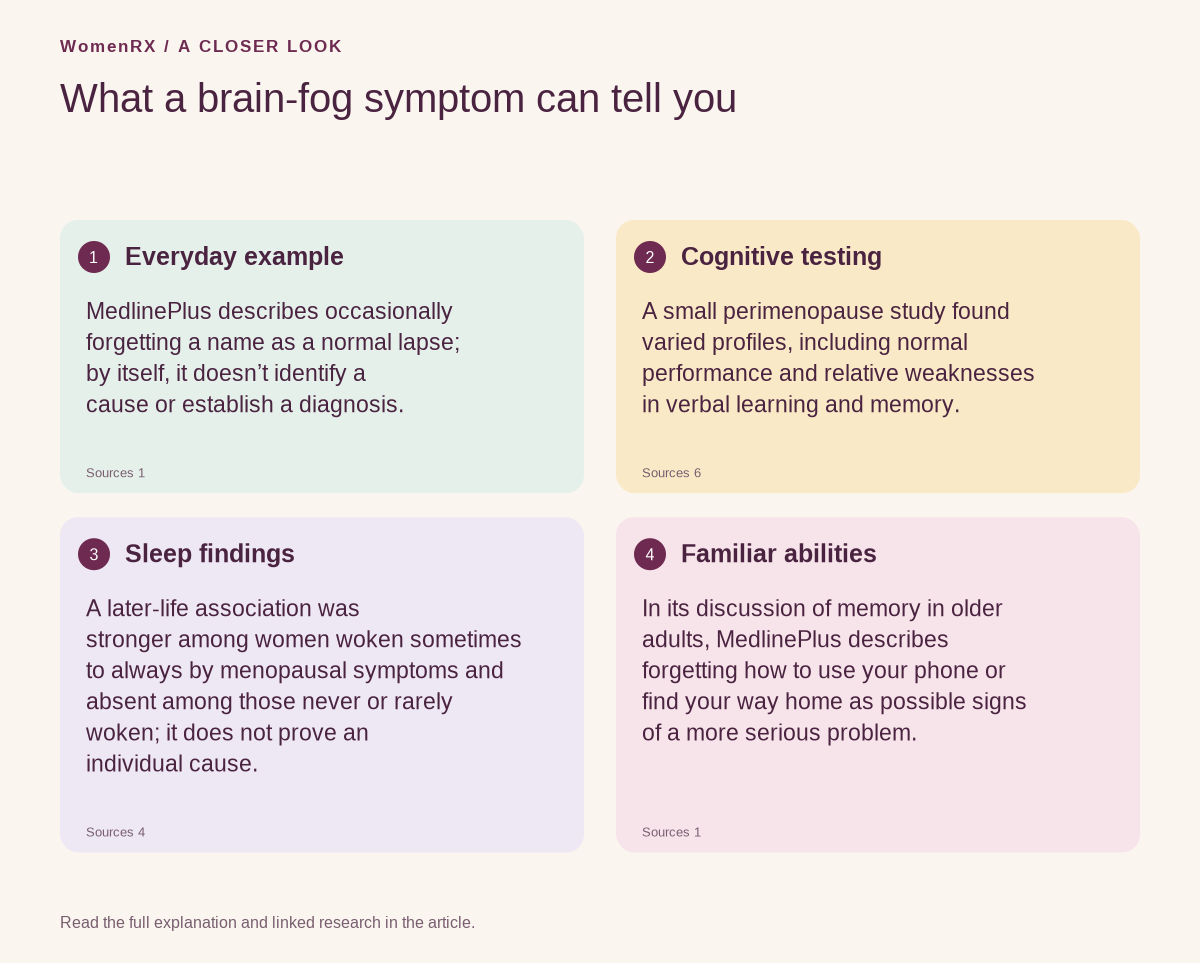
What a brain-fog symptom can tell you
Everyday example: MedlinePlus describes occasionally forgetting a name as a normal lapse; by itself, it doesn’t identify a cause or establish a diagnosis.1
Cognitive testing: A small perimenopause study found varied profiles, including normal performance and relative weaknesses in verbal learning and memory.6
Sleep findings: A later-life association was stronger among women woken sometimes to always by menopausal symptoms and absent among those never or rarely woken; it does not prove an individual cause.4
Familiar abilities: In its discussion of memory in older adults, MedlinePlus describes forgetting how to use your phone or find your way home as possible signs of a more serious problem.1
Read the figure as text
The distinction between a felt change, a research finding, and a reason to seek evaluation.- Everyday example: MedlinePlus describes occasionally forgetting a name as a normal lapse; by itself, it doesn’t identify a cause or establish a diagnosis.1
- Cognitive testing: A small perimenopause study found varied profiles, including normal performance and relative weaknesses in verbal learning and memory.6
- Sleep findings: A later-life association was stronger among women woken sometimes to always by menopausal symptoms and absent among those never or rarely woken; it does not prove an individual cause.4
- Familiar abilities: In its discussion of memory in older adults, MedlinePlus describes forgetting how to use your phone or find your way home as possible signs of a more serious problem.1
Sources you can check
- Memory | MedlinePlusAccessed 2026-09-25Return to first citation
- The 2022 hormone therapy position statement of The North American Menopause Society.“The 2022 Hormone Therapy Position Statement of The North American Menopause Society” Advisory Panel. · Menopause (New York, N.Y.) · 2022Return to first citation
- The 2023 nonhormone therapy position statement of The North American Menopause Society.Menopause (New York, N.Y.) · 2023Return to first citation
- Sleep disturbances during perimenopause and later-life cognitive function.Hu B, Lin JJ, Qiu X, McAlaine K, Mahalingaiah S, Weisskopf M. · Menopause (New York, N.Y.) · 2026Return to first citation
- A systematic review and critical appraisal of menopause guidelines.Hemachandra C, Taylor S, Islam RM, Fooladi E, Davis SR. · BMJ sexual & reproductive health · 2024Return to first citation
- Cognitive profiles in perimenopause: hormonal and menopausal symptom correlates.Weber MT, Rubin LH, Schroeder R, Steffenella T, Maki PM. · Climacteric : the journal of the International Menopause Society · 2021Return to first citation