Trouble Focusing in Midlife: What Might Be Going On?
Concentration changes can accompany perimenopause, but sleep, mood, medicines, and the pattern of change all deserve a look.
Trouble concentrating is a reported symptom during perimenopause and after menopause. Night sweats, poor sleep, and low mood may overlap with it, but they don’t explain every change in focus.3 Notice whether the difficulty varies with your nights and days. Memory problems that affect daily life merit an appointment; sudden confusion needs immediate medical attention.78
Start with the kind of difficulty you’re having
Maybe you lose your place in a conversation, reread the same paragraph, or struggle to finish a task when several things need your attention. Problems with memory and concentration are reported during perimenopause and after menopause, sometimes alongside sleep problems, night sweats, and mood changes.3 That makes menopause a reasonable part of the picture, not a complete explanation for every cognitive symptom.
It also helps to separate feeling less sharp from a measured loss of cognitive ability. In a small study of 31 postmenopausal women who reported cognitive changes, participants had normal performance on objective cognitive tests; the study examined associations with brain connectivity, not the cause or future course of their complaints.6 At the same time, a longitudinal study of 2,124 midlife women found gradual average declines on some cognitive tests even after accounting for menopausal stage, sleep disturbance, mood symptoms, and other factors. Its group averages cannot tell you what is causing your own trouble focusing.5
Look for what changes alongside your focus
Rather than trying to label the feeling “brain fog,” compare it with what else is happening. These are clues to consider, not a test that diagnoses the cause:
- Sleep: Are the harder days following nights when you woke repeatedly, including with night sweats? Interrupted or insufficient sleep can make it harder to focus, think clearly, and form memories.34
- Mood and stress: Does concentrating feel harder when you’re anxious, low, or under sustained pressure? Stress, anxiety, and depression are among the possible causes of memory difficulties.7 They’re worth considering in their own right, rather than treating them as proof that the problem is hormonal.
- Medicines and other changes: Did the problem begin or noticeably change after a new medicine or another change in your health? Medication effects are one possible contributor to subjective cognitive complaints, though that doesn’t establish that a particular medicine is responsible.6 Keep a list of what you take if you seek an evaluation; don’t stop a prescribed medicine based on a guess.
- Daily demands: Is the difficulty most noticeable when you’re interrupted or switching between tasks? For example, compare how it feels to read in a quiet room with trying to read while responding to messages. That comparison may help you describe the problem, even if it can’t identify a medical cause.
These factors can overlap. A night of broken sleep and a demanding workday might both matter. You don’t have to decide which one “counts” before asking for help.
If night sweats are part of the pattern
Treating a sleep problem as merely a concentration problem can miss something you may be able to address. Menopause guidance recognizes sleep difficulties associated with hot flashes and night sweats, and includes menopause-specific cognitive behavioral therapy (CBT) as an option for sleep problems linked to those symptoms.2 A review of trials in women with menopausal symptoms found improvements in sleep outcomes with psychosocial interventions, particularly CBT. It did not assess brain fog, so better sleep should not be presented as a proven cognitive treatment.1
If sleep remains difficult even without night sweats, that’s worth raising separately. Ongoing sleep trouble can have other causes, including sleep disorders, and may need its own assessment.4
Know when the pattern calls for care
Make an appointment if memory or concentration problems persist and affect day-to-day life, such as repeatedly interfering with tasks you used to manage. Seek an assessment if you or someone close to you notices that forgetfulness or confusion is gradually getting worse. Sleep, stress, anxiety, and depression can contribute to memory problems, but persistent change should not be assumed to have one of those causes without an assessment.78
Sudden confusion is different from an off day of focus. If someone suddenly doesn’t know where they are, cannot think or speak clearly, or has a sudden marked change in attention or awareness, seek emergency medical care immediately. Sudden confusion has several possible causes, some of which require urgent treatment.8
For an appointment about a less sudden change, a few concrete examples are more useful than a perfect symptom log: what you were trying to do, whether sleep or night sweats were involved, when the change began, and whether it’s stable or worsening. The aim isn’t to prove it’s menopause. It’s to give your concerns enough detail to be taken seriously and assessed on their own terms.
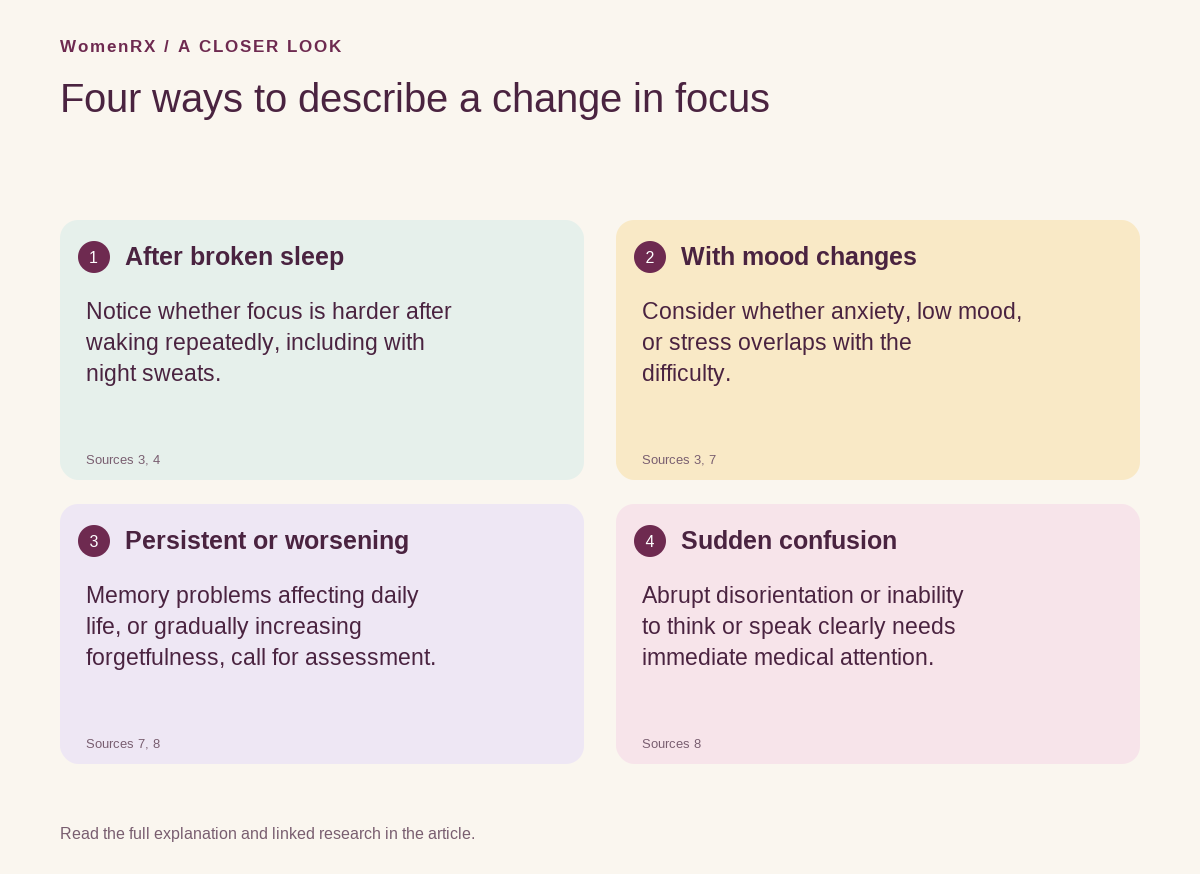
Four ways to describe a change in focus
After broken sleep: Notice whether focus is harder after waking repeatedly, including with night sweats.34
With mood changes: Consider whether anxiety, low mood, or stress overlaps with the difficulty.37
Persistent or worsening: Memory problems affecting daily life, or gradually increasing forgetfulness, call for assessment.78
Sudden confusion: Abrupt disorientation or inability to think or speak clearly needs immediate medical attention.8
Read the figure as text
These distinctions help describe a symptom; they do not diagnose its cause.- After broken sleep: Notice whether focus is harder after waking repeatedly, including with night sweats.34
- With mood changes: Consider whether anxiety, low mood, or stress overlaps with the difficulty.37
- Persistent or worsening: Memory problems affecting daily life, or gradually increasing forgetfulness, call for assessment.78
- Sudden confusion: Abrupt disorientation or inability to think or speak clearly needs immediate medical attention.8
Sources you can check
- The effectiveness of psychosocial interventions on physiological symptoms of menopause: a systematic review and meta-analysis.Robinson K, Hardy R, Melville M, Saidel S, Desai R, Spector A. · BMC women's health · 2026Return to first citation
- Recommendations | Menopause: identification and management | Guidance | NICEAccessed 2026-09-25Return to first citation
- Symptoms of menopause and perimenopause - NHSAccessed 2026-09-25Return to first citation
- Healthy Sleep | MedlinePlusAccessed 2026-09-25Return to first citation
- Evidence for Cognitive Aging in Midlife Women: Study of Women's Health Across the Nation.Karlamangla AS, Lachman ME, Han W, Huang M, Greendale GA. · PloS one · 2017Return to first citation
- Altered Brain Connectivity in Early Postmenopausal Women with Subjective Cognitive Impairment.Vega JN, Zurkovsky L, Albert K, Melo A, Boyd B, Dumas J, Woodward N, McDonald BC, Saykin AJ, Park JH, Naylor M, Newhouse PA. · Frontiers in neuroscience · 2016Return to first citation
- Memory loss (amnesia) - NHSAccessed 2026-09-25Return to first citation
- Sudden confusion (delirium) - NHSAccessed 2026-09-25Return to first citation