Dry Eyes Around Menopause: What Might Be Going On
Dry eyes can coincide with perimenopause, but their timing alone can’t tell you what’s causing them or when they’ll improve.
Dry eyes can occur around the menopause transition, and hormonal changes may contribute, but age and other factors can matter too. The cited studies don’t establish how long dryness typically lasts through natural perimenopause. If it continues after a few weeks of home care, arrange an eye exam. A painful, red eye or a red eye when you wear contacts needs prompt care. 1 3 4
Why the timing can be hard to interpret
Dry eye can mean your eyes don’t make enough tears or that tears dry up too quickly. Itching and unexpectedly watery eyes are possible signs; burning and discomfort can occur too. If these symptoms begin while your periods are changing, it’s reasonable to wonder about a connection. The timing, though, can’t identify the cause on its own. 1 2
Sex hormones may affect the tear film and the surface of the eye. A review describes hormonal shifts as one possible part of a more complex picture that also involves inflammation. That’s a plausible explanation for a connection with menopause, not a way to diagnose the cause of your particular symptoms. Age matters as well: dry eye is more likely after 50, and blepharitis, Sjögren’s syndrome, and lupus are among the conditions that can contribute. 1 3
Everyday circumstances can complicate the picture. For example, if you wear contact lenses or spend time in dry indoor air, those are worth considering rather than attributing every change to hormones. If you think a prescribed medicine might be involved, don’t stop it on your own. 1
What the research can actually tell you
In one study, 30 women ages 45 to 65 who were described as menopausal and already had moderate dry eye used a particular multi-ingredient eye drop. Researchers measured symptoms and tear-related changes after 30 days. The study offers information about that treatment in that group. Because it didn’t follow women from the start of perimenopause, it can’t tell us when menopause-associated dryness begins or how long it lasts. 2
Another study compared 90 women ages 40 to 50 in three groups: BRCA mutation carriers who had their ovaries removed, women receiving aromatase inhibitors, and healthy controls. The two estrogen-deprived groups had shorter tear break-up times, lower tear-production test scores, and higher dry-eye symptom scores than controls. That supports a connection between estrogen deprivation and dry-eye measures in those circumstances. Surgical or medication-related estrogen deprivation isn’t the same as natural perimenopause, however. 4
So there’s no reliable countdown from the end of perimenopause to the end of dry eyes in these findings. And while hormones may play a role, hormone therapy shouldn’t be treated as an established dry-eye treatment: a review describes improvement with estrogen replacement as limited and sometimes controversial. 3
Give mild symptoms attention, and know when not to wait
For mild dryness, practical measures include taking a break from contact lenses and wearing glasses, using a humidifier if the air is dry, and gently cleaning your eyelids. A warm, not hot, compress around the eyes is another option. These steps address common dry-eye problems without requiring you to decide whether menopause is involved first. 1
Arrange an eye exam if dryness is still bothering you after a few weeks of home care, or if the shape of an eyelid changes. An eye-care professional can assess what’s contributing and whether you need other treatment. Seek prompt care instead if an eye is painful and red, if you have a red eye while wearing contact lenses, if looking at light hurts, or if you’ve injured your eye. Those signs shouldn’t be written off as menopause-related dryness. 1
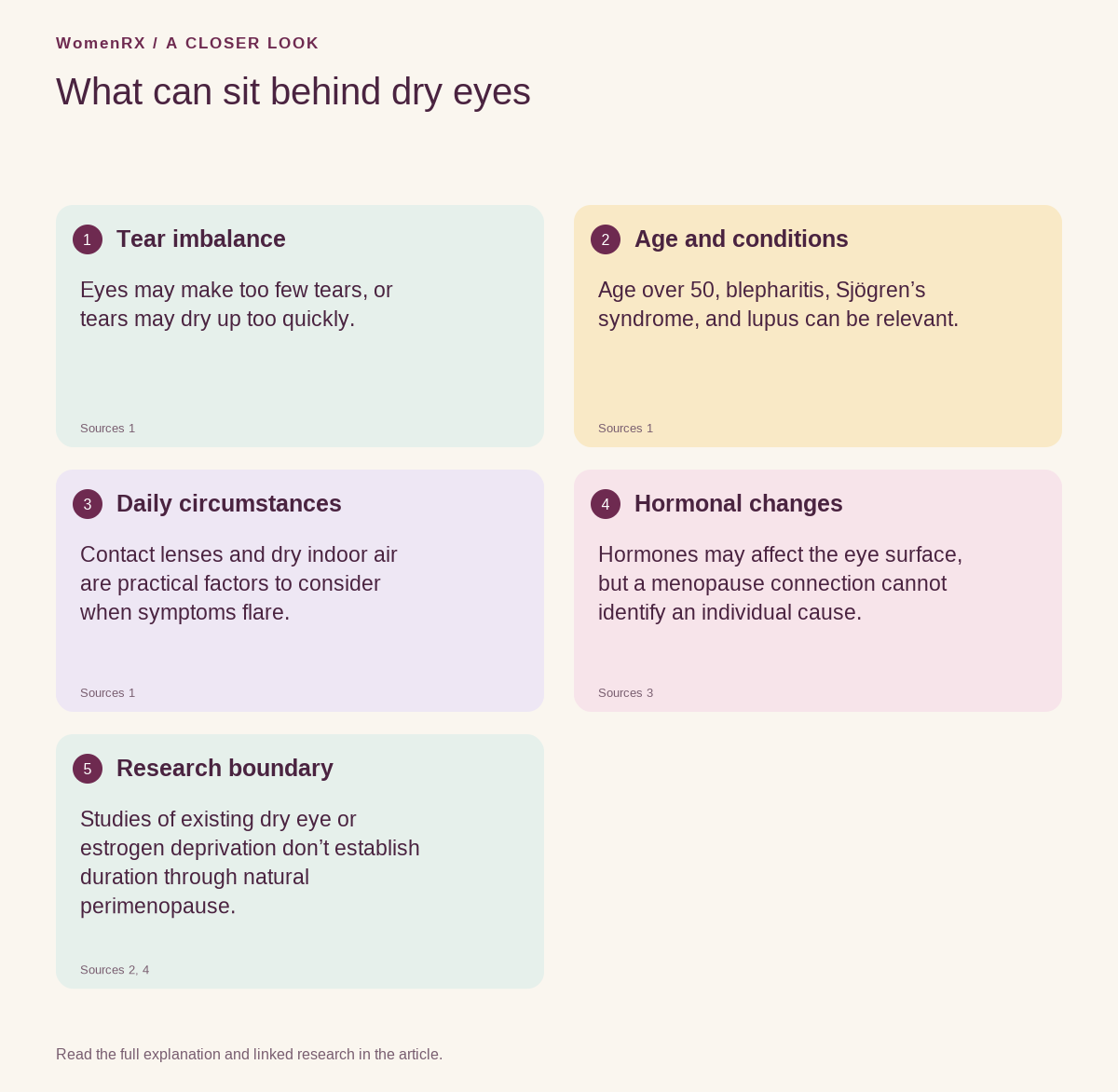
What can sit behind dry eyes
Tear imbalance: Eyes may make too few tears, or tears may dry up too quickly.1
Age and conditions: Age over 50, blepharitis, Sjögren’s syndrome, and lupus can be relevant.1
Daily circumstances: Contact lenses and dry indoor air are practical factors to consider when symptoms flare.1
Hormonal changes: Hormones may affect the eye surface, but a menopause connection cannot identify an individual cause.3
Research boundary: Studies of existing dry eye or estrogen deprivation don’t establish duration through natural perimenopause.24
Read the figure as text
These factors can overlap; noticing when dryness began is only one part of understanding it.- Tear imbalance: Eyes may make too few tears, or tears may dry up too quickly.1
- Age and conditions: Age over 50, blepharitis, Sjögren’s syndrome, and lupus can be relevant.1
- Daily circumstances: Contact lenses and dry indoor air are practical factors to consider when symptoms flare.1
- Hormonal changes: Hormones may affect the eye surface, but a menopause connection cannot identify an individual cause.3
- Research boundary: Studies of existing dry eye or estrogen deprivation don’t establish duration through natural perimenopause.24
More questions, answered
What if I think a medicine is drying my eyes?
Bring it up with the person who prescribes it rather than stopping it yourself. A possible medicine contribution is worth checking, but the timing of your symptoms alone doesn’t settle the cause. 1
Sources you can check
- Dry eyes - NHSAccessed 2026-09-25Return to first citation
- Efficacy of hyaluronic acid 0.3%, cyanocobalamin, electrolytes, and P-Plus in menopause patients with moderate dry eye disease.De-Hita-Cantalejo C, Sánchez-González MC, Silva-Viguera C, García-Romera MC, Feria-Mantero R, Sánchez-González JM. · Graefe's archive for clinical and experimental ophthalmology = Albrecht von Graefes Archiv fur klinische und experimentelle Ophthalmologie · 2022Return to first citation
- Immuno-inflammatory axis of menopausal dry eye: from hormonal fluctuations to ocular surface dysregulation.Tian ZT, Jing CY, Liu HB, Jia XK, Xu HY, Pang YY. · Frontiers in immunology · 2026Return to first citation
- Impact of Estrogen Deficiency on Dry Eye Disease in BRCA Mutation Carriers With Premature Menopause.Sedunov L, Fridman V, Cenkova K, Kravchenko V, Cervinkova E, Al-Redouan A, Zikan M. · Cornea · 2026Return to first citation