Dry Eyes in Midlife: Is There a Menopause Connection?
Dry-eye symptoms can occur during perimenopause and after menopause, but hormones are only one possible part of the picture.
Menopause may contribute to dry-eye symptoms, but the evidence doesn’t show that it’s the cause for any one person. Hormonal changes may affect the eye surface, while age, dry air, certain health conditions, screen-based work, contact lens discomfort, or a suspected medication effect may also deserve consideration. 1 3 6 Persistent symptoms or specific warning signs call for an eye evaluation. 1
Gritty or burning eyes can occur around midlife, and dry eye can also cause itching or unusually watery eyes. It happens when the eyes don’t make enough tears or when tears dry up too quickly. Those symptoms are real, but they can’t tell you by themselves whether menopause is the cause. 1 3 4
What the research says about menopause
Studies find dry-eye symptoms in both perimenopausal and postmenopausal women, but they don’t give a consistent answer about whether symptoms are more common or severe after menopause. An observational study of 1,947 women ages 45 to 79 reported more symptoms in postmenopausal than perimenopausal women. By contrast, a cross-sectional study of 262 midlife women found similar symptom rates between those stages and no significant difference in symptom scores. 5 6
Another cross-sectional comparison found more severe symptoms and signs of dry-eye disease among postmenopausal women than among age-matched men and younger women. That supports a possible association, but it cannot show that menopause caused the difference. The studies also looked at different groups and used different comparisons, so they don’t settle what menopause means for an individual woman. 4
There is a plausible biological connection: hormones may influence tear production and the eye’s surface, and a review describes possible immune and inflammatory pathways. These mechanisms help explain why researchers are investigating a connection; they don’t establish that hormonal changes caused your symptoms. The same review describes estrogen treatment’s improvement of dry-eye symptoms as limited and controversial, so dry eyes alone aren’t a reliable reason to start hormone therapy. 3
Check for other contributors
Age over 50 and conditions such as blepharitis, Sjögren’s syndrome, or lupus may be relevant. Dry air can contribute, too. In one study of midlife women, computer-based work was associated with moderate-to-severe dry-eye symptoms, though that finding shows an association, not proof that screen work caused symptoms. Contact lenses can be another practical clue if discomfort is worse while you’re wearing them. 1 6
If you suspect a prescribed medicine may be involved, ask the person who prescribed it about your concern. Don’t stop a prescribed medicine on your own. 1
Try practical steps, and know when to get checked
Notice whether discomfort seems worse in dry indoor air, during computer-based work, or while wearing contact lenses. A humidifier may help if the air is dry. If contact lenses are uncomfortable, guidance suggests taking them out and wearing glasses to rest your eyes. Gentle eyelid cleaning and a warm, not hot, flannel over the closed lids are other self-care options. 1
Arrange an eye evaluation if symptoms continue for a few weeks despite home care or if you notice a change in the shape of your eyelids. An evaluation can help check for a cause and guide treatment. 1
Don’t explain away a painful red eye as menopause. Seek urgent care for a painful red eye, a red eye while wearing contact lenses, pain when looking at light, a very dark-red eye, or a red eye with a severe headache and nausea. An eye injury or something stuck in the eye also needs urgent attention. 1
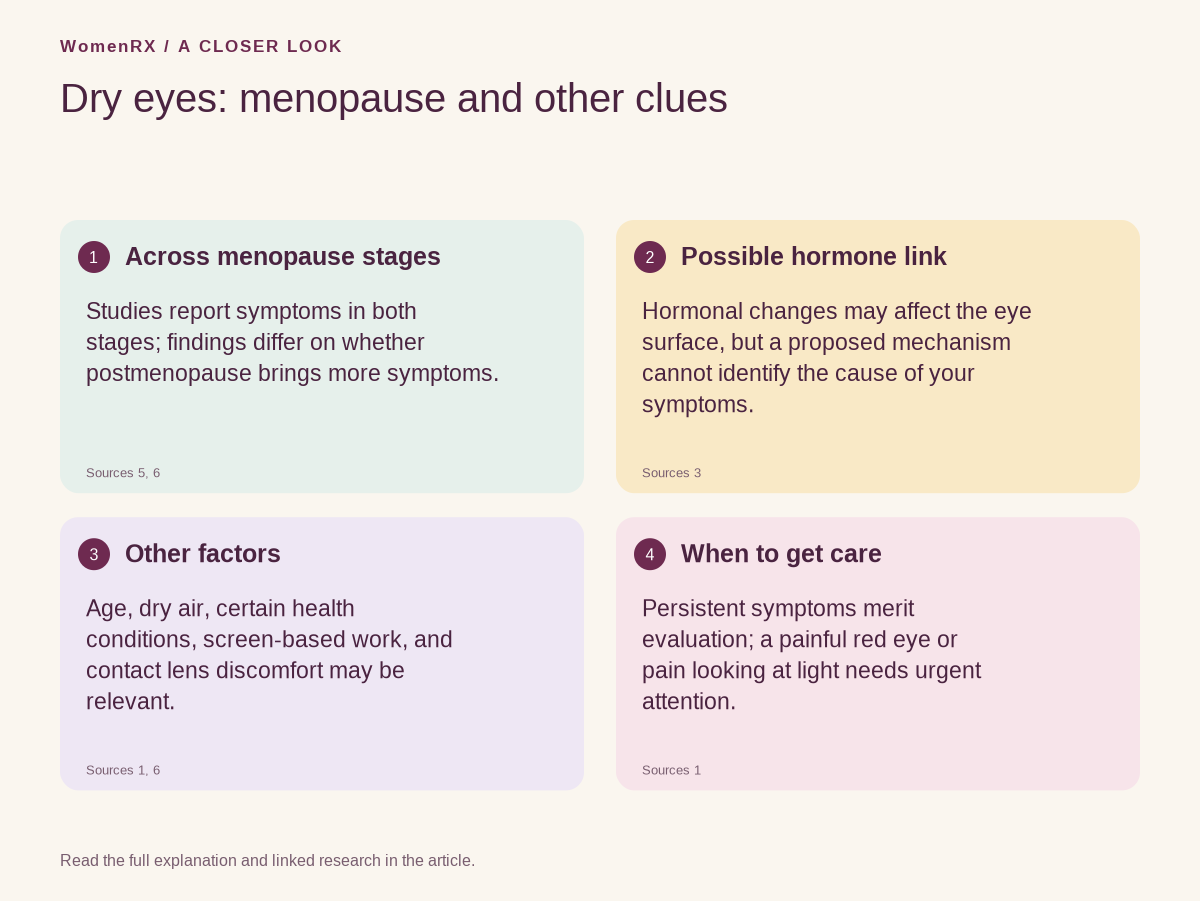
Dry eyes: menopause and other clues
Across menopause stages: Studies report symptoms in both stages; findings differ on whether postmenopause brings more symptoms.56
Possible hormone link: Hormonal changes may affect the eye surface, but a proposed mechanism cannot identify the cause of your symptoms.3
Other factors: Age, dry air, certain health conditions, screen-based work, and contact lens discomfort may be relevant.16
When to get care: Persistent symptoms merit evaluation; a painful red eye or pain looking at light needs urgent attention.1
Read the figure as text
A menopause connection is possible, but studies do not establish the cause of an individual's symptoms. These distinctions show what else may matter and when to seek care.- Across menopause stages: Studies report symptoms in both stages; findings differ on whether postmenopause brings more symptoms.56
- Possible hormone link: Hormonal changes may affect the eye surface, but a proposed mechanism cannot identify the cause of your symptoms.3
- Other factors: Age, dry air, certain health conditions, screen-based work, and contact lens discomfort may be relevant.16
- When to get care: Persistent symptoms merit evaluation; a painful red eye or pain looking at light needs urgent attention.1
More questions, answered
Does dry eye mean I’m in perimenopause?
No. Dry-eye symptoms occur in both perimenopause and postmenopause, but they also have other possible contributors. The symptom alone can’t identify your menopause stage or explain its cause. 1 5 6
Should I start hormone therapy for dry eyes?
Dry eyes alone aren’t a reliable reason to start hormone therapy. A review describes the symptom improvement from estrogen treatment as limited and controversial. Menopause hormone therapy has established uses, but dry-eye symptoms by themselves don’t show that it’s the right choice for you. 2 3
Sources you can check
- Dry eyes - NHSAccessed 2026-09-25Return to first citation
- The 2022 hormone therapy position statement of The North American Menopause Society.“The 2022 Hormone Therapy Position Statement of The North American Menopause Society” Advisory Panel. · Menopause (New York, N.Y.) · 2022Return to first citation
- Immuno-inflammatory axis of menopausal dry eye: from hormonal fluctuations to ocular surface dysregulation.Tian ZT, Jing CY, Liu HB, Jia XK, Xu HY, Pang YY. · Frontiers in immunology · 2026Return to first citation
- Impact of menopause on dry eye disease: a cross-sectional comparative study.Pandey H, Kumar R. · Post reproductive health · 2026Return to first citation
- Dry eye disease symptoms and quality of life in perimenopausal and postmenopausal women.Garcia-Alfaro P, Garcia S, Rodriguez I, Vergés C. · Climacteric : the journal of the International Menopause Society · 2021Return to first citation
- Dry eye symptoms in midlife women: A cross-sectional analysis of prevalence, risk factors, and quality-of-life outcomes.Vallibhakara SA, Chattrakulchai K, Vallibhakara O, Anantaburana M, Nijvipakul S. · Maturitas · 2025Return to first citation